
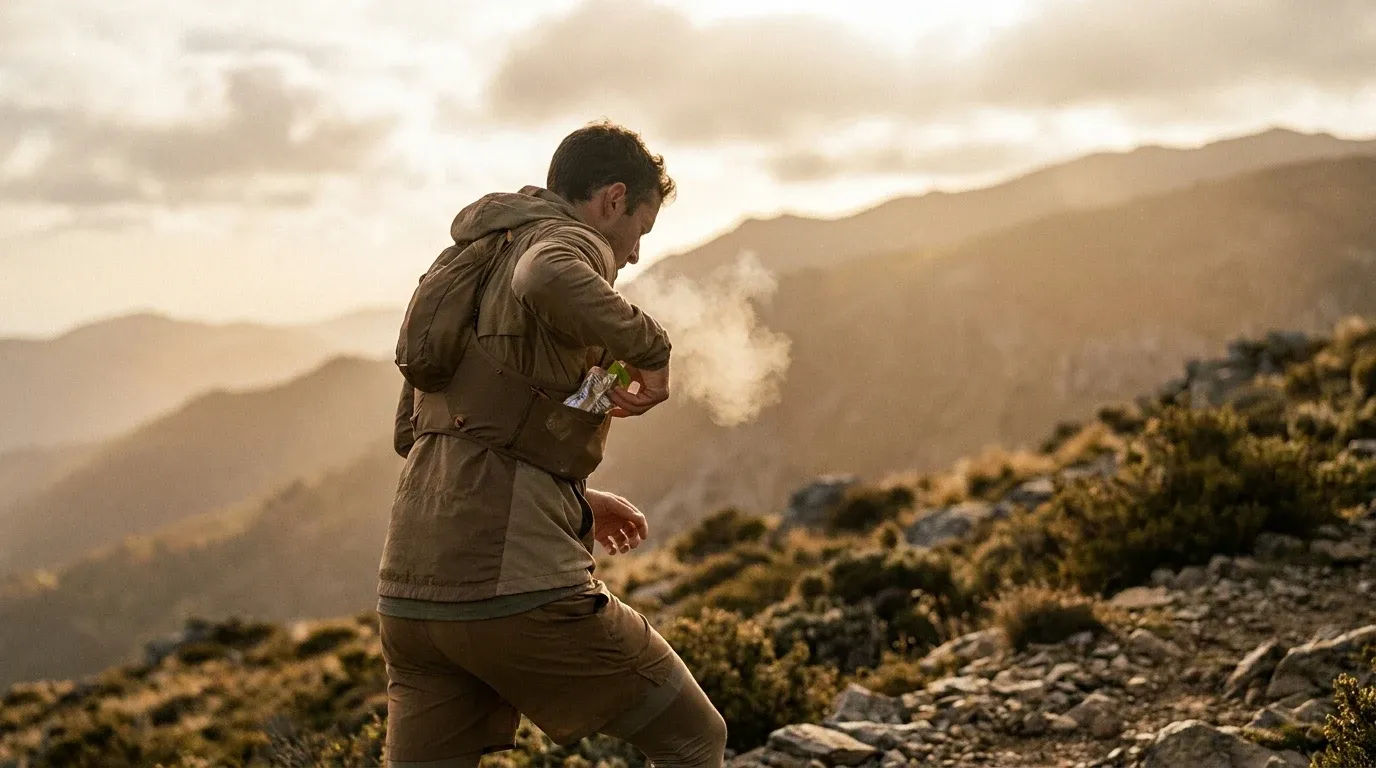
Fall race season pulls thousands of athletes toward high-elevation events. Pikes Peak, mountain ultras, high-country trail races. You train for months at sea level, then show up above 8,000 feet and wonder why everything feels harder than it should. The short answer: your physiology is running a completely different operating system up there, and your nutrition plan needs to reflect that.
Most altitude fueling advice stays vague. Drink more water. Eat more carbs. What that guidance skips is the specific chain of metabolic events driving those recommendations. Here's what's actually happening inside your body when the air gets thin.
Why You're Not Hungry But Desperately Need Calories
This is the cruelest paradox of altitude racing. Your caloric demand rises sharply while your appetite collapses. Research consistently shows that leptin, the hormone that signals satiety to your brain, increases at altitude even when you haven't eaten enough to justify that signal. Your body reads low oxygen as a stressor and responds by suppressing hunger as part of a broader stress response.
At the same time, your resting metabolic rate climbs. Studies on athletes above 8,000 feet show energy expenditure increases by 10 to 25 percent compared to equivalent sea-level effort. You're burning more fuel to breathe harder, maintain core temperature in thinner, colder air, and sustain any meaningful pace. The math is brutal: your brain is telling you to eat less while your muscles are demanding significantly more.
The practical consequence is that athletes who rely on hunger cues at altitude consistently under-fuel. By the time you feel hungry up high, you're already behind. Scheduled eating, not intuitive eating, becomes the strategy that keeps you functional.
How Carbohydrate Metabolism Shifts at Elevation
Your body's fuel preference changes at altitude, and understanding the shift helps you pace and time intake more effectively. At elevation, carbohydrate oxidation rates increase relative to fat oxidation. Your body leans harder on glycogen because glucose metabolism requires less oxygen per unit of energy produced compared to fat metabolism. That's a direct adaptation to oxygen scarcity.
What this means in practice: your glycogen stores deplete faster at altitude than they would during the same perceived effort at sea level. Athletes often hit the wall earlier in mountain races not because they didn't carry enough food, but because they underestimated how quickly they'd burn through their carbohydrate reserves.
Carbohydrate timing matters more at elevation than it does at lower altitude. Aim to consume 60 to 90 grams of carbohydrates per hour during sustained efforts above 8,000 feet. Don't wait until you feel depleted. Gut absorption can also become sluggish at altitude due to reduced blood flow to the digestive tract, so smaller, more frequent intake works better than large boluses spaced far apart.
Hydration: More Complicated Than Drinking More Water
You lose significantly more water at altitude than you realize, and the mechanism isn't sweating. Respiratory water loss is the primary driver. At elevation, you breathe faster and deeper, and every exhale carries moisture out of your body. In dry mountain air, that loss accelerates. Research suggests respiratory water loss at high altitude can exceed 1 to 1.5 liters per day above baseline, even before accounting for sweat during exercise.
Dehydration at altitude also compounds the effects of altitude sickness. Even mild fluid deficit amplifies headaches, cognitive fog, and performance decline. The problem is that thirst, like hunger, is blunted at elevation. Waiting to drink until you're thirsty leaves you chasing a deficit that's hard to recover from mid-race.
Electrolyte balance matters here too. Altitude triggers increased urinary output of sodium early in acclimatization, which means you're not just losing water but losing the electrolytes that help you retain it. Sodium-containing fluids and electrolyte supplements become more important at elevation than they are at sea level. Plain water alone won't cut it for efforts longer than 90 minutes above 8,000 feet.
Iron, B12, and the Acclimatization Demand
When you arrive at altitude, your body immediately begins producing more red blood cells to compensate for lower oxygen availability. That process is called erythropoiesis, and it requires raw materials. Specifically, iron and vitamin B12.
If your iron stores are already marginal coming into altitude events, which is common in endurance athletes and particularly in female athletes, acclimatization becomes harder and slower. Low ferritin blunts your body's ability to produce new hemoglobin, limiting the oxygen-carrying capacity gains that make altitude adaptation possible.
In the weeks before a major altitude event, getting bloodwork done to assess ferritin, hemoglobin, and B12 status is worth the time. If your ferritin is below 40 ng/mL, which research links to impaired endurance performance, working with a physician on targeted supplementation before travel gives your system the building blocks it needs. Food sources help too: red meat, organ meats, legumes, and leafy greens for iron; eggs, dairy, and fortified foods for B12. This nutritional preparation connects directly to broader questions about what specific populations need from their nutrition. What Women 50-75 Actually Need From Nutrition to Stay Strong covers how micronutrient demands shift with physical stress, principles that apply at altitude regardless of age.
Practical Meal Timing for Races Above 8,000 Feet
The day before a high-altitude race, carbohydrate loading still works, but do it at lower elevation if possible. Eating large meals at altitude when appetite is already suppressed is harder than it sounds. Front-load your carbohydrate stores the day before you ascend or on the evening you arrive, before full appetite suppression kicks in.
Race morning: eat two to three hours before start time. Keep the meal moderate in volume, carbohydrate-dominant, and low in fiber and fat to reduce GI stress. High-altitude races already stress your digestive system. Don't compound that with a meal that's hard to process.
During the race, here's a framework that works for efforts of three hours or more above 8,000 feet:
- First 30 minutes: Start fueling earlier than you would at sea level. Don't wait for the first hour mark. Your glycogen burn rate is already elevated.
- Every 20 to 25 minutes: Take in 20 to 30 grams of carbohydrates. Gels, chews, rice cakes, or sports drink all work. Variety helps if nausea becomes an issue.
- Fluid intake: Target 500 to 750 ml per hour minimum, adjusted upward in warm or very dry conditions. Include electrolytes in every other fluid intake.
- Caffeine: Useful at altitude for performance, but it increases urinary output. If you rely on caffeinated gels or drinks, increase fluid intake proportionally.
Post-race recovery at altitude deserves attention too. Your glycogen resynthesis rate is not impaired at elevation, but your appetite suppression will likely persist for hours after finishing. Force a recovery meal or shake within 30 to 45 minutes of crossing the finish line. A 3:1 or 4:1 ratio of carbohydrates to protein supports glycogen replenishment and begins muscle repair. The Fall Recovery Reset: How to Actually Bounce Back Now covers recovery structure in more depth, including sleep and nutrition timing after high-stress events.
What Supplements Actually Help at Altitude
The supplement space around altitude performance is noisy. Most products marketed for altitude adaptation have weak or nonexistent evidence behind them. A few, however, have genuine research support.
Iron and B12 supplementation, when deficiency is confirmed, helps directly. Beet root juice and dietary nitrates have real evidence for improving oxygen efficiency and are worth including in the days leading into an altitude event. Antioxidants like vitamin C and E are sometimes recommended to counter increased oxidative stress at elevation, though the evidence is more mixed and high doses may blunt some adaptation signals.
Be cautious with anything marketed specifically as an altitude performance enhancer. Many products in this category have little regulatory oversight. Peptides Sold Online: The Risk Athletes Keep Ignoring is worth reading if you're considering less conventional compounds being marketed for recovery or performance.
Sleep quality at altitude also degrades, particularly in the first few nights. Reduced oxygen availability disrupts sleep architecture and blunts the hormonal recovery that happens during deep sleep. If you're racing multiple days or spending more than a few nights at elevation, sleep becomes a nutrition adjacent problem. What you eat affects sleep quality at altitude just as it does at sea level. What a Sleep Study Reveals About Your Heart and Lungs outlines how sleep deficits affect cardiovascular and respiratory function, both of which are already under pressure at elevation.
The Bottom Line on Altitude Fueling
Altitude does not simply make exercise harder. It reorganizes your metabolic priorities, suppresses the signals you normally rely on to guide eating and drinking, and increases demand for specific micronutrients at the exact moment your body is trying to adapt. Relying on how you feel to guide fueling decisions above 8,000 feet is a losing strategy.
Scheduled intake, front-loaded preparation, and attention to iron and hydration status before you ever leave sea level are what separate athletes who perform well at elevation from those who spend the race managing a deficit they never anticipated. The mountain doesn't reward improvisation.