
Gut Health and Sports Performance: The Microbiome Connection
Gut microbiome diversity correlates with higher VO2 max in elite athletes, according to multiple independent studies published on PubMed, which puts the microbiome among the physiological factors serious athletes should understand.
But in a market projected to reach $29.1 billion by 2033 according to NutraIngredients, knowing what the science actually supports versus what's marketing has become a skill in itself.
Here's where the evidence actually stands, without overpromising.
Key Takeaways
- Gut microbiome diversity correlates with higher VO2 max in elite athletes: multiple independent studies point in the same direction
- Intense training can temporarily increase intestinal permeability and systemic inflammation
- Lactobacillus probiotic strains show modest but real reductions in upper respiratory infections in high-volume athletes
- Fiber and fermented foods come first: supplements don't compensate for a diet low in plant diversity
- A $29.1B market doesn't mean every product in it is scientifically justified
Microbiome and VO2 Max: The Connection Researchers Found
Multiple studies on elite endurance athletes, including marathon runners and professional cyclists, have identified a correlation between gut microbiome alpha diversity and VO2 max values measured in the lab.
In plain terms: athletes with a more diverse microbiome tend to have higher VO2 max scores than those with an impoverished microbiome, when you control for age, weight, and training volume.
What to avoid concluding too quickly: this correlation doesn't prove that the microbiome directly causes better aerobic capacity.
It's possible that athletes with a naturally higher VO2 max also happen to eat a more varied diet, which enriches their microbiome.
Causality is still an active research question.
But the correlation is robust enough to take seriously.
Another line of research worth knowing: some gut bacteria appear to play a role in lactate metabolism.
Studies have found that Veillonella atypica, present in higher amounts in marathon runners after a race, can convert muscle lactate into propionate, a short-chain fatty acid that can be reused as an energy source.
That's a genuinely interesting finding, but it's still in early stages.
Intense Training and Your Gut: What Athletes Need to Know
Very intense training, especially in the heat or over long durations, can temporarily increase intestinal permeability.
This happens because during hard efforts, blood flow gets redirected to the muscles and heart, reducing blood supply to the intestinal wall.
This transient intestinal hypoxia weakens the epithelial barrier and can allow certain bacterial endotoxins to cross into the bloodstream, triggering a systemic inflammatory response.
For athletes training 10 or more hours per week at high intensity, this can happen often enough to maintain a chronically elevated baseline level of inflammation.
That inflammation isn't always felt as pain or discomfort, but it can weigh on recovery, sleep quality, and the ability to absorb training loads over multiple weeks.
This isn't a reason to avoid intense training.
It's a reason to take your diet and recovery seriously, specifically by prioritizing fermentable fiber and fermented foods that support the integrity of the intestinal barrier.
Probiotics: What the Science Actually Supports for Athletes
The literature on probiotics and sports performance is rich but uneven.
Here's what the data supports consistently enough to be actionable.
Lactobacillus strains, specifically L. casei Shirota and L. rhamnosus GG, show modest but real reductions in upper respiratory infections in athletes under high training loads, according to studies published in the Journal of the International Society of Sports Nutrition.
Modest here means a reduction in the duration and severity of illness episodes, not full immunity.
For an athlete training at high volume through winter, that's still meaningful.
What isn't supported: claims about directly improving VO2 max or performance through probiotic supplementation don't have robust human data behind them yet.
The promising studies are mostly animal-based or small-scale.
Marketing got ahead of the science on this one.
The Foundation Before Supplements: Fiber and Fermented Foods
Before spending money on probiotics, the question worth asking is simple: is your current diet already feeding your microbiome?
The research on predictors of a diverse microbiome consistently points to 2 dietary factors: plant diversity and fermented foods.
Plant diversity translates practically to aiming for 30 different plant foods per week, a target that comes from the research behind the Human Microbiome Project and has been picked up across recent literature.
These don't all have to be different vegetables: seeds, nuts, herbs, and spices count too.
The goal is diversity of fermentable fibers that feed different bacterial families.
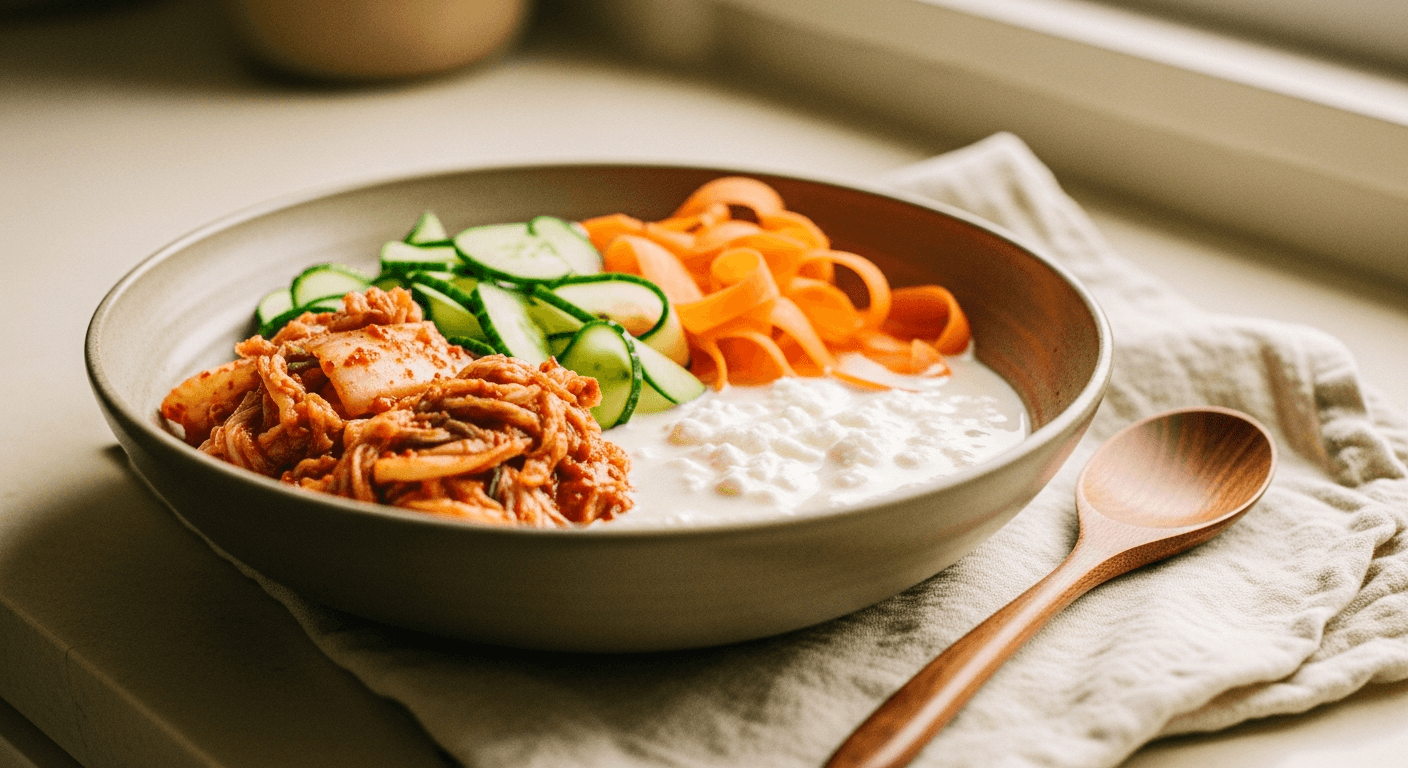
Fermented foods, including yogurt, kefir combined with prebiotic fiber, kimchi, unpasteurized sauerkraut, and miso, introduce live bacteria into the digestive tract and showed in a study published in Cell in 2021 a measurable increase in microbiome diversity over 10 weeks, greater than a high-fiber diet alone.
Navigating the Market: What to Question
The global gut health supplement market is projected to reach $29.1 billion by 2033 according to NutraIngredients, which means the product landscape is going to keep expanding.
Before buying a probiotic or prebiotic supplement, 3 questions are worth asking.
Is the strain specified? Not all probiotics are the same. L. rhamnosus GG and L. acidophilus don't have the same documented effects. A product that just says "Lactobacillus" without naming the strain doesn't have strain-specific data behind it.
Is the dose viable? Most studies use doses between 1 and 10 billion CFU per day. Products claiming hundreds of billions of CFU aren't necessarily more effective: a significant portion of those bacteria won't survive the gastric transit.
Are the cited studies done in humans? A lot of athletic performance claims around probiotics are based on animal or in vitro studies. That's not worthless, but it's not the same as a controlled clinical trial in human athletes.
The Practical Takeaway
The gut microbiome is a real physiological factor that serious athletes should pay attention to.
The correlation with VO2 max is documented, the impact of intense training on intestinal permeability is real, and Lactobacillus-strain probiotics have enough data behind them to reduce respiratory infections during high-load training periods.
What's not supported: the idea that a probiotic supplement will directly improve your performance or compensate for a diet low in plant diversity.
The foundation is the same as it's always been: eat varied, include fermented foods regularly, recover properly.
Supplements come after that, not instead of it.