
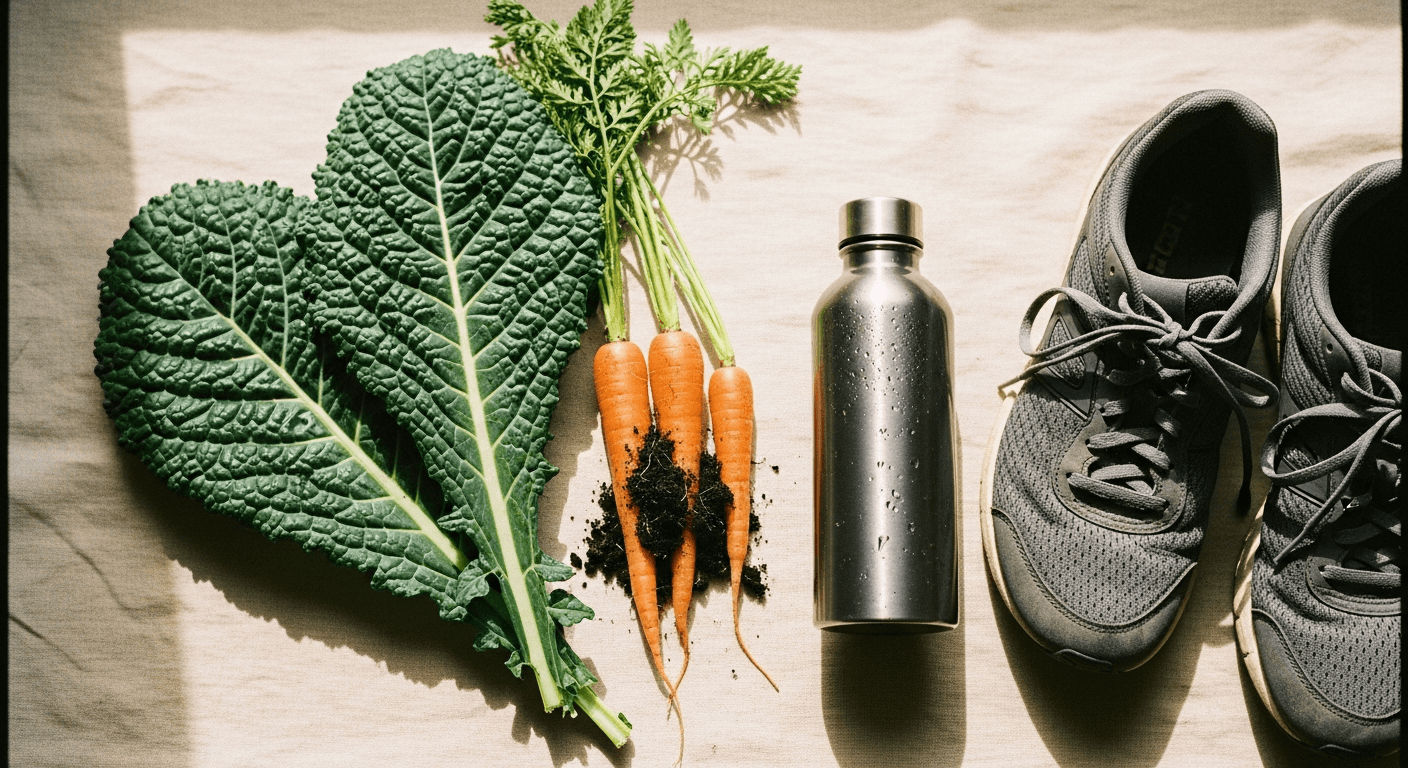
Walk through any premium grocery store or scroll through a serious athlete's meal prep content, and organic food is everywhere. Brands are increasingly positioning organic eating not just as a health choice, but as a performance edge. The pitch is intuitive: cleaner inputs, better outputs. But when you strip away the packaging and look at the peer-reviewed evidence, the picture is more complicated and more honest than most marketing suggests.
Here's what the science actually supports, where the gaps are, and how to make smart decisions about organic food without overspending on claims that won't move the needle in your training.
The Direct Performance Link Is Weaker Than Marketed
Let's be direct: there is currently no strong body of peer-reviewed evidence showing that eating organic food directly improves athletic performance metrics like VO2 max, power output, time-to-exhaustion, or strength gains. The studies that exist tend to be observational, short-duration, or conducted on general populations rather than trained athletes.
The confusion often comes from conflating general health benefits with performance outcomes. Organic food may support long-term systemic health, and long-term systemic health does support athletic longevity. But that's a different claim from "eat organic and run faster." Athletes and coaches deserve that distinction, especially when organic produce can cost 20 to 50 percent more than conventional equivalents.
This doesn't mean organic food is irrelevant to your performance. It means the mechanisms are indirect, and understanding them is more useful than accepting a marketing headline at face value.
Where the Evidence Is Clearer: Pesticide Load, Hormones, and the Gut
The more credible performance-adjacent case for organic food runs through two systems: hormonal health and the gut microbiome.
Certain pesticides used in conventional agriculture, particularly organophosphates and some fungicides, have been identified in research as endocrine-disrupting compounds. Several large-scale studies, including data from the National Health and Nutrition Examination Survey (NHANES), have found measurable urinary pesticide metabolites in people who regularly consume conventionally grown produce. For athletes, even modest disruption to testosterone, cortisol regulation, or thyroid function can affect recovery, body composition, and training adaptation over time.
Organic produce consistently shows lower pesticide residue levels, which is one of the most robustly replicated findings in this space. Whether that translates to meaningfully better hormonal markers in athletes specifically is still under-researched. But the plausibility is there, and it's more grounded than most performance nutrition marketing claims.
The gut microbiome link is similarly indirect but gaining traction. Some research suggests that chronic low-level pesticide exposure may negatively affect gut microbial diversity, which in turn influences nutrient absorption, inflammation, and immune function. For athletes in heavy training blocks, where gut health is already under mechanical and physiological stress, this is a non-trivial consideration. Recovery isn't just about sleep and protein. It's about everything your gut is doing overnight. If you're building out a full recovery protocol, Sleep and Athletic Performance: The Evidence-Based Protocol is worth reading alongside this piece.
Polyphenols and Antioxidant Capacity: A Modest But Real Signal
One of the more consistent findings in organic food research involves polyphenol content. A large meta-analysis published in the British Journal of Nutrition found that organic crops contained significantly higher concentrations of certain antioxidants and polyphenols compared to conventional crops. The difference wasn't uniform across all produce, but it was meaningful in specific categories including berries, apples, and leafy greens.
Why does this matter for athletes? During heavy training blocks, oxidative stress accumulates. Your body's antioxidant defense systems, powered partly by dietary polyphenols, help manage that load. Higher polyphenol intake from food sources is associated with reduced exercise-induced inflammation and improved markers of muscle recovery in some trials.
The key caveat: the polyphenol advantage in organic produce appears to be driven largely by the absence of synthetic nitrogen fertilizers, which accelerate plant growth but dilute secondary metabolite concentration. This means the effect is most pronounced in slow-grown, seasonal organic produce, not in out-of-season organic items shipped internationally.
For athletes, this points to a simple heuristic: local, seasonal organic produce is likely to offer more antioxidant benefit than organic produce that traveled thousands of miles. Buying organic blueberries in July is a different proposition than buying organic asparagus in December.
The Cost-Benefit Framework: Where Organic Matters Most
If your grocery budget isn't unlimited, which it isn't for most people, you need a framework for allocating organic spend. Not every organic swap carries equal evidence weight. Some are well-supported. Others are largely noise.
The Environmental Working Group (EWG) publishes an annual "Dirty Dozen" list of conventional produce with the highest pesticide residue levels. For athletes trying to reduce pesticide exposure without doubling their grocery spend, this list provides a practical prioritization tool. Strawberries, spinach, kale, peaches, and apples consistently appear near the top, meaning the organic version offers a meaningfully lower residue burden.
On the other end, the EWG's "Clean Fifteen" includes items like avocados, sweet corn, pineapples, and onions, where conventional versions test with minimal residue. Spending the organic premium here is largely marketing noise for most consumers. Your training budget is better allocated elsewhere, whether that's quality protein, a creatine protocol supported by emerging research, or simply more volume of whole food, regardless of certification.
Five Organic Swaps Most Supported by the Evidence
If you're an athlete with a real grocery budget and you want to make targeted organic choices, here are the five swaps with the strongest evidence-to-cost justification:
- Strawberries and soft berries. Consistently top the pesticide residue charts and are among the richest dietary sources of anthocyanins. Organic versions offer both lower residue load and, in seasonal form, higher polyphenol density. Relevant for recovery and antioxidant support during hard training.
- Spinach and leafy greens. High pesticide retention due to surface area and thin skin. Spinach also provides nitrates that support oxygen efficiency during aerobic exercise, making its quality genuinely relevant to training. Choose organic when it's within budget reach.
- Apples. Among the most pesticide-laden conventional produce items when consumed with skin. Given that much of the polyphenol content sits in the skin, you're either peeling away the benefit or ingesting the residue. Organic apples resolve that trade-off.
- Oats and whole grains. Less discussed in the Dirty Dozen context but worth attention. Glyphosate has been widely used as a pre-harvest desiccant on conventional oats in North America, with residue detections appearing in numerous independent lab analyses of major brands. For athletes eating large oat volumes daily, organic oats are a reasonable swap.
- Bell peppers and hot peppers. Rank high for pesticide residue and are vitamin C-dense foods that many athletes rely on. Organic versions have stronger grounds for recommendation than, say, organic avocados or pineapples.
What's notably absent from this list: organic meat and dairy. These are the highest-cost organic swaps and carry more complex evidence profiles. Organic dairy does show modestly higher omega-3 fatty acid levels in some studies, but the absolute difference is small compared to the cost premium. If omega-3 status is a genuine priority for your training and recovery, a dedicated supplement is far more cost-effective. The evidence on omega-3s across different life stages and performance goals supports this approach for most athletes.
What Organic Food Won't Fix
It's worth naming what organic eating cannot substitute for in a performance nutrition strategy. If your total calorie intake is inadequate, your protein targets are unmet, or your training load is mismanaged, organic certification on your food will not compensate for any of that. The performance hierarchy still starts with the fundamentals.
Protein timing, carbohydrate periodization, and hydration drive far more of your training adaptation than the farming method behind your produce. For athletes training through demanding conditions, getting the foundational nutrition right, including how your needs shift in different environments, matters more than organic labels. How your protein needs shift during summer training is a good example of that kind of practical, evidence-based prioritization.
Organic food is not a performance shortcut. It's a long-term health investment with some indirect performance relevance that's worth making strategically, not categorically.
The Bottom Line
The evidence does not support the idea that going fully organic will make you a better athlete in any direct, measurable sense. What it does support is a narrower and more honest version of that claim: reducing your pesticide exposure through targeted organic choices may protect hormonal and gut health over time, and higher polyphenol content in some organic produce can modestly support antioxidant capacity during intense training.
Spend your organic premium where the residue evidence is strongest, seasonal soft fruits, leafy greens, apples, peppers, and oats. Skip the organic premium on produce that's already low-risk conventional. And keep your performance nutrition hierarchy intact: fundamentals first, optimization second, and organic certification somewhere useful but not central to that picture.