
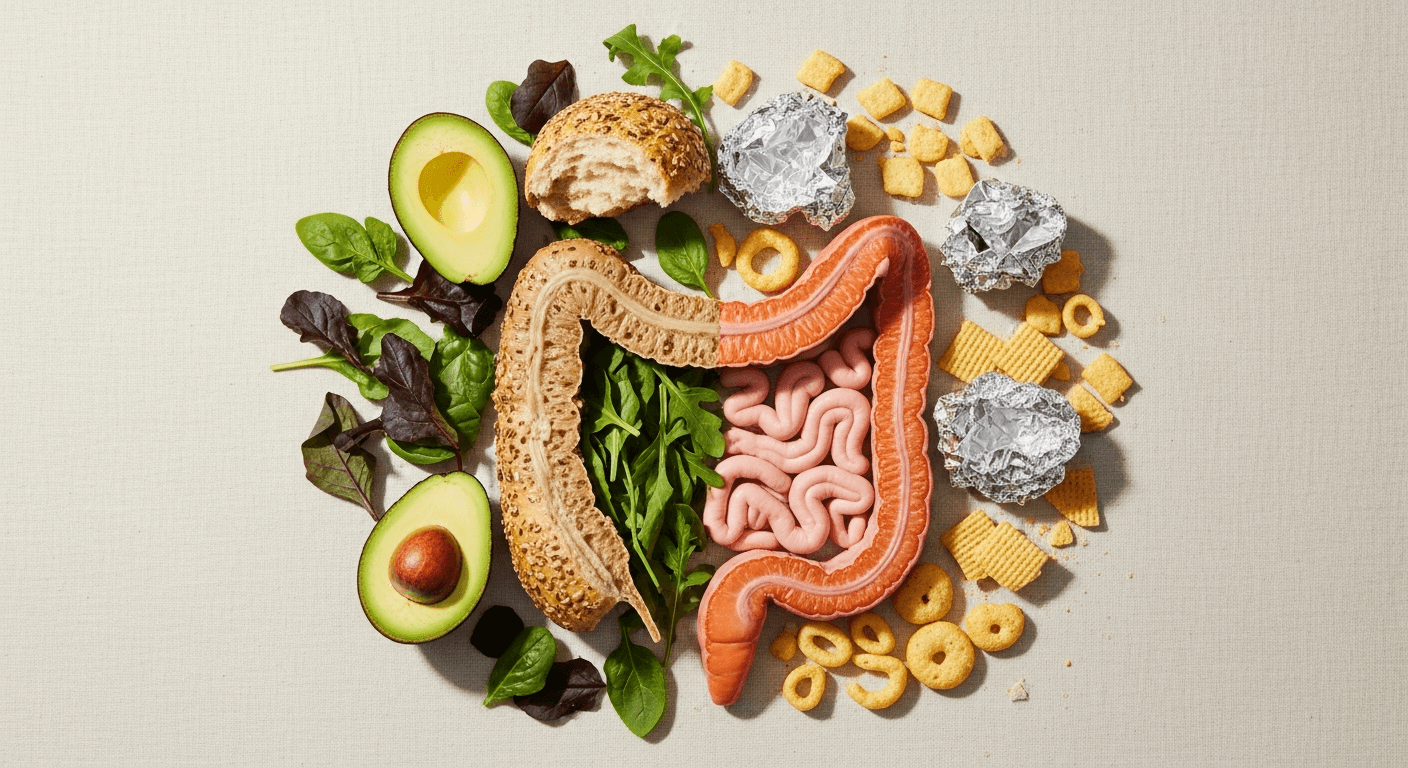
You already know ultra-processed foods aren't doing your body any favors. But the conversation has mostly stayed at the surface level: too much sugar, not enough protein, empty calories. The newer research is more specific, and more alarming, than that.
What's emerging now is a structural picture. Ultra-processed foods don't just deliver poor nutrition. They actively remodel the microbial ecosystem in your gut in ways that compound every downstream health and performance outcome you care about. If you train seriously, this affects you directly, regardless of how clean the rest of your diet looks.
The Scale of the Problem Is Bigger Than You Think
Ultra-processed foods now account for more than 50% of daily caloric intake across many Western countries. In the United States, that figure sits closer to 57% among adults. In the United Kingdom and Australia, the numbers aren't far behind. This isn't a fringe dietary pattern. It's the default.
That matters because the athletic and fitness community tends to assume it's insulated from this trend. It isn't. Many of the most commonly consumed products in gym culture, including flavored protein powders, pre-workout blends, protein bars, and ready-to-drink shakes, fall squarely within the NOVA classification system's definition of ultra-processed foods. The ingredients that make these products shelf-stable, palatable, and cheap are often the same ones most disruptive to gut bacteria.
As strength training has become the dominant fitness goal heading into 2026, the nutritional substrate that supports muscular adaptation deserves the same level of scrutiny as the programming itself.
What Ultra-Processed Foods Actually Do to Your Gut
The gut microbiome is not a passive bystander in your nutrition. It synthesizes nutrients, modulates inflammation, regulates immune function, and signals directly to your brain via the gut-brain axis. When its composition shifts, everything downstream shifts with it.
Ultra-processed food consumption is now consistently linked to reductions in microbial diversity, specifically a decline in bacteria from the Bifidobacterium and Lactobacillus genera, and an increase in pro-inflammatory species. This isn't a marginal change. Studies using metagenomic sequencing show measurable shifts within two weeks of sustained UPF intake.
The downstream effects for athletes are significant. A disrupted microbiome reduces the gut's capacity to synthesize key B vitamins, particularly B12, B6, folate, and riboflavin, that are essential for energy metabolism and red blood cell production. It also impairs the production of short-chain fatty acids (SCFAs), primarily butyrate and propionate, which serve as fuel for intestinal cells, reduce systemic inflammation, and support cognitive function and mood regulation.
Less butyrate means more intestinal permeability. More permeability means more inflammatory signaling reaching systemic circulation. For an athlete training hard, that baseline inflammation directly competes with recovery.
The Sports Nutrition Blind Spot: Emulsifiers and Sweeteners
Here's where it gets specific to the products marketed directly to you. Two categories of additives are now drawing sustained attention from gut microbiome researchers: emulsifiers and artificial sweeteners.
Emulsifiers, including carboxymethylcellulose (CMC) and polysorbate-80, are widely used in processed sports foods to improve texture and extend shelf life. Animal and human studies both show these compounds disrupt the mucus layer lining the gut, reducing the physical barrier between intestinal contents and the gut wall. The result is increased bacterial contact with gut epithelial cells and a measurable rise in inflammatory markers.
Artificial sweeteners present a separate but overlapping problem. Sucralose, acesulfame-K, and saccharin have each been shown in randomized trials to alter gut microbiome composition in ways that impair glucose regulation. This is particularly counterproductive for athletes managing carbohydrate timing, since a dysregulated gut response to sugar undermines the precision of any carbohydrate strategy you're following.
Check the label on your protein bar. If it contains sucralose and polysorbate-80 alongside 30g of protein, you're getting a mixed signal at best.
Iron Absorption and the VO2 Max Connection
One of the most underappreciated performance costs of poor gut health is impaired mineral absorption, particularly iron. The gut microbiome plays an active role in iron bioavailability. Dysbiosis reduces the expression of iron transport proteins in intestinal cells and increases hepcidin, a hormone that blocks iron absorption from the gut.
Functional iron deficiency, even without clinical anemia, is associated with a 3-5% reduction in VO2 max. That's a meaningful number. For a competitive runner or cyclist, that margin is the difference between podium performance and a mediocre result. For a recreational athlete, it's the difference between feeling strong at the end of a session and feeling depleted.
Given that cardiorespiratory fitness is one of the strongest predictors of long-term health outcomes, protecting your VO2 max by maintaining gut integrity isn't a marginal concern. It's foundational.
The same absorption disruption applies to magnesium and zinc, two minerals critical to muscle contraction, testosterone regulation, and sleep quality. These aren't exotic micronutrients. They're the basic operating requirements for athletic function, and a degraded gut environment systematically undermines your ability to absorb them even when your diet contains adequate amounts.
How Quickly Can You Shift the Microbiome?
This is where the evidence becomes genuinely encouraging. The gut microbiome is more responsive to dietary change than most people realize.
Dietary intervention data consistently shows that replacing as few as three ultra-processed meals per week with whole-food equivalents produces measurable increases in microbiome diversity within four weeks. You don't need to overhaul everything at once. Targeted substitutions, swapping a protein bar for Greek yogurt with berries, replacing a flavored shake with whole eggs and oats, choosing whole fruit over a "functional" snack product, generate detectable microbial shifts within a month.
This four-week window aligns with typical adaptation timelines in training. The same discipline you apply to progressive overload applies here. Small consistent changes compound. The gut responds to the same logic your muscles do.
For those looking at longer-term dietary strategy, improving diet quality at any age carries measurable longevity benefits, and the gut microbiome appears to be a primary mechanism through which those benefits are delivered.
Practical Steps for Athletes
You don't need a perfect diet to shift this. You need a strategic one. Here's where to focus first:
- Audit your sports nutrition products. Look specifically for polysorbate-80, carboxymethylcellulose, sucralose, and acesulfame-K. These are the highest-impact disruptors. Products containing these in combination deserve the most scrutiny.
- Add fermented foods before you add supplements. Plain kefir, kimchi, sauerkraut, and live-culture yogurt are consistently shown to increase microbiome diversity. A daily serving of any one of these is a stronger intervention than most probiotic capsules.
- Prioritize dietary fiber diversity. SCFAs are produced when gut bacteria ferment fiber. Different bacteria ferment different fiber types. Eating 30 or more distinct plant foods per week, a target supported by large observational studies, is one of the most robust predictors of microbiome diversity.
- Time your whole-food replacements around training. Post-workout is when gut permeability is naturally elevated. This is the window where an ultra-processed recovery product does the most structural damage. Prioritize whole-food meals in the two hours after hard sessions first.
- Don't treat protein quantity as the only variable. A protein source that arrives inside a product loaded with emulsifiers and synthetic sweeteners comes with a microbiome cost that isn't reflected in the macronutrient count.
The Bigger Picture for Performance Nutrition
The fitness industry has spent years treating gut health as a separate category from performance nutrition. Probiotics live in the wellness aisle. Protein powders live in the sports nutrition aisle. That separation is no longer scientifically defensible.
The microbiome is the infrastructure through which all of your nutrition decisions are processed. Feed it well and it amplifies the return on every gram of protein, every strategic carbohydrate, every micronutrient you're deliberately including. Degrade it with chronic UPF exposure and you're absorbing less, inflaming more, and recovering slower, regardless of what the label says.
Women navigating strength training, for instance, are already working against some structural disadvantages in how recovery research has historically been conducted. The evidence now confirms that women respond to the same programming as men, but gut health optimization remains an equalizer. A compromised microbiome erases advantages that smart training is designed to build.
The conversation about ultra-processed foods has been stuck at the level of calories and macros for too long. The microbial evidence reframes the stakes. It's not just what you're eating. It's what your gut can actually do with it.