
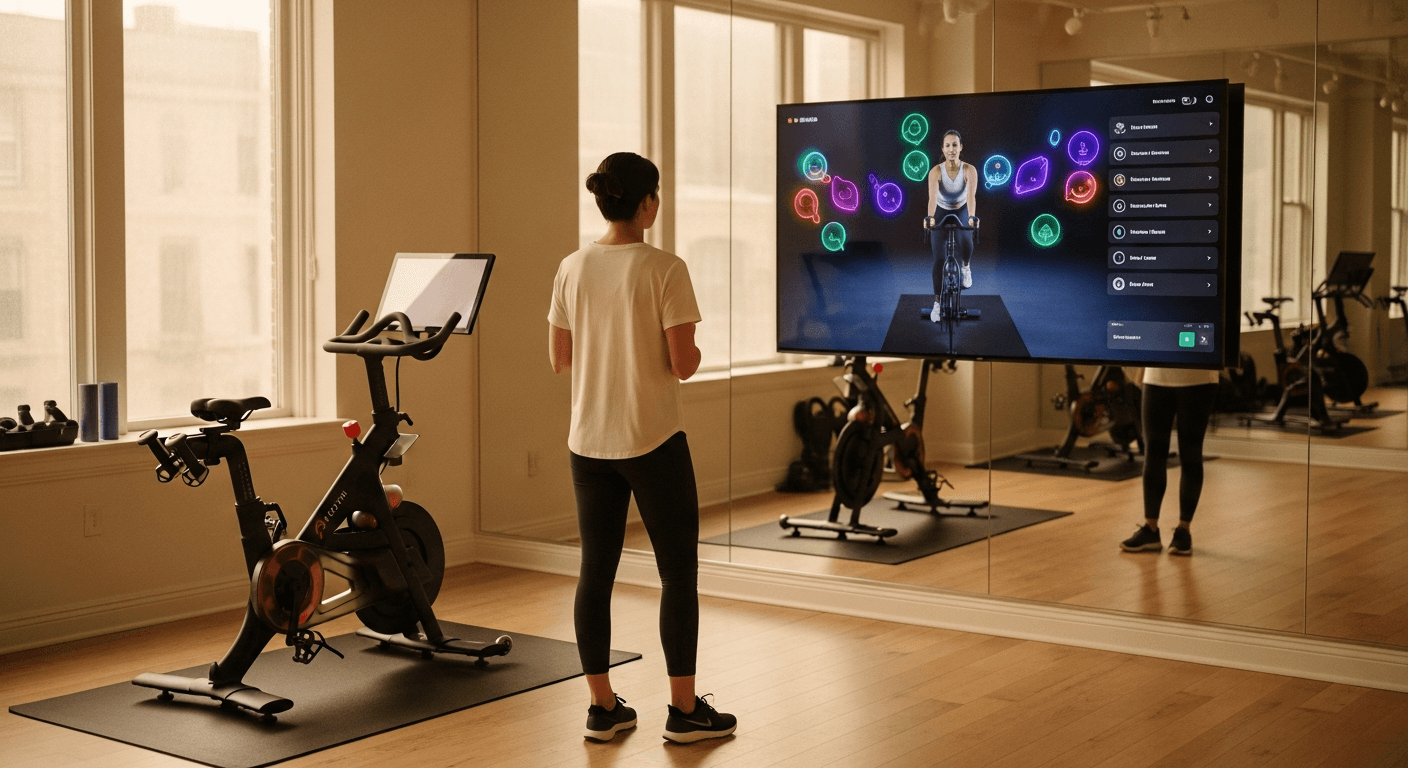
Peloton's addition to the S&P SmallCap 600 index as of May 25, 2026, didn't make headlines the way its IPO did. But for gym operators and fitness brands paying attention, it signals something more consequential than a stock listing. It confirms that Peloton has successfully restructured itself. The market now prices it as a viable mid-cap business, not a pandemic-era hardware casualty.
Pair that with a global content licensing partnership with Spotify, and the picture becomes clear. Peloton is no longer competing with Trek or NordicTrack. It's competing with content platforms, coaching IP owners, and digital fitness subscription businesses. That repositioning has direct consequences for anyone whose competitive moat depends on proprietary programming.
What the S&P Inclusion Actually Means
Index inclusion is rarely about the company itself. It's about liquidity and institutional behavior. When a stock enters the S&P SmallCap 600, index funds are required to buy it. That creates a mechanical floor under the price and brings in institutional eyes that wouldn't have looked twice before.
For Peloton, this matters beyond the balance sheet. It validates the post-restructuring model: leaner hardware margins, recurring subscription revenue, and a platform strategy built around content delivery. The market is effectively saying the pivot is credible enough to track.
That credibility translates into real business leverage. Institutional backing makes it easier to fund content deals, negotiate licensing agreements, and attract talent. The Spotify partnership didn't happen in a vacuum. It happened because Peloton now has the financial standing to sit at that table.
The Spotify Deal Reframes the Entire Competitive Set
The Spotify partnership is not a marketing collaboration. It's a structural repositioning. By licensing content through Spotify's ecosystem, Peloton gains access to a distribution network of more than 600 million users globally. That's not a fitness audience. That's a general consumer audience that Peloton now has a pathway to convert.
From a platform economics standpoint, this is the move. Hardware margins are thin and logistically brutal. Software and content margins scale differently. A single instructor, a single class format, a single audio experience can be delivered to millions of users at near-zero marginal cost once the content exists.
For gym operators, the implication is uncomfortable. If Peloton's content becomes discoverable and consumable through an app already on your members' phones, the friction between your in-person programming and their digital alternatives just dropped significantly. You're no longer competing with the Peloton bike sitting in someone's garage. You're competing with their morning Spotify session.
Connected Fitness Is Repricing Around Software, Not Hardware
The connected fitness market is projected to reach $43.3 billion by 2035. That number sounds like a hardware story. It isn't. The growth is concentrated in subscription platforms, coaching software, and content licensing. The bike is increasingly a delivery mechanism, not the value itself.
Peloton's own subscriber data illustrates the tension. Connected fitness subscriptions have continued to decline from their pandemic peak, yet Peloton's strategic response has been to double down on content rather than discount hardware. That's the right call if you believe the margin lives in the software layer, and the evidence increasingly supports that belief.
This trajectory is consistent with what's happening across the broader equipment segment. As detailed in Fitness Equipment Market Hits $18.4B: Where the Margin Is, IoT-connected equipment is forcing every hardware manufacturer to answer the same question: are you a device company or a data and experience company? The ones treating that as a rhetorical question are losing ground.
Tonal, Life Fitness, and the Intelligence Layer
Peloton's content pivot isn't an isolated move. It's part of a broader repricing of the fitness equipment category around intelligence rather than physical product.
Tonal, backed by investors including Mark Cuban and Maria Sharapova, continues to expand with a value proposition centered on adaptive AI coaching rather than weight stacks. The machine is almost incidental. The draw is the intelligence layer that adjusts resistance, tracks progress, and delivers coaching feedback in real time.
Life Fitness has moved in a parallel direction with AI-powered equipment launches designed to generate member data and feed into facility management systems. The pitch to gym operators is no longer about durability and warranty terms. It's about what the equipment knows and what it can do with that information.
This shift matters because it changes what you're actually selling to members. When the equipment thinks, the coaching credential attached to it carries more weight, not less. That's a significant consideration for operators building programming strategies around on-device AI that's already reshaping coaching revenue in 2026.
What Gym Operators Need to Benchmark Against
If you're running a gym or a fitness brand with proprietary programming, here's the honest benchmark problem you're facing. Peloton now has the institutional capital, the content library, and a distribution deal with Spotify. Your in-house programming is competing against that reach whether you've thought about it explicitly or not.
That doesn't mean you're losing. It means the standard has shifted. Members who consume fitness content digitally, which at this point is the majority of active gym members, are continuously calibrating their expectations against the best content they encounter anywhere. If your class formats, coaching voice, and programming logic don't hold up to that comparison, retention becomes harder to defend.
The operators who are navigating this well are doing a few things consistently:
- Treating proprietary programming as a product, not an operational detail. They document it, protect it, and build member communication around it explicitly.
- Investing in coach development as a content asset. A coach with a recognizable methodology and genuine audience connection is something Peloton's platform can't easily replicate locally.
- Using technology to personalize at scale. Generic group fitness is the most vulnerable segment. Personalized programming, even partially automated, creates defensible differentiation.
- Building community depth that digital platforms structurally can't match. The in-person relationship, the accountability loop, the physical space. These aren't soft advantages. They're structural ones when you build around them deliberately.
The institutional capital flowing into fitness businesses that get this right is real. The $100 million BlackRock-backed investment in GymNation, analyzed in GymNation's $100M BlackRock Bet: What It Signals, is a direct signal that value-positioned gym operators with strong unit economics and differentiated programming are attracting serious capital. The question is whether your operation is positioned to tell that story.
The Subscription Decline Is a Warning, Not a Ceiling
It would be tempting to read Peloton's declining subscriber count as evidence that connected fitness is fading. That's the wrong interpretation. What's fading is the undifferentiated connected fitness model: buy the hardware, get the app, consume generic content. The model that's growing is the one where content, coaching, and software are genuinely better than what you'd get elsewhere.
The US fitness market has crossed 100 million active users, a threshold examined in detail in the HFA's 2026 analysis of what fitness market maturity actually means. In a mature market, the growth doesn't come from expanding the total addressable pool. It comes from winning share through retention, experience, and differentiation. That's the competitive environment Peloton is repositioning for. It should be the one you're positioning for too.
Operators who treat digital content as a threat rather than a design constraint will continue to be surprised by it. The more useful frame is to accept that your members live in a high-quality content environment all day and ask what your programming offers that environment doesn't. Specificity, accountability, progressive structure, and community are the answers that hold up. Generic class schedules and undifferentiated coaching don't.
The Near-Term Moves That Matter
Peloton's S&P inclusion and Spotify deal are not reasons to panic. They're market signals that give you useful information if you're willing to act on it.
The content platform model is now institutionally validated. The margin in fitness is migrating toward software, coaching IP, and data. The equipment segment is repricing around intelligence. And the distribution reach of platforms like Spotify means that even well-funded fitness brands are now one licensing deal away from being in your members' ears before they walk through your door.
Your response doesn't require a technology overhaul or a content studio. It requires clarity on what your programming actually delivers, intentional investment in the coaches who carry your brand voice, and honest evaluation of where your member experience is genuinely differentiated versus where it's merely familiar.
The fitness operators winning right now are the ones who've stopped waiting for the digital content wave to peak and started building businesses that are better because of it. That's still an open opportunity. But the window for treating it as optional is closing faster than most operators realize.