
Peloton's Q3 2026 results didn't just beat guidance. They reframed what the company actually is. Total revenue came in at $631 million, posting positive year-over-year growth for the first time in several quarters, with connected fitness equipment sales leading the charge. Pilates modality grew 48% year-over-year. The narrative around Peloton's recovery, however, misses the more consequential story underneath the numbers.
This isn't a comeback for the at-home fitness model. It's a calculated entry into a market Peloton currently controls almost none of. And if you're building a fitness brand, a gym operation, or a supplement or coaching business, what happens next affects your competitive landscape directly.
The 3% Number That Explains Everything
Peloton's own internal estimates place its commercial gym equipment market share at roughly 3% of a market it values at over $10 billion globally. That's the figure the company is leading with internally as it frames commercial expansion as its primary growth vector heading into fiscal Q2 2027 product launches.
Three percent is not a weakness to apologize for. In strategic terms, it's a green field. With brand recognition that most commercial equipment manufacturers can't buy, Peloton is walking into a B2B channel where awareness is already high but unit penetration is near zero. That's a rare position for a hardware company to be in at this stage of its lifecycle.
For context, the global commercial fitness equipment market has been consolidating steadily, with operators increasingly demanding connected hardware that generates member data, not just repetitions. Peloton's software stack, content library, and instructor-led format give it a differentiated value proposition that legacy manufacturers are still trying to replicate.
The Commercial Series: What It Means in Practice
Peloton is developing a dedicated Commercial Series of bikes and treadmills engineered specifically for high-traffic gym environments. These aren't consumer units with a different color scheme. High-traffic commercial equipment faces different durability standards, maintenance cycles, and connectivity requirements than anything built for a spare bedroom.
The product development shift moves Peloton into direct competition with Technogym, Life Fitness, and Matrix in the B2B channel. These aren't soft competitors. Technogym holds long-term supply contracts with hotel chains, luxury gym operators, and sports performance facilities across multiple continents. Life Fitness has deep relationships with university athletic programs and municipal recreation centers. Matrix has built significant share in the mid-market club segment.
Peloton is not walking into a vacuum. It's walking into entrenched relationships, procurement cycles measured in years, and purchasing committees that prioritize service agreements as much as hardware specs. The brand has to earn that trust at scale, and it has to do it while managing a consumer business that still represents the majority of its revenue.
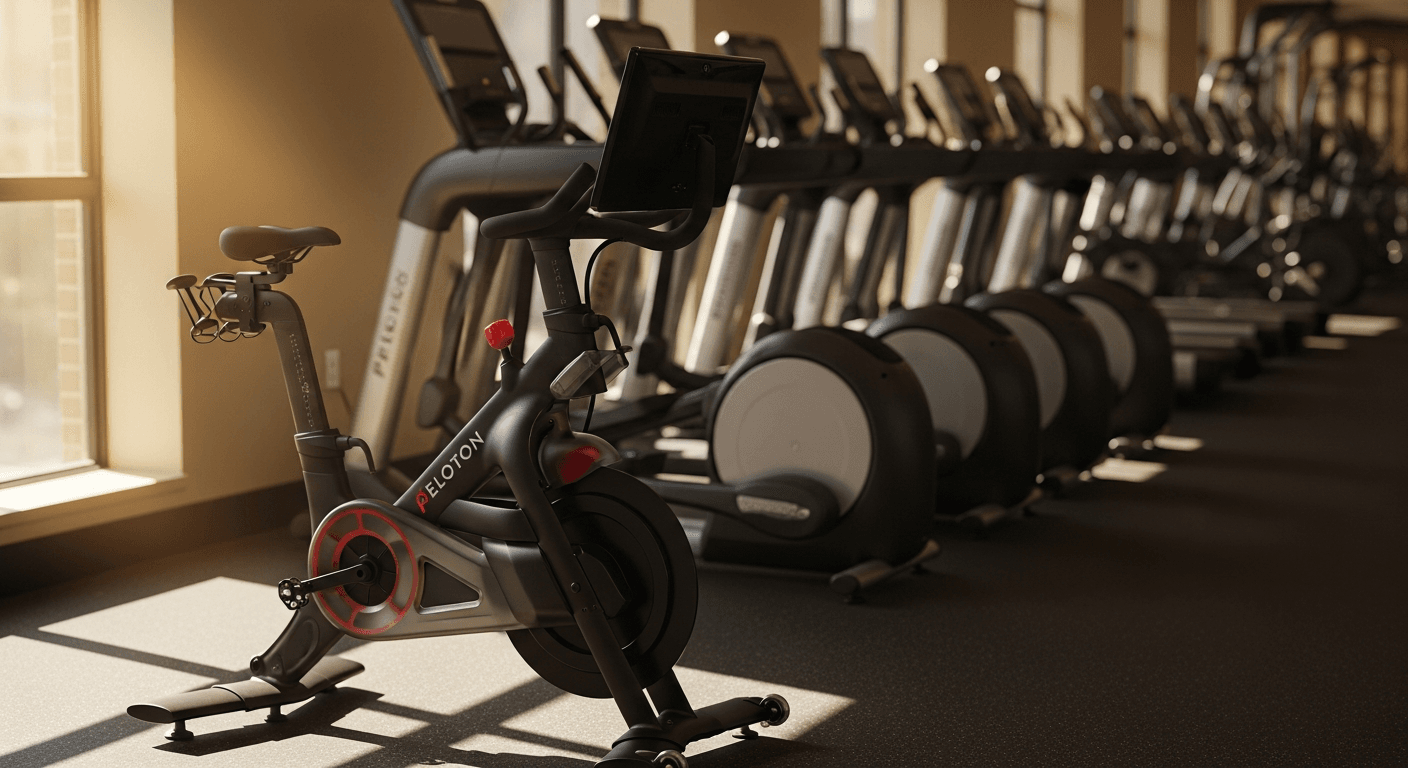
That said, don't underestimate what Peloton brings to this fight. Its instructor talent, its content ecosystem, and its member engagement metrics are genuinely difficult to replicate. A gym floor Peloton bike doesn't just deliver a workout. It delivers a branded content experience that keeps a member on the machine longer and creates a data trail the operator can actually use.
Technogym's Precedent and What the Margin Battle Looks Like
Peloton isn't the only signal worth watching here. Technogym posted a 10% revenue jump in Q1 2026, driven heavily by AI-integrated commercial equipment. That number confirms what the supply chain and procurement data have been suggesting for months: the connected commercial equipment segment is becoming the highest-margin battleground in the entire fitness hardware category.
Margins in direct-to-consumer fitness hardware have been under pressure since 2022. Acquisition costs rose, return rates stayed elevated, and the subscription attach rate that justified aggressive hardware subsidies plateaued in saturated markets. Commercial contracts operate differently. A single hospitality group or fitness chain can represent thousands of units under a multi-year agreement, with service contracts, software licensing, and content fees layered on top of the hardware sale.
For any brand tracking where connected fitness revenue will concentrate over the next three years, the answer is increasingly clear. It's not in the living room. It's in the gym. If you want a broader view of where the at-home segment is heading by contrast, the dynamics around at-home fitness equipment in 2026 and AI-driven Asia-Pacific growth tell a useful parallel story.
What Pilates Growth at 48% Tells You About Modality Expansion
The 48% year-over-year growth in Peloton's Pilates modality is not a footnote. It's evidence that the platform's content diversification strategy is working, and it points toward how Peloton will position itself on the commercial gym floor.
Pilates is no longer a boutique category. Studio roll-up activity has accelerated significantly, with operators acquiring multi-location Pilates brands as anchor tenants in mixed-use fitness facilities. Aligned Fitness's acquisition of six Club Pilates locations is one example of the kind of consolidation that's normalizing Pilates as a mainstream gym floor offering rather than a standalone studio visit.
If Peloton can bring Pilates-format connected content to a commercial gym floor, it solves a real operator problem: how to deliver a modality that members want without the overhead of a dedicated studio buildout. That's a compelling B2B pitch, and 48% growth suggests the demand signal on the consumer side is strong enough to justify the infrastructure investment.
The training methodology behind Pilates also aligns with broader programming trends. Members who engage with Pilates on a connected platform are often cross-training with cycling and strength work, which maps well to structured approaches like those covered in applying progressive overload to cardio training. Peloton's ability to integrate these modalities under one subscription is a retention mechanism that gym operators will find hard to ignore.
The Adjacent Brand Opportunity: Apparel, Supplements, and Coaching
Here's where the Peloton commercial pivot gets interesting for brands that aren't in the hardware business at all. When Peloton was exclusively a direct-to-consumer brand, its gym-floor presence was essentially zero. Co-placement partnerships, branded content integrations, and data-sharing agreements with gym operators simply weren't on the table.
That changes the moment Peloton bikes and treadmills are installed in commercial facilities at scale. Gym floors are high-dwell environments where members are already primed to engage with brand messaging. A supplement brand with a recovery positioning, a performance apparel brand with a technical fit story, or a digital coaching platform with a connected training angle all have a reason to be in conversation with whoever is programming those machines.
The supplement category in particular is moving fast enough that timing matters. The Fall 2026 supplement brand playbook makes clear that distribution channel diversification, including gym-floor adjacency, is one of the primary strategies separating growing brands from stalled ones.
Digital coaching platforms have a parallel opportunity. Peloton's commercial gym presence creates a physical touchpoint for member acquisition that didn't exist before. A coaching brand that can integrate with, or sit adjacent to, a connected equipment ecosystem gains access to a motivated, data-rich audience. The AI personalization layer matters here too. Platforms investing in intelligent coaching infrastructure are better positioned to convert that gym-floor exposure into recurring clients. The case for that investment is well documented in coverage of AI personalization as the defining coaching investment of 2026.
The Competitive Redrawn: Who Needs to Respond
Peloton's commercial pivot redraws competitive lines across multiple categories simultaneously. Here's who needs to be paying attention:
- Legacy commercial equipment manufacturers. Technogym, Life Fitness, and Matrix now face a competitor with superior content infrastructure and a brand that members actively request by name. Their response will likely accelerate AI and software investment, which raises the floor for what "connected" means in a commercial RFP.
- Boutique studio operators. If commercial gyms can deliver a Peloton Pilates or cycling experience without a boutique price point, some segment of boutique demand will migrate. Studio operators need to sharpen what's irreplaceable about their format: community, live instruction, and physical space design.
- Supplement and apparel brands. The gym-floor distribution opportunity is real but won't be available to everyone. Brands that build relationships with commercial gym operators now, before Peloton's presence scales, will have a first-mover advantage in co-placement conversations.
- Digital coaching platforms. Peloton's commercial expansion creates a data-rich gym environment where coaching upsells become more contextually relevant. Platforms that can integrate or affiliate with connected equipment ecosystems will have a structural advantage over those operating in isolation.
The Q2 2027 Product Window Is Closer Than It Looks
Peloton has framed fiscal Q2 2027 as the launch window for new commercial products. That's not distant. For a gym operator, procurement timelines mean decisions made in the next two to three quarters will determine what equipment is on the floor when those products ship.
For adjacent brands, the window to establish co-placement conversations, partnership frameworks, and data-sharing agreements is similarly short. Commercial gym infrastructure decisions are slow to reverse once made. The brands that position themselves as natural partners to Peloton's commercial ecosystem during this pre-launch period will be far better placed than those who wait to see how the rollout performs.
Peloton's Q3 2026 is not a recovery story. It's a repositioning story. The 3% commercial market share number is the starting line, and every connected fitness hardware brand, every gym operator sourcing equipment, and every adjacent brand selling to the gym floor is now operating in a competitive environment that looks meaningfully different than it did twelve months ago. The question isn't whether to respond. It's how fast you can move.