
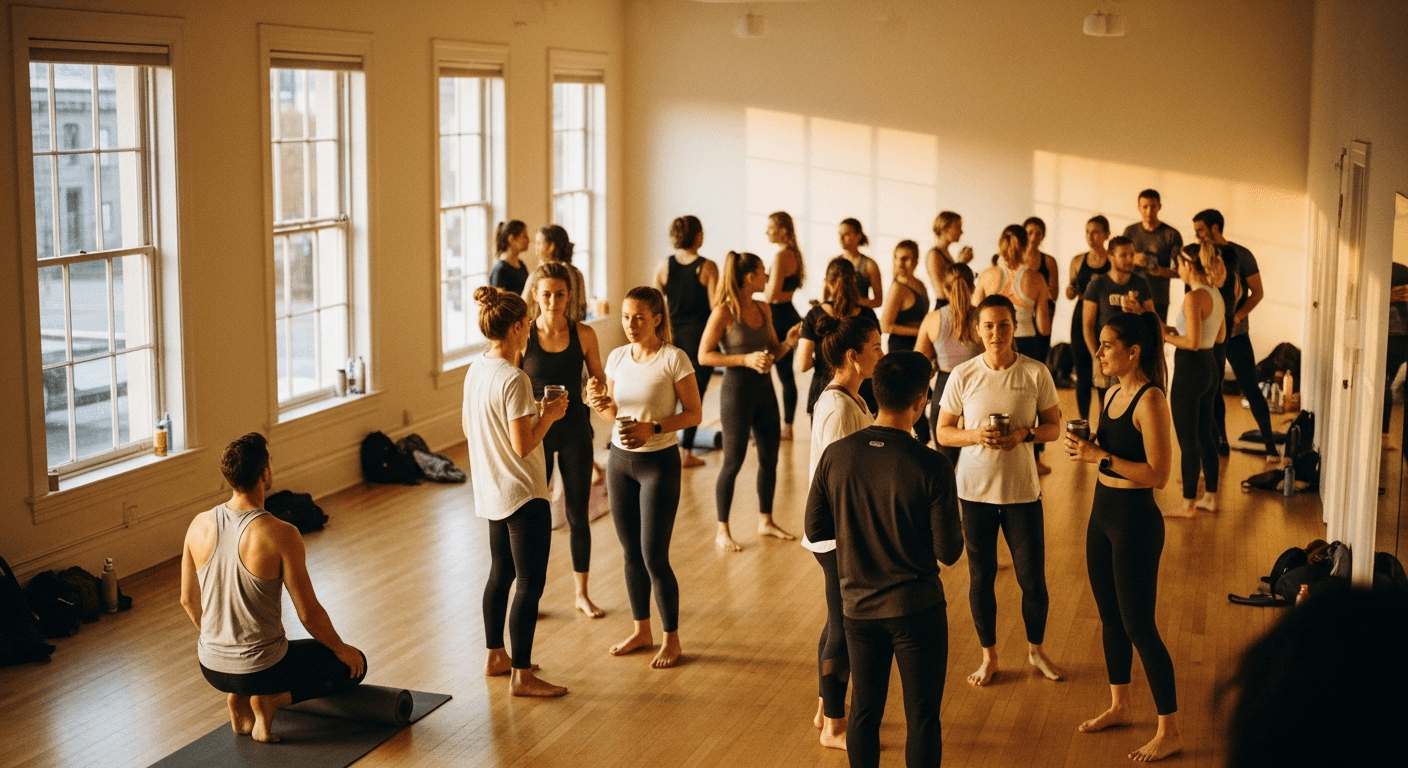
The global health and wellness market is on track to reach approximately USD 9 trillion by 2030, and the brands pulling ahead aren't simply selling better products. They're selling access, identity, and belonging. Live events, once treated as a line item under marketing spend, are being restructured as a direct revenue category with their own unit economics, retention metrics, and compounding LTV contribution.
If you're building a fitness or wellness brand in 2026, this shift isn't optional. It's the difference between a business that compounds and one that competes on price until it can't.
From Marketing Cost to Revenue Line
Historically, brands organized in-person events to generate awareness, acquire customers, or photograph content. The event itself was a cost. Any revenue from ticket sales was incidental, usually folded back into logistics budgets to justify the spend.
That model is being replaced. The most innovative fitness brands identified in 2026 are treating events as a standalone revenue category with its own contribution margin. Workshops, retreats, training days, and immersive brand experiences are being priced as premium products, not loss leaders.
The mechanism is straightforward: when an event delivers genuine transformation or community connection, attendees return. Repeat attendance converts into membership. Membership converts into predictable recurring revenue. The math starts to look less like a trade show and more like a subscription business.
This has direct implications for how you should think about event pricing. A $150 workshop with 80 attendees generates $12,000 in gross revenue. If 30% of those attendees convert to a $75/month community membership, you've created a recurring revenue stream worth $27,000 annually from a single event. That's not a marketing cost. That's a business unit.
The Third Place Strategy
Analysts tracking the most innovative brands of 2026 are using the term "third place" to describe what the leading operators are building. The concept is simple: your home is your first place, your workplace is your second, and the brand environment. physical, digital, or hybrid. is your third. Brands that successfully occupy that third-place position earn a level of loyalty that product-only companies structurally cannot achieve.
Life Time Fitness is the clearest large-scale example. Its clubs are designed to function as destination environments, not transactional gyms. The brand layers in nutrition programming, recovery services, and community events on top of a baseline membership, creating a model where the average member's relationship with the brand deepens over time rather than eroding. Life Time's in-club nutrition coaching structure illustrates precisely how premium operators are engineering upsell pathways that feel like added value, not sales pressure.
The third-place model also drives retention in ways that pure-product or pure-digital brands struggle to replicate. When members associate a physical space or recurring event with their social identity and wellbeing, churn becomes emotionally costly, not just financially inconvenient. Building member retention into your operating model rather than reacting to churn after the fact is the structural shift this model demands.
Product as Community Signal
Design-forward brands are adding a layer to this model that's worth studying carefully. When a product becomes a community identity marker, ownership itself drives event attendance.
Bala is the clearest current example. Its weighted bangles and training accessories are designed to be worn visibly, photographed deliberately, and recognized instantly within a specific wellness-adjacent community. The product functions as a social signal. When Bala hosts or sponsors a live event, its existing customers don't just show up as consumers. They show up as members of a tribe that the product helped define.
This creates a flywheel. Strong product aesthetics generate social visibility. Social visibility attracts community. Community creates demand for live gathering. Live gathering deepens loyalty and drives repeat product purchases. Each element reinforces the others, and none of it is easily replicated by a competitor that's competing solely on formulation or specification.
The strategic implication for brands building in this space is that design investment is not a vanity expense. It's infrastructure for community formation, which is infrastructure for event revenue.
The Commoditization Threat Is Real
Here's the context that makes the urgency clear. FMCG conglomerates are actively acquiring product-only wellness brands. The consolidation is accelerating. Unilever's acquisition of Grüns is a direct signal that large consumer goods companies are moving into the supplement and functional nutrition space with distribution muscle and margin compression that independent brands cannot match on product alone.
If your brand's competitive advantage is the product itself, that advantage has a shelf life. The moment a company with Unilever's supply chain decides to compete in your category, your pricing power erodes. The brands that survive that compression are the ones that have built something a corporation cannot simply acquire and replicate: a genuine community with lived, recurring touchpoints.
Experience-led brands retain pricing power because their members aren't just buying a product. They're buying continued access to a network, an environment, and an identity. That's not something you can private-label.
Hybrid Models and Digital Extension
Physical events alone don't scale economically. The brands building durable recurring revenue are using live events as the anchor, then extending the relationship digitally to capture members who can't attend in person or who want continuous access between events.
This hybrid structure is becoming the standard playbook. A brand might host four quarterly in-person events at $200 to $500 per ticket, supported by a digital membership at $30 to $50 per month that includes on-demand content, community access, and live-streamed programming. The in-person events drive acquisition and emotional commitment. The digital layer captures recurring revenue at scale.
Connected fitness and AI-powered platforms are accelerating this model's viability. PersonalHour's AI-driven pilates platform represents the kind of infrastructure that makes hybrid event-to-membership conversion technically feasible for brands that don't have the budget to build proprietary technology in-house.
The economics improve significantly when you layer this correctly. A community of 500 digital members at $40/month generates $240,000 in annual recurring revenue. Convert 20% of those members to attend a quarterly in-person event at $300 per ticket and you've added another $120,000. That's a $360,000 revenue engine built on community, not inventory.
What the Unit Economics Actually Look Like
The shift in unit economics is the most important structural change for brands to internalize. When events are a marketing cost, you measure them by CAC reduction or brand awareness lift. When events are a revenue category, you measure them by contribution margin, attendee LTV, and conversion rate to membership.
That measurement shift changes every downstream decision. You invest differently in event production, speaker curation, venue selection, and post-event follow-up when you're optimizing for recurring revenue rather than impressions. The brand that treats its annual wellness retreat as a revenue product will out-invest the brand treating the same event as a PR moment, and over time, that investment gap compounds.
For brands operating in adjacent categories like coaching and professional services, the same logic applies. Defending your pricing in 2026 depends on building the same kind of experiential and community moat that product brands are now racing to construct. Price compression hits the undifferentiated first.
Building the Infrastructure Now
The window for building a defensible community infrastructure is not indefinitely open. As the 2030 market projection makes clear, capital is flowing into wellness at scale. Well-funded competitors are moving fast. The brands that establish their third-place positioning in the next 18 to 24 months will be considerably harder to displace than those that wait for the model to fully mature before acting.
The practical starting point is simpler than most brands assume. You don't need a flagship physical space or a proprietary app. You need a recurring format. that creates genuine value, attracts a specific community, and gives members a reason to return. A monthly training event, a quarterly immersive workshop, a members-only online forum tied to a live programming calendar. These are the seeds of a recurring revenue model built on experience rather than inventory.
What separates the brands that succeed with this model from those that don't isn't production budget. It's intentionality. Every element of the event should be designed to deepen the member relationship and create a clear pathway to the next touchpoint. That's how live turns into recurring revenue. Not through a single spectacular event, but through a system that makes the next gathering feel necessary.