
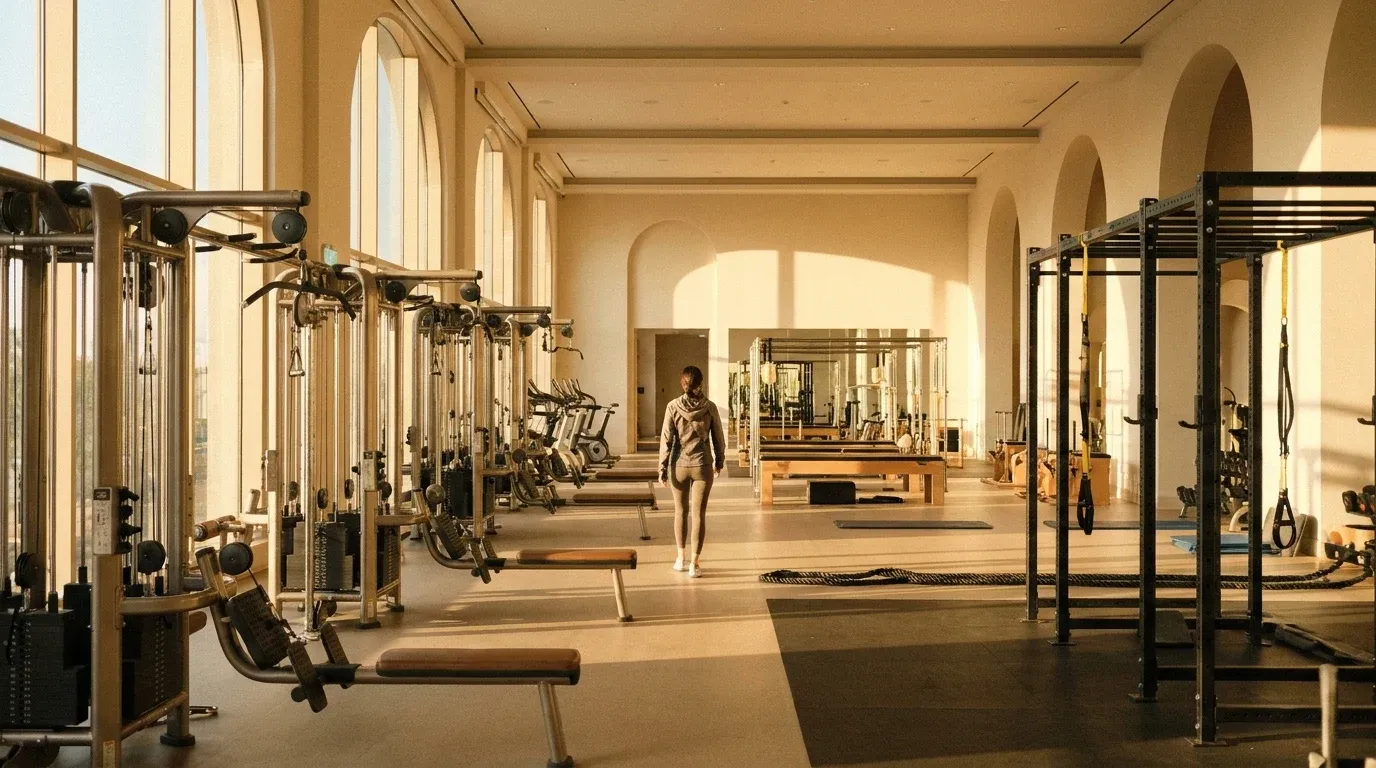
EoS Fitness has never been subtle about its ambitions. The Phoenix-based chain opened 11 new locations in Q3 2026 and signed 12 additional leases, locking in a growth trajectory that few operators in any segment can match right now. But the raw unit count isn't the most interesting part of the story.
What's worth your attention is what EoS is putting inside those gyms. Reformer Pilates classes. HYROX-style training blocks. Programming formats that, until recently, you'd only find at studios charging $30 to $40 per session. EoS is offering them inside a membership that runs well under $30 a month. That's not an incremental tweak. That's a structural challenge to how the fitness industry has always divided itself.
Eleven Locations in One Quarter
Opening 11 gyms in a single quarter requires a level of operational infrastructure that most chains never build. Real estate pipelines, construction timelines, staffing pipelines, equipment procurement at scale. The 12 signed leases running in parallel suggest Q4 2026 and early 2027 will carry a similar pace.
EoS currently operates across Arizona, California, Nevada, Texas, and Florida, with its density concentrated in Sun Belt markets where population growth has consistently outpaced national averages. The new leases point toward further expansion into those corridors and potentially into new states, where mid-market and independent operators will face a well-capitalized, well-branded competitor arriving with a significantly lower price point.
For context on what's at stake across the broader market, the $135B fitness club market breakdown shows exactly where independents hold advantages and where they don't. Spoiler: price competition with an HVLP chain at scale is rarely one of them.
Pilates and HYROX Inside an HVLP Model
The programming additions are the more strategically complex move. Reformer Pilates has been one of the fastest-growing formats in the US fitness market over the past three years, with studio memberships often running $150 to $250 per month. HYROX, the competitive fitness race format combining running and functional exercises, has built a devoted following across Europe and is gaining serious traction in North American markets.
EoS is not running a boutique. It's not charging boutique prices. But it's now offering access to formats that boutique members are currently paying a premium to access elsewhere. That changes the value calculation for a large segment of the fitness consumer population.
This move also reflects something broader happening in the HVLP segment. Operators have historically accepted that you trade programming depth for price accessibility. EoS is testing whether that trade-off is actually necessary, or whether it was just an assumption the industry inherited from an earlier era.
If you're a fitness consumer evaluating your options, this is precisely why keeping your training approach flexible matters more than loyalty to any single format or facility. The best programming available to you is shifting, and it's shifting downmarket in price without shifting down in quality.
The Experience vs. Margin Assumption Is Breaking Down
The traditional HVLP model, built by Planet Fitness and refined by others, operates on a simple premise: high volume, low price, low friction. Cardio equipment, basic strength floors, no judgment, no complexity. The model works because overhead stays lean and memberships stay sticky even among members who rarely show up.
EoS has never been a pure Planet Fitness clone. Its clubs run larger, its equipment selection is broader, and its approach to free weights has always been more serious. But the addition of structured programming formats signals a deliberate move toward what you might call the experience layer. The idea that a $25-per-month member should have access to varied, coached, high-quality training modalities, not just open floor time.
This has real implications for mid-market operators charging $50 to $80 per month for a broadly similar proposition. If EoS can deliver reformer Pilates access and HYROX programming at under $30 a month, the value gap becomes very difficult to defend. YouFit's $10M renovation strategy offers one model for how mid-market clubs can reinvest in differentiation before that gap widens.
The operators most exposed are those whose value proposition sits between HVLP convenience and boutique depth without fully committing to either. That middle position becomes harder to hold as EoS compresses the experience gap from below.
What 2027 Market Entries Mean for Competitors
The 12 signed leases heading into 2027 aren't just a growth metric. They're a signal to every operator in those target corridors that the competitive environment is about to change materially.
EoS's market entry pattern follows a recognizable playbook. It identifies metros with high population density, underserved HVLP supply, and income profiles that skew toward value-conscious consumers. It opens large-format clubs, invests in equipment quality, and prices aggressively to capture market share quickly. By the time local operators fully register the impact, EoS has already built its membership base.
Independent operators who rely on price proximity to HVLP chains as part of their positioning will feel this most acutely. Those who have built genuine community, specialized programming, or demographic niches have more insulation. That's not a new insight, but EoS's 2027 expansion makes it urgent rather than theoretical.
The acquisition activity elsewhere in the sector adds another layer of pressure. Providence's acquisition of Fitness Park shows how consolidation is reshaping competitive dynamics for operators at every scale. HVLP expansion and M&A activity are moving in the same direction simultaneously, compressing the space available to independent and regional operators.
The Membership Math Behind the Strategy
EoS's ability to layer boutique-adjacent programming into an HVLP price point depends on the same fundamental economics that drive every large-format club. High membership volume spread across a large floor means revenue per square foot stays viable even at low monthly rates. When you add programming formats like reformer Pilates, you're adding a draw that increases new member acquisition and reduces churn without dramatically increasing per-club operating costs.
The reformer equipment investment is real, but it's a one-time capital cost spread across a membership base of several thousand members per club. The HYROX programming requires coaching infrastructure and scheduling, but EoS has the staff footprint to absorb it at scale. What looks like a boutique offering from the outside is, operationally, a retention and acquisition tool inside a proven HVLP cost structure.
This is also why the GLP-1 trend running through the broader fitness market is relevant here. As more members enter gyms managing weight-loss medications and looking for structured programming to preserve muscle mass, facilities offering guided, varied formats have a meaningful advantage over open-floor-only environments. Understanding what GLP-1 users actually need from their training helps explain why programming depth is becoming a differentiator, not a luxury.
What EoS Is Actually Proving
Strip away the quarterly metrics and the lease announcements, and what EoS is demonstrating is a testable hypothesis about the fitness consumer. That hypothesis is this: given the choice between a $150-per-month boutique membership and a $25-per-month membership with access to comparable formats, a large segment of consumers will choose the latter. And once they do, they're harder to move back up the price ladder.
This doesn't mean boutique fitness is in trouble. The best boutique studios compete on community density, instructor quality, and social identity in ways that a 40,000-square-foot HVLP club can't replicate. But it does mean the addressable market for boutique-at-scale is real and growing, and EoS is building the infrastructure to own it.
For anyone running a fitness business, training clients, or building programming at a facility, the competitive landscape you're operating in is changing faster than the annual strategic planning cycle can capture. The operators who stay ahead of it will be the ones who understand that price and experience are no longer on opposite ends of the same axis. EoS is making that case with 11 new gyms and 12 signed leases, and it's not done yet.