
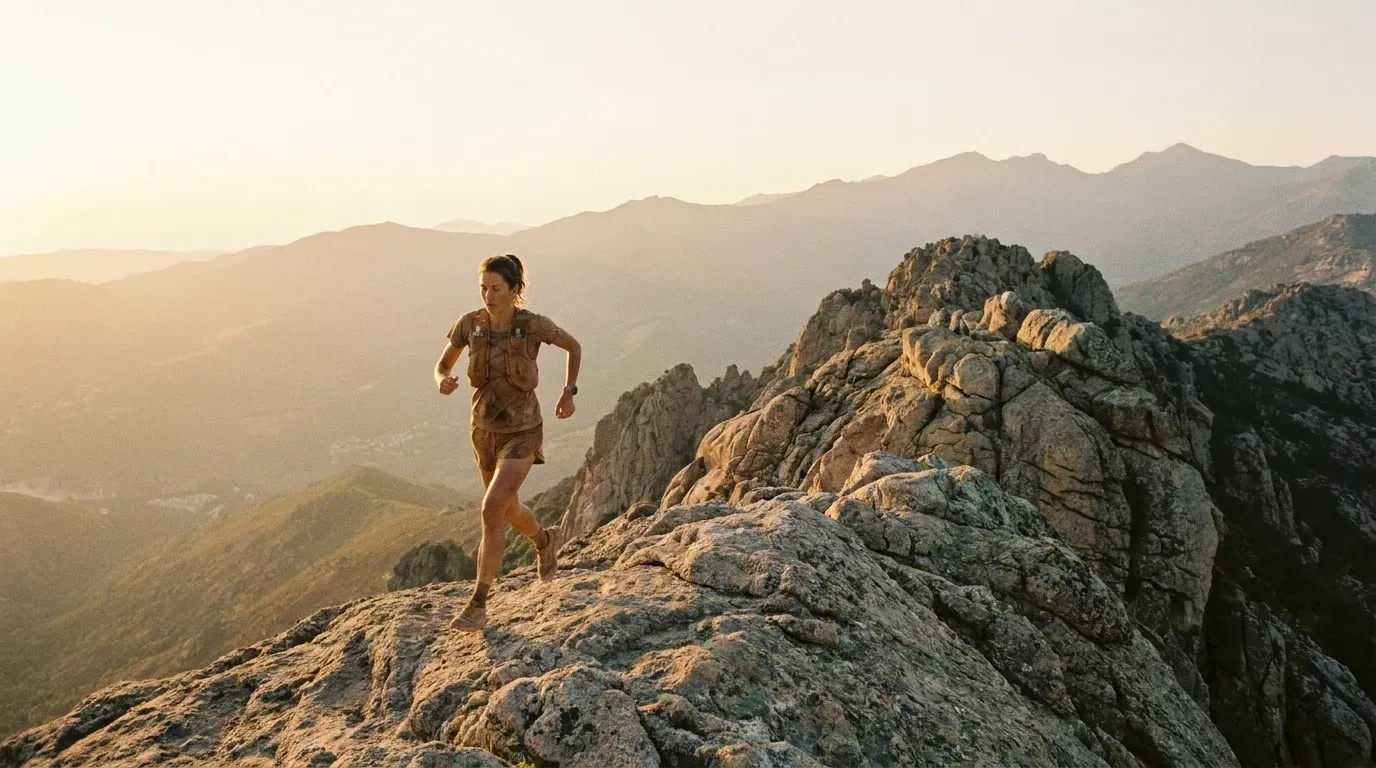
Aurélien Dunand-Pallaz has set a new men's supported Fastest Known Time on Corsica's GR20, one of the most brutally demanding long-distance trails in Europe. The French ultra runner completed the 180-kilometer route in a time that resets the benchmark for what's physically possible on a trail that has humbled even the most decorated mountain runners in the world.
The record isn't just a personal milestone. It's a signal that the GR20 is moving from bucket-list fantasy to competitive arena, and that FKTs as a format are earning serious legitimacy alongside traditional ultra racing.
What the GR20 Actually Demands
The GR20 runs the length of Corsica from Calenzana in the north to Conca in the south. Its 180 kilometers include over 13,000 meters of cumulative elevation gain, with exposed ridgelines, technical scrambling sections, loose granite, and weather that can shift from baking heat to freezing gusts within hours. The trail is not runnable in any conventional sense for long stretches. It requires hands-on-rock movement, careful route reading, and a level of mental endurance that separates it from most European long-distance routes.
The GR20 is regularly cited alongside the Haute Route and the Tour du Mont Blanc as one of Europe's most demanding multi-day trails. What makes it distinct is the relentlessness. There's no easy valley section to recover your legs. The technical terrain persists almost continuously, which means the physiological and psychological demands compound over time in ways that flat-to-rolling ultra courses simply don't replicate.
For runners curious about what it takes to fuel and perform at elevation across multi-day efforts, fueling your runs at altitude breaks down the specific nutritional demands that high-mountain terrain creates, including how caloric needs shift and why standard race-day protocols often fall short.
Dunand-Pallaz and the Record Itself
Aurélien Dunand-Pallaz is no stranger to high-level mountain running. He's a competitive presence in the UTMB circuit and has demonstrated consistent ability across technical alpine terrain. His GR20 attempt was a supported FKT, meaning a crew was permitted to assist him at designated points along the route, providing food, hydration, gear, and pacing support where terrain allowed.
The supported format doesn't diminish the effort. Covering 180 kilometers over 13,000-plus meters of gain at record pace demands athletic output that few runners on the planet could sustain regardless of support. What crew access does is remove the logistical margin for error. Dunand-Pallaz could run closer to his physical ceiling knowing he wouldn't bonk from a missed resupply or suffer from gear failure without a fix nearby.
His record places a new marker on a route where conditions vary enormously between attempts. Heat in the southern sections, ice risk on northern ridges in shoulder season, and trail-finding demands in poor visibility all factor into any GR20 time. Context matters when comparing FKT splits, which is why most serious followers of the format track conditions and season alongside the raw numbers.
Why FKTs Are Becoming Their Own Category
Fastest Known Times have existed in mountaineering and running culture for decades, but the last several years have pushed them into mainstream endurance sport conversation. Part of that shift is structural. Traditional ultra racing has entry lotteries, waitlists, and registration fees that can reach several hundred dollars for premier events. An FKT attempt costs what you make it cost. The trail is public. The format is self-governed.
That accessibility, combined with growing platforms that track and verify records, has made FKTs a legitimate competitive format in their own right. Elite runners are increasingly treating specific FKT targets as seasonal goals rather than casual side projects. Sponsors have noticed. Coverage has followed.
There's also a purity argument that resonates with serious runners. An FKT on a route like the GR20 puts you against the trail and the clock, not a curated race field on a marked course with aid stations every 15 kilometers. The variables are rawer. The self-reliance required, even in the supported category, is greater. For a growing cohort of runners, that's the point.
This trend connects to a broader shift in how competitive runners are defining achievement. Women winning ultras outright in 2026 reflects another dimension of that evolution, where performance metrics are being reframed and new stories are emerging at the sharp end of the sport.
What Makes the GR20 FKT Particularly Compelling
Most high-profile FKTs sit on routes that runners know well from racing: the Appalachian Trail, the John Muir Trail, the Hardrock 100 course. The GR20 is different. There's no major race that follows the full route. There's no established competitive context that runners can reference for pacing benchmarks or course knowledge. Anyone attempting the FKT is working with thinner data and fewer community resources.
That relative obscurity, combined with the route's genuine difficulty, gives the GR20 record a distinct weight. Dunand-Pallaz wasn't chasing a number that dozens of elite runners had previously targeted with full race-level preparation. He was moving on terrain that demands respect on its own terms.
The route also has growing appeal among recreational trail runners planning multi-day traverses. Most hikers take 15 days to complete the GR20. Elite trekking parties might push it to 10 or 11. The FKT conversation happening at the top end is creating downstream interest among runners who want to attempt the route fast-packing style, covering it in four to six days with lightweight gear and disciplined daily mileage.
Training Implications for Runners Targeting Big Routes
If Dunand-Pallaz's record inspires you to consider the GR20, or any comparable technical mountain route, the training implications are worth thinking through clearly. Speed on this kind of terrain isn't primarily about cardiovascular fitness. It's about strength, stability, and the ability to move efficiently over unpredictable surfaces while fatigued.
Lower-body strength, particularly hip stability, single-leg control, and eccentric quad strength for descents, matters more over 13,000 meters of gain and loss than it does on a road ultra. Runners who neglect strength work find their technique deteriorating on technical terrain long before their aerobic engine gives out. Building that foundation takes time, which is why what elite running coaches actually do differently often comes down to structuring strength work around sport-specific demands rather than treating it as an optional add-on.
Recovery capacity across consecutive days is the other variable. The GR20 isn't a single-day effort for almost anyone. Training needs to include back-to-back long runs and time on your feet in conditions that approximate the demands of the route. Single-day peak efforts tell you relatively little about how your body will respond on day three or four of consecutive mountain running.
Nutritional preparation is equally specific. High-altitude, high-output efforts require caloric intakes that most runners underestimate, and the practical challenge of consuming enough food while moving over technical terrain adds another layer. Getting this right in training, not just on race day or during an FKT attempt, separates runners who perform consistently from those who blow up mid-route.
The Broader Moment for Trail Running
Dunand-Pallaz's record lands at a moment when trail running's competitive ecosystem is expanding rapidly. New events, new formats, and new audiences are creating space for performances that don't fit the traditional race model to receive genuine recognition. FKTs on iconic routes are part of that expansion.
The GR20 now has a men's supported benchmark that serious runners can orient toward. That benchmark will likely be challenged. Routes with newly established or recently broken FKTs tend to attract focused attempts from runners who see a realistic target. The competitive dynamic that makes road marathon records compelling, the sense that a number is known and beatable, now applies to Corsica's most demanding trail.
If you're building toward a big autumn target, autumn 2026 road races worth signing up for right now covers the calendar events that are still open for registration and worth your training block. For longer-term ambitions on routes like the GR20, the work starts well before the attempt. The trail will tell you whether you did enough.