
There are ultramarathons, and then there is the Hardrock 100. Every year, thousands of runners enter a lottery for a race that will almost certainly break them. The odds are brutal. The course is worse. And somehow, that's exactly the point.
As the 2026 edition draws renewed attention from the trail running world, it's worth asking what this race actually represents. Not just as a physical challenge, but as a cultural phenomenon that sits at the heart of what extreme trail running means.
A Course Built to Humble You
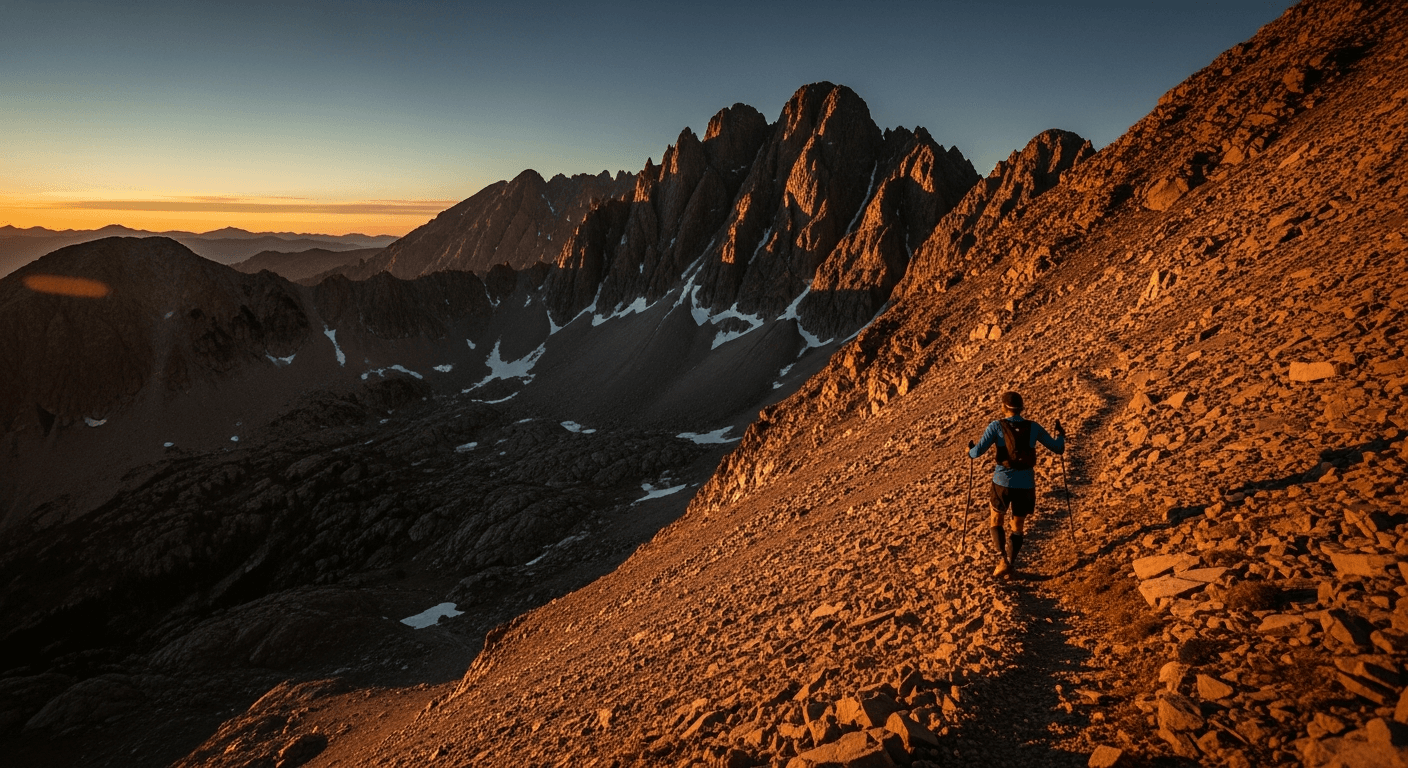
The Hardrock Hundred Mile Endurance Run takes place in the San Juan Mountains of southwestern Colorado, a range that doesn't apologize for itself. The course covers 100 miles of high-altitude terrain with over 33,000 feet of elevation gain. For reference, that's roughly equivalent to climbing Mount Everest from sea level and then doing it again, partially.
The average altitude sits above 11,000 feet, with the course topping out above 14,000 feet at multiple points. You're not just running. You're navigating technical scrambles, river crossings, and exposed ridgelines where weather can shift from clear skies to lightning in under an hour.
The cutoff time is 48 hours. Not because the race is easy. Because it is genuinely that hard to finish within that window. Completion rates often hover around 70 percent in good conditions, and significantly lower when the mountains decide otherwise. Every runner who crosses the finish line kisses a bronze boar sculpture. It's one of those traditions that sounds odd until you've earned it.
The Lottery That Fuels the Legend
You cannot simply sign up for Hardrock. Entry is determined by a weighted lottery system that rewards repeat applicants and previous finishers, but offers no guarantees to anyone. In recent years, acceptance rates for first-time applicants have dropped below 5 percent. That's a rejection rate that makes elite university admissions look generous.
This scarcity is not accidental. The race is capped at around 150 runners, largely to protect the fragile alpine environment of the San Juans. The Hardrock Hundred Memorial Foundation works in close partnership with land management agencies, and the permit constraints are real. But the practical effect of that cap is mythological. Runners spend years, sometimes over a decade, collecting lottery tickets before they get their shot.
That waiting period does something interesting to the race's culture. By the time most people toe the start line in Silverton, Colorado, they've been dreaming about it long enough that the event carries a weight most races simply can't manufacture. You're not just running 100 miles. You're running the 100 miles you've been waiting years to run.
Adventure Over Speed: The Hardrock Ethos
If you follow competitive trail running, you know that the sport has professionalized rapidly. Prize money, sponsorships, timing chips, and broadcast deals have transformed events like UTMB into spectator sports with global audiences. Why Some Race Directors Are Making Marathons Harder on Purpose speaks to a broader tension in endurance sport between accessibility and challenge. Hardrock lives firmly on the challenge side of that line.
There is no prize money at Hardrock. There is no official course record chasing. The culture of the race actively resists the metrics-first mindset that dominates so much of modern endurance sport. The fastest known times are tracked informally, but they're not the point. Runners here are not optimizing splits. They're navigating wilderness.
This stands in sharp contrast to the professionalization happening elsewhere in fitness and endurance sports. Events built around measurable performance benchmarks have seen massive participation growth. But Hardrock has maintained its character precisely by refusing to chase that model. The race rewards presence, patience, and mountain sense over raw speed.
That ethos attracts a specific type of runner. Not necessarily the fastest. Often not even close. But deeply committed to the experience of suffering through something vast and largely indifferent to their ambitions.
What Road Racing Can't Give You
Road racing has its own pull, and it's real. The crowd support at a major marathon, the flat courses designed for personal bests, the chip timing and corral systems built for efficiency. Research consistently shows that structured road events help runners hit pacing targets. Studies on marathon performance have found that men hit the wall twice as often as women in marathons, a gap driven largely by early pacing errors that structured courses and race support help manage.
Hardrock offers none of that scaffolding. There are no crowds cheering you through mile 60 at 2 a.m. on a remote ridgeline. There's no pacer until you've arranged one yourself. The aid stations are sparse, the navigation is your responsibility, and the mountain genuinely does not care about your finish time.
That absence is the draw. Runners who come to Hardrock aren't looking for a supported performance environment. They're looking for something closer to an expedition. The race forces a kind of self-reliance and present-moment focus that road racing, for all its strengths, simply can't replicate. You're making decisions constantly. Route choices, nutrition timing, layering up before a storm hits. The mental load is as significant as the physical one.
For many participants, the race functions as a deliberate counterweight to modern life. No signal, no metrics dashboard, no optimization. Just you, the mountain, and the next checkpoint.
The Community Built Around Shared Suffering
One of the less-discussed elements of Hardrock's appeal is what happens before and after the race itself. The town of Silverton, population under 700, transforms into a temporary village of trail runners, crew members, and pacers for race week. People who've been strangers online for years meet in person. Veterans offer route advice to first-timers. The community that forms around the event has a texture you rarely find in larger, more commercial events.
This isn't unique to Hardrock, but the race's small scale and difficult entry amplify it. When 150 runners share a starting line, and when most of those runners have waited years to be there, there's a density of intention and respect that feels different. People genuinely want each other to finish.
The pacers and crew play a significant role in this. Runners are allowed to bring pacers for portions of the course, and many of those pacers are experienced Hardrock finishers who return year after year to help others through the hardest miles. The knowledge transfer that happens in those night hours, somewhere above treeline with headlamps cutting through the dark, is part of what makes the Hardrock community genuinely tight.
The 2026 Edition and What It Means
The 2026 Hardrock 100 arrives at a moment when the broader trail running world is processing some significant shifts. Participation in endurance events of all kinds is up. Events built around measurable functional fitness have seen enormous growth. But so has interest in the kind of raw, unmediated wilderness experience that Hardrock represents.
There's a conversation happening in endurance sport about what different formats actually offer. Richmond Half Marathon Sells Out for the 3rd Year in a Row, pointing to sustained appetite for structured road events. At the same time, the waitlists and lottery entry pools for technical mountain ultras continue to grow. Runners aren't choosing one or the other. Many are doing both, using road events to build fitness and using races like Hardrock as a kind of north star.
What the 2026 edition specifically adds to the conversation is timing. Trail running as a sport is more visible than it's ever been. Media coverage, elite athlete platforms, and documentary filmmaking have brought events like Hardrock to audiences who'd never heard of the San Juans. That visibility brings new entrants into the lottery pool, increases the cultural weight of the race, and raises real questions about how a deliberately small, environmentally constrained event maintains its identity as interest scales.
So far, the answer has been: carefully. The race has resisted expansion. It has maintained its permit limits and its low-key presentation. It hasn't chased sponsorship dollars that would reshape its character. Whether that holds as the sport grows is one of the more interesting questions in trail running right now.
Why Runners Keep Coming Back
Ask anyone who's finished Hardrock what the experience was like, and you'll rarely get a clean answer. The standard response is some version of: it was the hardest thing I've ever done, and I'm already trying to get back in.
That tells you something important. The race isn't appealing despite its difficulty. It's appealing because of it. The suffering is not incidental. It's the mechanism through which runners access something that's increasingly scarce: an experience that can't be optimized, purchased, or abbreviated. You have to go through all of it.
For runners who've spent years chasing finish-time goals, Hardrock represents a reset. A reminder that the mountains don't negotiate. And that sometimes, the most meaningful athletic experiences are the ones where the outcome is genuinely uncertain until the very end.
That's not a niche appeal. That's a deeply human one. And it's why the Hardrock 100 will keep drawing runners who are willing to wait years for their shot at 48 hours of type-two misery in one of the most beautiful places on earth.