
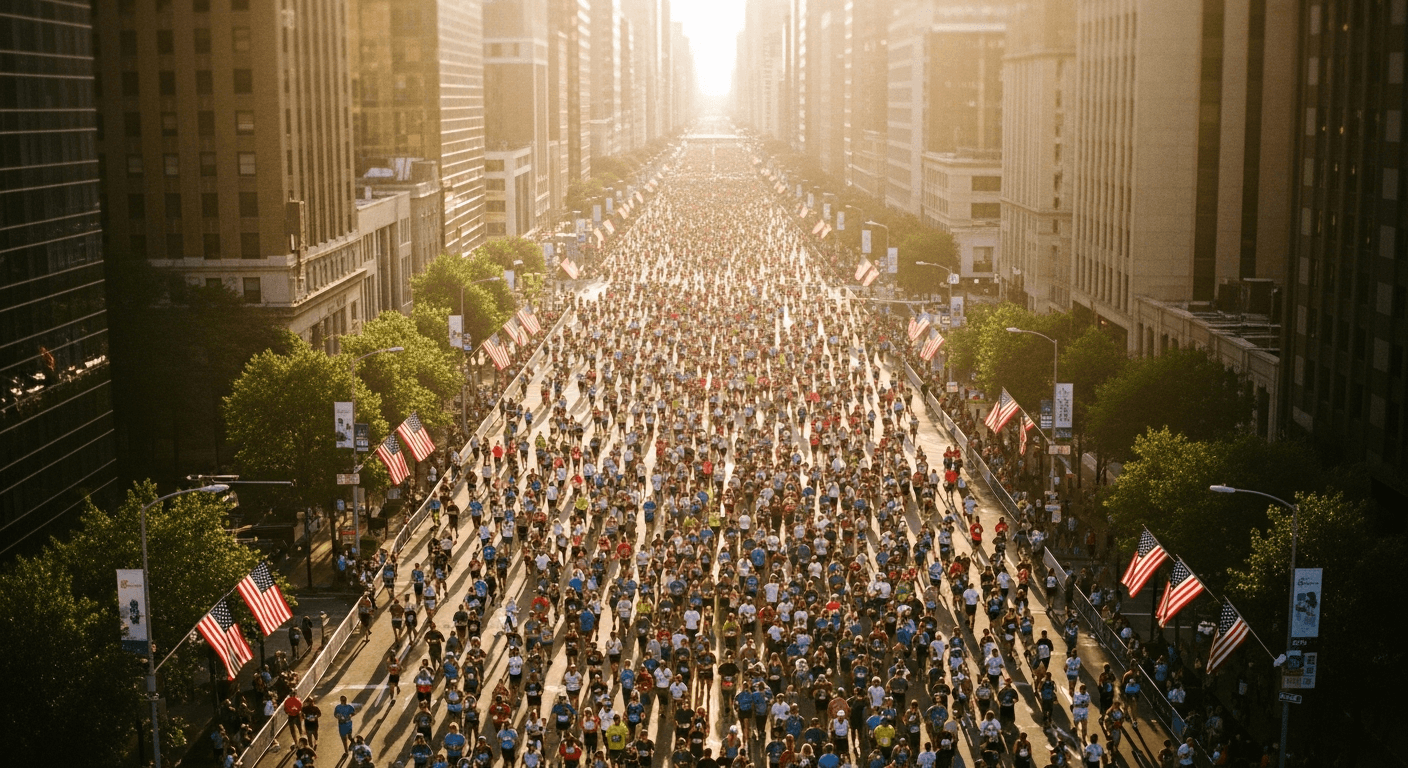
America's 250th birthday didn't just bring fireworks and flags. It brought runners. Millions of them. On July 4, 2026, the United States experienced the largest single-day participation event in the history of recreational road racing, and the data behind it tells a story that goes well beyond one exceptional holiday.
RunSignup, the race registration platform that processes a significant share of U.S. running events, reported a 39% increase in race participants on July 4, 2026 compared to the same date in 2025. That is not a rounding error. That is a structural shift in how Americans think about running, community, and national identity, all in a single morning.
Two Factors That Made 2026 Impossible to Ignore
To understand why the numbers jumped so sharply, you need to look at what made this particular July 4th different from any other in recent memory. Two things converged at once.
First, the USA Semiquincentennial, the 250th anniversary of American independence, gave race organizers a marketing moment that only comes around once in a lifetime. Local running clubs, city governments, and national race brands all leaned into the occasion. New events launched. Existing events rebranded. The cultural energy was real, and it pulled casual runners off their couches and onto start lines.
Second, July 4th fell on a Saturday in 2026. This matters more than it might seem. When the holiday lands mid-week, participation drops because of work schedules, travel logistics, and general fatigue. A Saturday holiday removes every practical barrier. You can race at 8 a.m., finish by 10, and still have the entire day ahead of you. That calendar alignment alone typically adds a meaningful bump to participation. Combined with the anniversary, it was a perfect storm.
Supply Expanded to Meet the Surge
Here's where the data gets even more interesting. The number of races held on July 4th didn't just grow slightly. It jumped 55% year over year. That means organizers were anticipating demand, not scrambling to catch up with it.
This kind of supply expansion is unusual in the running industry. Launching a race requires permits, insurance, timing equipment, volunteers, and months of planning. A 55% increase in new or relocated events signals that race directors, municipalities, and running organizations collectively decided 2026 was a moment worth investing in. That level of institutional commitment doesn't happen by accident.
It also suggests that the barrier to launching community running events has continued to lower. Registration platforms, digital marketing tools, and the normalizing of smaller neighborhood races have all made it more accessible for a local running group to put on a certified 5K without a six-figure budget.
It Wasn't Just New Events. Established Races Got Bigger Too.
The most telling number from RunSignup's data isn't the 39% participant surge or the 55% race count increase. It's the quieter statistic: existing races grew by an average of 9.9%.
That figure matters because it separates novelty from depth. If all the growth came from brand-new races, you could reasonably argue that the numbers were inflated by one-off events that might not survive beyond 2026. But when established races, events with track records and loyal participant bases, also grow by nearly 10% in a single year, that signals something different. It signals that runners who were already engaged became more engaged. And that new runners found their way into events that already had community infrastructure waiting for them.
For the running industry, that's the healthiest kind of growth. It compounds. A runner who finishes their first 4th of July 5K at an established local race is far more likely to sign up for that same event next year than someone who completed a hastily organized new race with few amenities and poor course logistics.
The Bigger Picture: Community Running Is Rebounding
The July 4th numbers don't exist in isolation. They're part of a broader pattern that has been building since 2023, as the running industry worked through its post-pandemic stabilization period.
During 2020 and 2021, in-person races collapsed almost entirely. Virtual events filled some of the gap, but they couldn't replicate the social energy of a mass start. From 2022 onward, participation slowly recovered, but it was uneven. Big marathons bounced back quickly. Smaller community 5Ks took longer, partly because they depend on volunteer networks and local sponsor support that had atrophied during the shutdowns.
What the 2026 data suggests is that the recovery phase is over. Community running isn't just back. It's operating at a level that exceeds pre-pandemic benchmarks in many categories. If you've been watching London Marathon's decision to expand to a two-day format to accommodate 100,000 runners in 2027, you can see the same pattern playing out globally. Demand for organized running events has reached a point where legacy infrastructure simply can't contain it anymore.
What This Means for Runners Right Now
If you run, or you've been thinking about starting, the current moment is genuinely favorable. Race options have expanded. Entry-level events are easier to find than at any point in the last decade. And the social infrastructure around community running, pace groups, free training programs, local clubs, is more robust than it was even five years ago.
For runners who are already training seriously, the growth in community events also creates a useful structure. If your longer-term goal is something like a trail ultra, it helps to stay connected to shorter events throughout the year. The 5K and 10K formats that dominate July 4th racing are excellent opportunities to work on turnover, test race-day nutrition, and stay calibrated to competitive effort levels.
Speaking of training structure, new injury science is challenging the conventional 10% weekly mileage increase rule, which is worth understanding if you're ramping up your volume to prepare for a fall race season. The old guideline is more nuanced than most runners realize, and building smart is always more important than building fast.
The Data Also Points to a Demographic Shift
RunSignup's participation numbers don't just capture how many people are running. They also reflect who is running. Industry observers have noted that the post-2022 recovery in community racing has been driven significantly by first-time and returning participants, not just the hardened racing regulars who never stopped.
Younger runners in their 20s and early 30s, many of whom picked up running during pandemic lockdowns as a solo activity, are now gravitating toward organized events. They grew up with fitness as a social experience through group fitness classes and gym culture, and they're bringing that expectation into road racing. They want the event, the community, the photo at the finish line, and the post-race gathering.
This demographic appetite for running as a social experience rather than just an athletic pursuit is reshaping how events are designed and marketed. Race organizers are investing more in finish line experiences, post-race food and music, and curated course scenery. The race itself is almost secondary to the morning it creates.
That same instinct toward community and shared challenge is also showing up in other formats. The growth of obstacle and fitness racing events, as documented in recent HYROX race results from Hangzhou 2026, reflects an overlapping audience that wants structure, competition, and collective experience all at once.
What Race Organizers Should Take From This
If you're involved in organizing running events, the 2026 data offers a clear message. The appetite is there. The question is whether the infrastructure and experience quality can keep pace with it.
Runners who enter events for the first time in 2026 are forming opinions about what organized racing feels like. If the experience is good, they'll return. If the logistics are poor, the course is poorly marked, or the finish line feels like an afterthought, they may conclude that racing isn't for them and retreat back to solo runs. Retention starts at the first event.
There's also a practical consideration around training support. More participants, especially new ones, means more runners who are undertrained, underprepared, or unfamiliar with how to build safely toward race day. Understanding physiological differences in how runners manage sustained effort is one piece of that puzzle, and it points to a broader need for better education integrated into the registration and pre-race communication process.
A Movement With Momentum
The 39% participant increase, the 55% jump in race count, the 9.9% growth in established events. These aren't isolated metrics. They're a single, coherent signal: community running in America is in the middle of a genuine resurgence, and 2026's July 4th weekend may be the clearest evidence of that yet.
The 250th anniversary gave the moment a flag to rally around. But the underlying trend was already building. What happens next depends on whether the industry can sustain quality as the numbers grow, and whether the runners who showed up for the first time this July decide to keep showing up.
If the history of running is any guide, most of them will.