
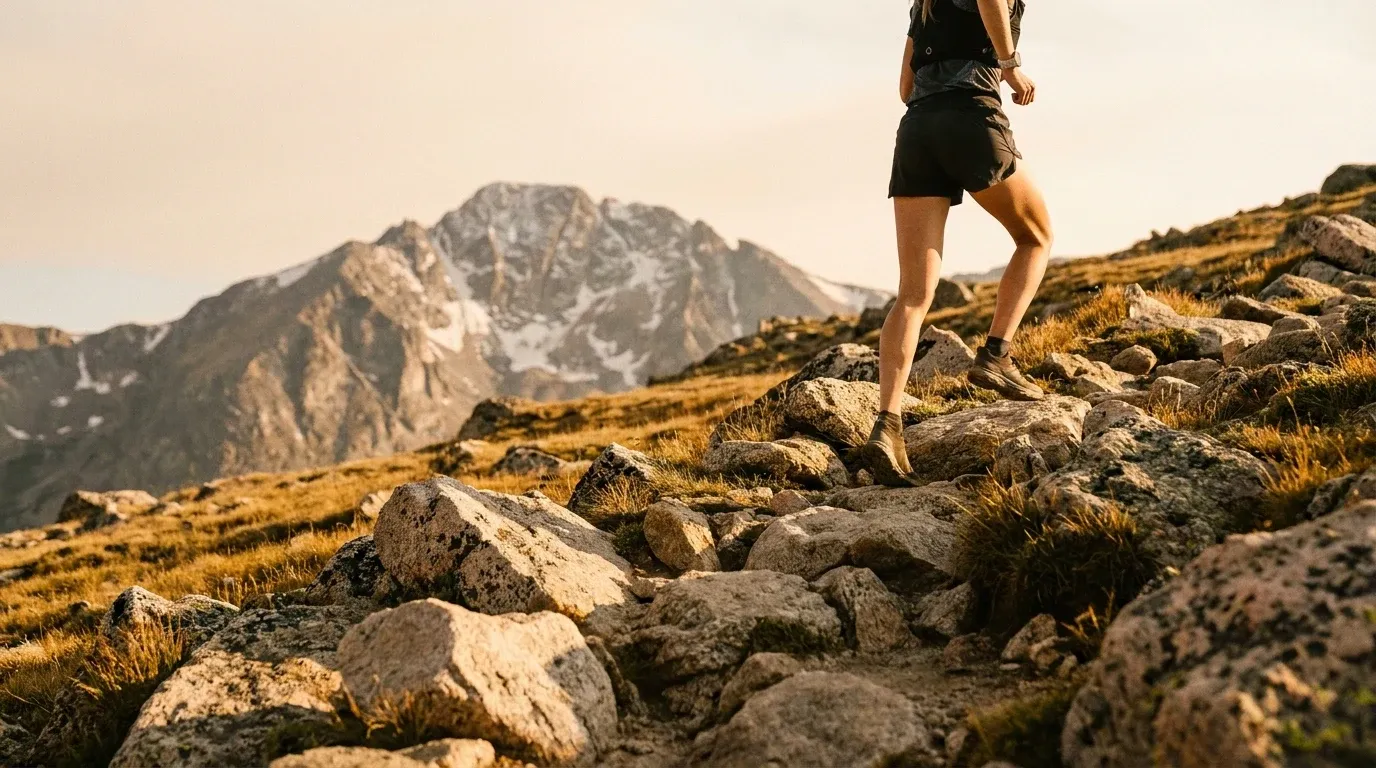
On October 3, 2026, Jane Maus stood at the summit of Longs Peak, Colorado, having just rewritten what's possible for women in high-altitude mountain running. Her new Fastest Known Time on one of the Rockies' most unforgiving routes sent an immediate signal through the trail running community: the standard had shifted.
This wasn't a race with aid stations, crowds, or timing mats. It was a solo effort against the clock on a peak that demands technical competence, altitude tolerance, and tactical precision in equal measure. Here's how she did it, and what her run reveals about the discipline of FKT attempts at the highest level.
Why Longs Peak Matters
Longs Peak sits at 14,259 feet in Rocky Mountain National Park and is Colorado's most northerly fourteener. What separates it from other high-altitude objectives isn't just the elevation. It's the Keyhole Route, which involves exposed scrambling, narrow ledges, and a final push up the Homestretch, a steep slab of granite that demands hand-and-foot movement in thin air.
The round trip from the trailhead clocks in at roughly 15 miles with around 5,000 feet of elevation gain. For context, most runners finishing strong mountain ultras are working at altitudes significantly below Longs Peak's summit. The air at 14,000-plus feet contains roughly 60% of the oxygen available at sea level, and the body's ability to sustain high-intensity effort drops sharply with every thousand feet gained.
Setting a women's FKT here carries real weight. The route's technical sections filter out pure speed merchants. You need scrambling confidence, sound route-finding, and the composure to move fast without rushing into dangerous decisions. That's a rare combination, and it's part of why the women's record on Longs Peak is considered one of the more meaningful benchmarks in American mountain running.
The broader growth of competitive women's mountain efforts has been striking. Women-only running events are booming across the US and globally, reflecting a wider shift in how women are engaging with endurance sport at every level, from community fun runs to elite FKT attempts.
The Anatomy of an FKT Attempt
Unlike a sanctioned race, an FKT attempt strips away all external support structures. There's no aid station crew handing you a cup of broth at mile 10. There's no race director managing the course, no medical tent, no other competitors to pace off. Every decision, from what you eat to when you push and when you hold back, falls entirely on the athlete.
That creates a specific kind of pressure. In a race, the infrastructure makes certain decisions for you. In an FKT, strategic errors compound quickly with no mechanism to correct them mid-effort.
Maus's preparation involved months of altitude-specific training, with regular visits to Colorado's high-elevation terrain to acclimatize and build route familiarity. Knowing where to move fast and where to slow down on technical sections isn't improvised. It's the result of repeated exposure. Sources close to her effort described a multi-week block of training above 10,000 feet leading into October, timed to sharpen altitude adaptation without accumulating excessive fatigue before the attempt itself.
Gear selection on an FKT attempt at altitude involves genuine trade-offs. Carrying enough clothing for a weather turn can cost you minutes. Carrying too little is a safety risk on a summit that sees rapid afternoon storms, particularly in late season. Maus reportedly ran with a compact emergency shell, a single handheld bottle supplemented by a soft flask, and a minimal pack. Every gram on that route at that altitude is a metabolic cost.
Pacing Strategy at Altitude: What the Data Tells Us
High-altitude pacing is counterintuitive for athletes trained primarily at lower elevations. The impulse on a fast attempt is to push hard from the start, but research on hypoxic performance consistently shows that athletes who go out too aggressively above 12,000 feet pay a steep price in the second half of their effort, particularly as they hit the technical crux sections where physical and cognitive demands peak simultaneously.
The optimal strategy on a route like the Keyhole is to run conservatively through the lower forested section, preserve neuromuscular reserves for the technical scrambling above the Boulder Field, and then open up on the descent where altitude stress reduces and the body can finally operate closer to its sea-level capacity.
This mirrors principles you'd apply to any well-structured mountain effort. Understanding how to build and taper into a peak performance window is critical. The logic behind peak week preparation in marathon training applies in modified form here too: arrive at your attempt day fresh, sharp, and primed, not depleted from a final block of heavy training.
Maus's split times, as reported by observers who tracked her effort, showed a disciplined early pace through the Keyhole approach, with time gains coming decisively on the descent. That's not a coincidence. It reflects a tactical blueprint designed around the route's specific demands rather than a generic fast-is-fast approach.
The Conditions That Opened the Window
October is a narrow window on Longs Peak. The summer crowds are gone, trails are quieter, and the early morning temperatures, while cold, are often stable. The risk of afternoon thunderstorms, which force many summer attempts to abort near the summit, drops meaningfully in early fall.
The October 3 date was not arbitrary. Weather windows on fourteeners are carefully monitored, and sources indicate Maus and her support team tracked forecasts closely in the days leading up to the attempt. Clear skies, low winds at summit level, and dry rock conditions on the Homestretch created a technical environment where speed was possible without undue risk.
Cold temperatures at altitude also have a physiological upside. Overheating is a genuine performance limiter in endurance sport, and running in cooler conditions allows athletes to sustain higher intensities for longer before heat stress becomes a factor. At 14,000 feet in early October, that's a meaningful advantage for someone moving at FKT pace.
Strength and Resilience Behind the Attempt
What doesn't show up in the FKT listing is the physical preparation that underpins an effort like this. Mountain running at elite level demands more than aerobic fitness. It requires the single-leg stability, hip strength, and lower-body resilience to handle thousands of feet of technical descent without the form breakdown that leads to injury or a dramatic slowdown in the final miles.
Strength training, specifically the kind that builds functional stability under load, is increasingly embedded in elite trail runners' programs. Research has consistently linked resistance training to reduced injury rates and improved running economy, and there's growing evidence of its impact on mood and mental resilience too. A study on weightlifting's effects on depression in women found significant psychological benefits, an underreported dimension of why strength work makes athletes more durable across long, grueling efforts.
Endurance athletes who absorb a serious setback and rebuild are a particular source of insight about what physical resilience actually looks like in practice. Paul Wilson's return to ultra-distance running after a shattered leg is a striking example of what a structured, patient rebuilding process can produce.
What This Record Means for Women in Mountain Running
FKTs sit in an interesting space in endurance sport. They're self-reported, unsanctioned, and reliant on community trust and GPS verification. But they function as genuine performance benchmarks, especially on routes like Longs Peak where the technical and physiological demands are so clearly defined.
Maus's record raises the visible ceiling for what women are doing on high-altitude technical terrain. It shifts what other athletes believe is achievable, and that effect on collective ambition is real. The women's field in trail and mountain running has deepened significantly over the past several years, with more athletes training specifically for mountain objectives rather than treating them as extensions of road or flat-trail performance.
If you're looking at your own trail running calendar for fall, the kind of mountain-specific fitness Maus demonstrated doesn't emerge from road miles alone. October trail races offer a useful target window for building toward bigger mountain objectives, giving you both competitive experience and altitude exposure before winter shuts down high-terrain access.
The Longs Peak women's FKT is now a different number. And the athlete who set it built toward it the way serious mountain runners do: methodically, patiently, and with a complete strategy for the specific demands of the route. That's the standard now.