
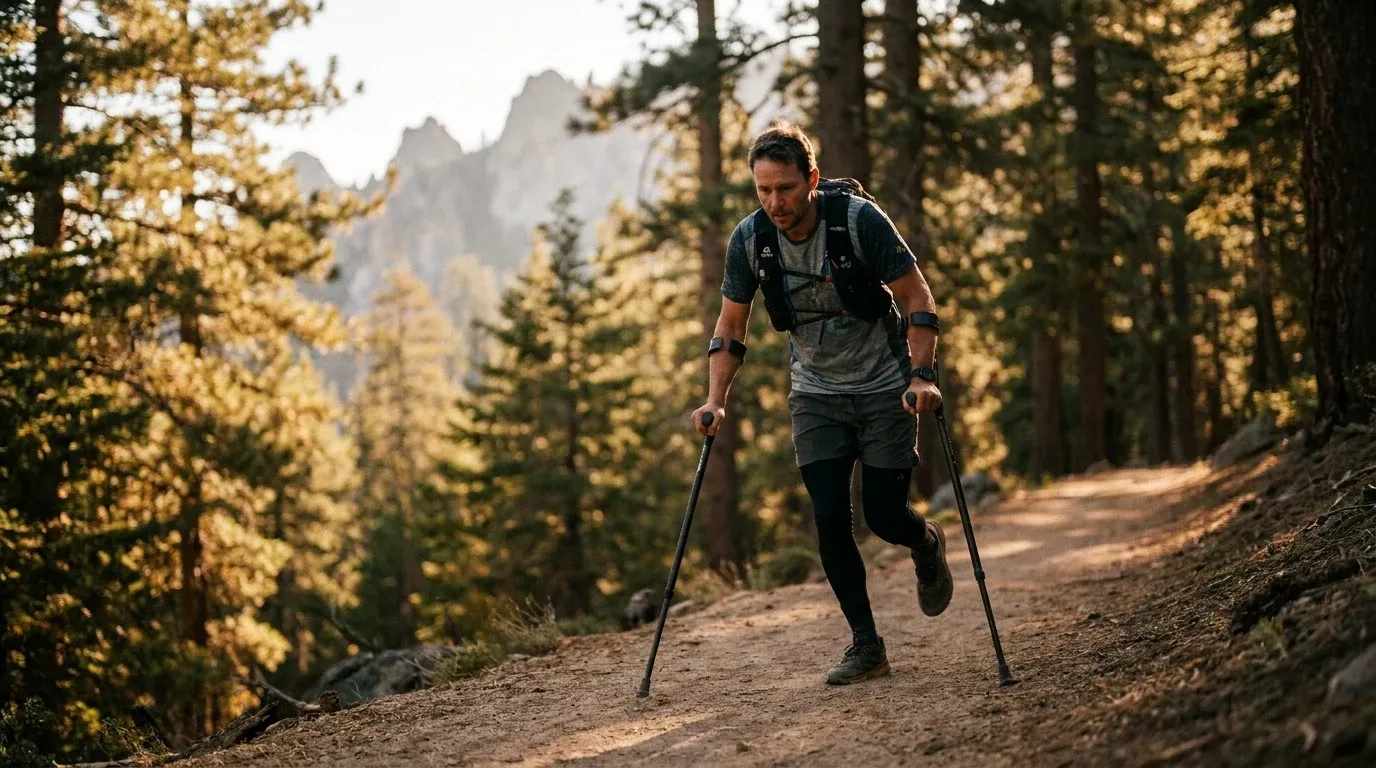
Trail running has long prided itself on being a sport for everyone. Rugged, egalitarian, indifferent to pace. But when it comes to formal competitive structures for para athletes, the sport has quietly trailed behind road racing for years. That gap just got a little smaller.
Mammoth Trailfest, held in Mammoth Lakes, California, has introduced what is being reported as the world's first dedicated prize purse for para athletes in a trail running event. It's a modest but meaningful step. And in a sport currently experiencing its biggest participation surge in a decade, the timing matters.
Why This Milestone Took So Long
Road racing normalized para athlete prize money years ago. The Boston Marathon has offered a separate prize structure for wheelchair divisions since the 1970s, and most major city marathons followed suit. Track and field has its own well-established Paralympic infrastructure. Trail running, by contrast, has been slow to formalize anything comparable.
The reasons aren't purely cultural. Trail running's terrain creates genuine logistical complexity that road events don't face. Variable surfaces, significant elevation gain, exposed ridgelines, and course conditions that can shift dramatically mid-race all create barriers that are harder to navigate than a flat urban course. Adapting those environments for competitive para athletes requires course-specific planning, equipment considerations, and category definitions that race directors haven't historically been equipped or incentivized to develop.
That's not an excuse. It's context. The infrastructure challenge is real, but it's also solvable. Mammoth Trailfest appears to have decided that waiting for a perfect solution was no longer a reason to delay a necessary one.
What Mammoth Trailfest Actually Did
The event, set against the eastern Sierra Nevada at elevations that test even elite able-bodied runners, introduced prize money specifically allocated for para athletes competing across its race distances. The purse structure mirrors the approach used for open and age-group categories, signaling that para divisions aren't being treated as an afterthought or a PR gesture.
Competing at altitude adds a layer of physiological demand that affects every athlete on the start line. For para athletes using handcycles, racing wheelchairs, or adaptive prosthetics, the altitude variable compounds the physical challenge considerably. If you're planning a race at elevation, understanding what that environment does to your body is worth your time. Eating at Altitude: What Actually Changes for Your Body breaks down the physiological shifts you'll face and how to adjust your approach before and during a mountain event.
Mammoth Trailfest's decision to offer prize money at altitude, rather than at a lower-stakes, flatter venue, sends a clear message. It's not treating para competition as a soft introduction. It's integrating it into the full challenge of the sport.
The Road Racing Gap and What It Reveals
The contrast with road racing is instructive. Para athletes competing in major marathons can earn significant prize money. The six World Marathon Majors collectively offer prize structures that treat wheelchair and handcycle divisions as legitimate competitive fields, not symbolic additions. Some elite wheelchair racers earn well into six figures annually from prize money and sponsorships combined.
Trail running has produced no comparable ecosystem. There's no established circuit, no consistent prize structure, and historically no formal governing body mandate requiring para athlete inclusion in competitive purses. Athletes who have competed in trail ultras as para athletes have often done so without any financial recognition, regardless of their performance level.
This is partly a function of trail running's organizational culture. The sport grew from a grassroots, low-overhead tradition where even open elite prize money was modest or absent entirely. Events like Western States 100 and UTMB only formalized significant prize purses relatively recently. Run Rabbit Run 100's record-setting performances illustrated how the sport's elite tier is professionalizing. Para athlete prize structures are the next logical layer of that professionalization.
A Sport in the Middle of Its Biggest Boom
Trail running's participation numbers have risen sharply since 2022. Race registrations across North America, Europe, and Australia have hit records in multiple consecutive years. Shorter trail distances, from 5K to half marathon formats, have pulled in new runners who might have otherwise defaulted to road events. The sport is no longer niche.
That growth creates both an opportunity and a responsibility. When a sport's audience and participant base expands this quickly, the structures it builds during that expansion tend to stick. If trail running normalizes para athlete prize purses now, while the boom is still accelerating, those structures become baseline expectations rather than exceptions. If it waits, it risks calcifying the same exclusion that took road racing decades to address.
The evidence from road racing suggests that inclusion drives participation. When para athletes see competitive legitimacy reflected in prize structures, more para athletes train toward those competitions. That increases field depth, which increases competitive quality, which increases media attention, which grows the sport further. It's a cycle that trail running hasn't yet unlocked, but Mammoth Trailfest's move is a functional first step.
The sport's expansion is also happening at a moment when elite performances are reaching new heights. Americans sweeping the IAU 100K World Championships signals that trail and ultra running talent is deepening globally. A broader, more inclusive competitive structure would only accelerate that development.
What Needs to Follow
A single prize purse at a single event is a starting point, not a solution. For this moment to matter beyond its symbolic value, other race organizations need to follow and they need to do it without waiting another decade.
Several things would help translate this milestone into structural change:
- Standardized para athlete categories across trail events. Road racing has established category frameworks. Trail running needs something comparable, developed in consultation with para athletes and adaptive sports organizations.
- Course access planning built into race design. Prize money means little if course conditions make competition impractical. Race directors need to work with adaptive athletes during course development, not after.
- Governing body leadership. Organizations like World Athletics and the international trail running association need to formalize inclusion standards rather than leaving it to individual race directors to decide whether para athletes are worth recognizing.
- Sponsor alignment. Much of elite trail running's prize money flows from brand sponsorships. Brands that already invest in para athlete marketing on the road side have a clear incentive to extend that investment to trail events, but someone needs to make the ask explicitly.
None of this is technically difficult. It requires coordination, commitment, and the willingness to move before there's external pressure to do so.
What This Means for the Broader Running World
Trail running's relationship with inclusion has always been complicated. The sport's appeal is partly its rawness, its resistance to the over-produced, sponsor-saturated atmosphere of big city road races. But that identity has sometimes been used, consciously or not, to justify a lack of structure that benefits certain athletes and marginalizes others.
The sport doesn't have to choose between its grassroots identity and competitive inclusion. Those things aren't in conflict. A trail race can still feel wild and unpredictable and demanding while also ensuring that para athletes have a formal, financially recognized place in the competitive field.
If you're training for any competitive trail event right now, the fundamentals still apply regardless of category. Building aerobic capacity through consistent, lower-intensity work is the foundation that everything else sits on. Why Your Easy Runs Are Your Most Important Runs makes the case for why the unsexy training sessions are often the most consequential ones, a principle that holds whether you're running your first trail 10K or preparing for a multi-day mountain event.
And if you're racing soon, the two-week countdown to your fall race covers how to manage both the physical taper and the mental load that builds in the final stretch before a big effort.
The Finish Line Isn't Here Yet
Mammoth Trailfest deserves recognition for moving first. That takes organizational courage in a sport that hasn't historically prioritized this kind of structural change. But the finish line isn't a single event offering prize money. It's a trail running landscape where para athlete competition is expected, funded, and celebrated at events of every size and distance.
The road running world took roughly 50 years to get there. Trail running doesn't have to. The infrastructure, the awareness, and the competitive talent base exist. What's been missing is the will to build formal systems around them.
That will appears to be building. Mammoth Trailfest just offered the clearest evidence yet.