
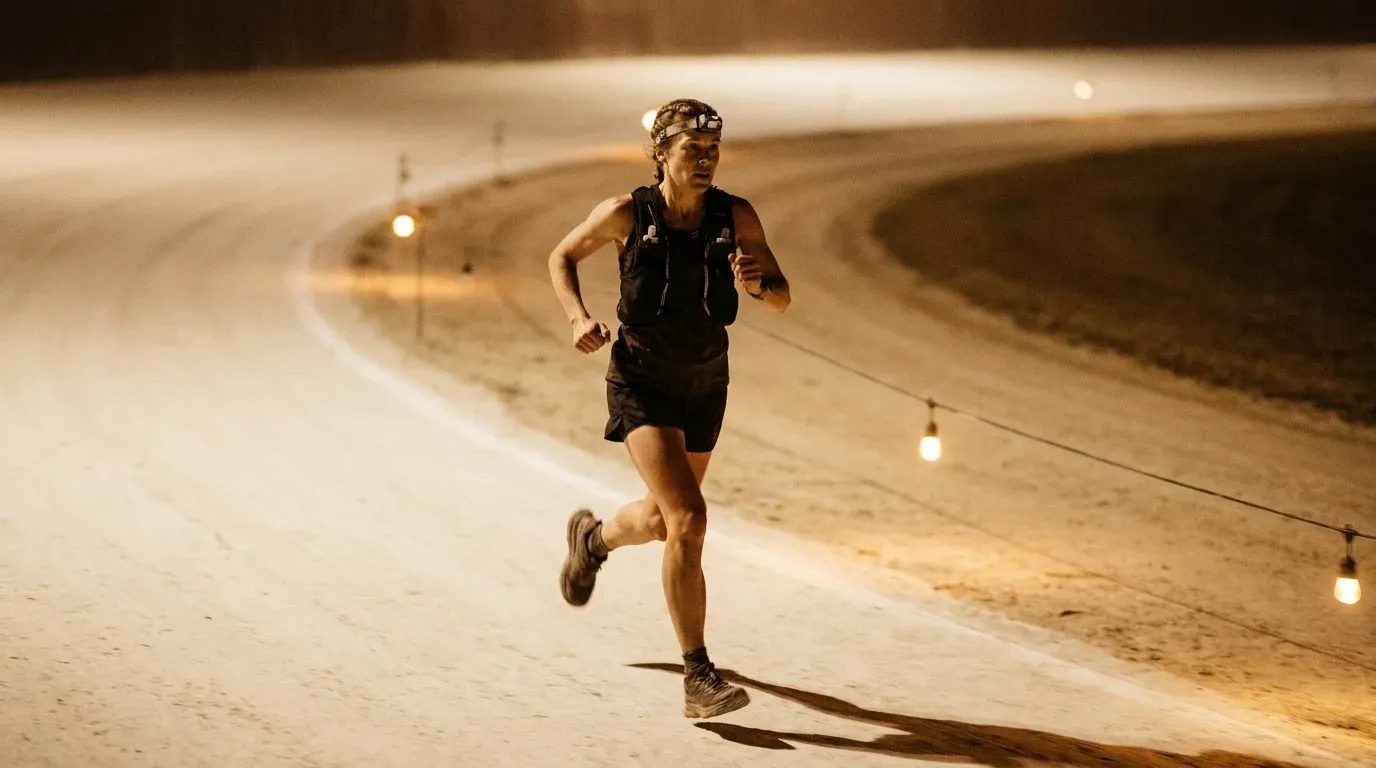
Megan Eckert Runs 636 Miles in Six Days and Rewrites History
Six days. One half-mile loop. One thousand, one hundred and forty laps. Megan Eckert just completed one of the most remarkable performances in the history of ultrarunning, covering 636 miles to set a new women's world record in the six-day run format. She didn't just break the previous women's mark. She also surpassed the men's American record, making her achievement a landmark moment that transcends gender categories entirely.
This is the biggest ultra performance story of 2026, and it arrives at exactly the right time.
What the Six-Day Run Actually Demands
If you're new to this format, here's what you need to understand. A six-day run is exactly what it sounds like: athletes have 144 hours to cover as much distance as possible, typically on a short, measured loop. Eckert's event used a half-mile circuit, which means she completed 1,140 laps to reach her final total. That number alone deserves a moment of silence.
The format is brutal in ways that standard ultramarathons are not. There's no finish line psychology to carry you forward. No defined distance to lock onto mentally. You simply keep moving until time expires, managing sleep deprivation, caloric intake, joint breakdown, and the particular madness that sets in somewhere around hour 72. Pacing isn't just strategy. It's survival.
What's especially demanding about the looped course format is the repetition. Running the same half-mile stretch hundreds of times tests mental resilience in ways that point-to-point courses simply don't. Every lap is a decision to keep going. After 500 laps, after 800, after 1,000, that decision becomes something closer to a reflex. Eckert built that reflex over years of racing, and it showed.
A Record That Crosses Two Boundaries
The previous women's world record in the six-day run stood as a serious benchmark. Eckert didn't just edge past it. She posted a total that also cleared the men's American record, placing her in territory that no American man has reached over six days of continuous running.
That detail matters for reasons beyond the headline. American records in endurance sports carry significant weight in the global ultrarunning community, and the men's six-day mark has long been treated as an elite threshold. The fact that a woman now holds the higher number in both categories simultaneously is not a footnote. It's a signal.
The ultrarunning world has been watching women's performances in extreme-distance events with growing attention over the past few years, and Eckert's effort is the kind of data point that sharpens that conversation considerably. Conversations happening at events like the US Trail Running Conference, where leaders including Craig Thornley and Sally McRae are keynoting, are increasingly centered on how women are redefining the ceiling of human endurance performance.
The Science Behind Women's Ultra Dominance
Eckert's record doesn't exist in a vacuum. It lands alongside a growing body of research suggesting that women may hold genuine physiological advantages in ultra-long-distance events. Recent studies indicate that women tend to outperform men relative to their gender norms once race distances exceed approximately 195 miles. At those distances, the variables that typically favor men, including raw speed and explosive power, become far less relevant than fat oxidation efficiency, metabolic consistency, and the ability to maintain output under prolonged stress.
Women generally show greater fat-burning efficiency at moderate intensities, which is exactly the metabolic zone that a six-day run operates in. They also tend to experience more consistent energy regulation over extended time periods, with lower rates of the severe glycogen crashes that derail male competitors during multi-day events. Hormonal factors appear to play a role as well, though the research is still developing in that area.
None of this diminishes the achievement. Understanding the physiology behind Eckert's performance makes it more impressive, not less. She optimized a set of physiological tools and applied them at the highest possible level over six days. That's athletic excellence by any definition.
If you're training for long-distance events yourself, it's also worth paying attention to the nutritional foundations that underpin multi-day performance. Iron deficiency is one of the most overlooked performance limiters for endurance athletes, and in a format like the six-day run, where the body undergoes continuous mechanical and metabolic stress, ferritin levels can make or break a result.
The Revival of an Old Format
Six-day running is one of the oldest organized athletic formats in existence. In the late 1800s, six-day pedestrian races drew massive crowds in cities like New York and London. Competitors moved through public arenas for days at a time, watched by spectators who treated the events with the same cultural gravity we now attach to major marathons. The format eventually faded, displaced by shorter, more telegenic races.
In 2026, it's back. Participation in multi-day fixed-time events has grown steadily over the past three years, driven partly by a cohort of athletes who have exhausted traditional ultra formats and are looking for something that tests a different dimension of human capacity. Race organizers across the US, UK, and Australia have reported increased interest in 48-hour, 72-hour, and six-day events, with fields that now include both elite competitors and experienced age-group runners.
The growth mirrors what's happening in the broader endurance sports market. Athletes are pushing the definition of what a race is, and formats that once seemed extreme are becoming reference points for a new generation of competitors. If you're someone who has run a 100-miler and is wondering what comes next, the six-day format is an answer worth taking seriously.
That same spirit of exploration is showing up across the endurance calendar. Events like the Marathon des Sables, which is expanding to two formats for 2027, reflect how race directors are responding to an audience that wants more variety, more challenge, and more ways to test their limits.
What Eckert's Performance Means for the Rest of Us
Most people reading this will never run a six-day race. That's fine. Records like Eckert's still matter to you for a few reasons.
First, they shift the frame of what's possible. Every time the ceiling moves, it changes what athletes at every level believe they can achieve. The psychology of performance is deeply connected to reference points, and Eckert just moved a major one.
Second, the training principles that underpin multi-day ultra performance, specifically the emphasis on metabolic efficiency, consistent sleep protocols, and resilience under accumulated fatigue, are directly applicable to any long-distance training program. Research consistently shows that endurance athletes who prioritize sleep quality alongside physical training see measurable improvements in both performance and recovery. The relationship between sleep and training quality is one of the most underused tools in any endurance athlete's toolkit.
Third, stories like this matter culturally. Women's performances in extreme endurance sports are not a niche topic. They're part of a broader conversation about how athletic categories are evolving, how physiology is being understood, and how the sports media covers women's achievements on their own terms rather than as footnotes to men's results.
What Comes Next
Eckert's record will stand until someone goes further. That's the nature of the format. But the immediate effect of what she's done is to raise the competitive baseline for six-day running globally and to bring new attention to a discipline that has been quietly producing extraordinary performances for years.
For any runner curious about where ultrarunning is heading, the six-day format is worth watching. Elite performance in this space is accelerating, and the athletes pushing it forward are doing things that would have seemed physiologically implausible a decade ago.
If you're building toward your own long-distance goals this year, there's no shortage of ambitious events on the calendar. From trail marathons this fall to multi-stage desert races, the endurance world is wide open. Eckert just reminded everyone exactly how far that world extends.
- 636 miles covered in six days, setting a new women's world record
- 1,140 laps of a half-mile loop completed over 144 hours
- Men's American record also surpassed, making this a dual historic milestone
- Research threshold: women show physiological advantages in races beyond approximately 195 miles
- Format revival: six-day events are growing across the US, UK, and Australia in 2026
Megan Eckert ran 1,140 laps. She ran them one at a time. That's the whole story, and it's a remarkable one.