
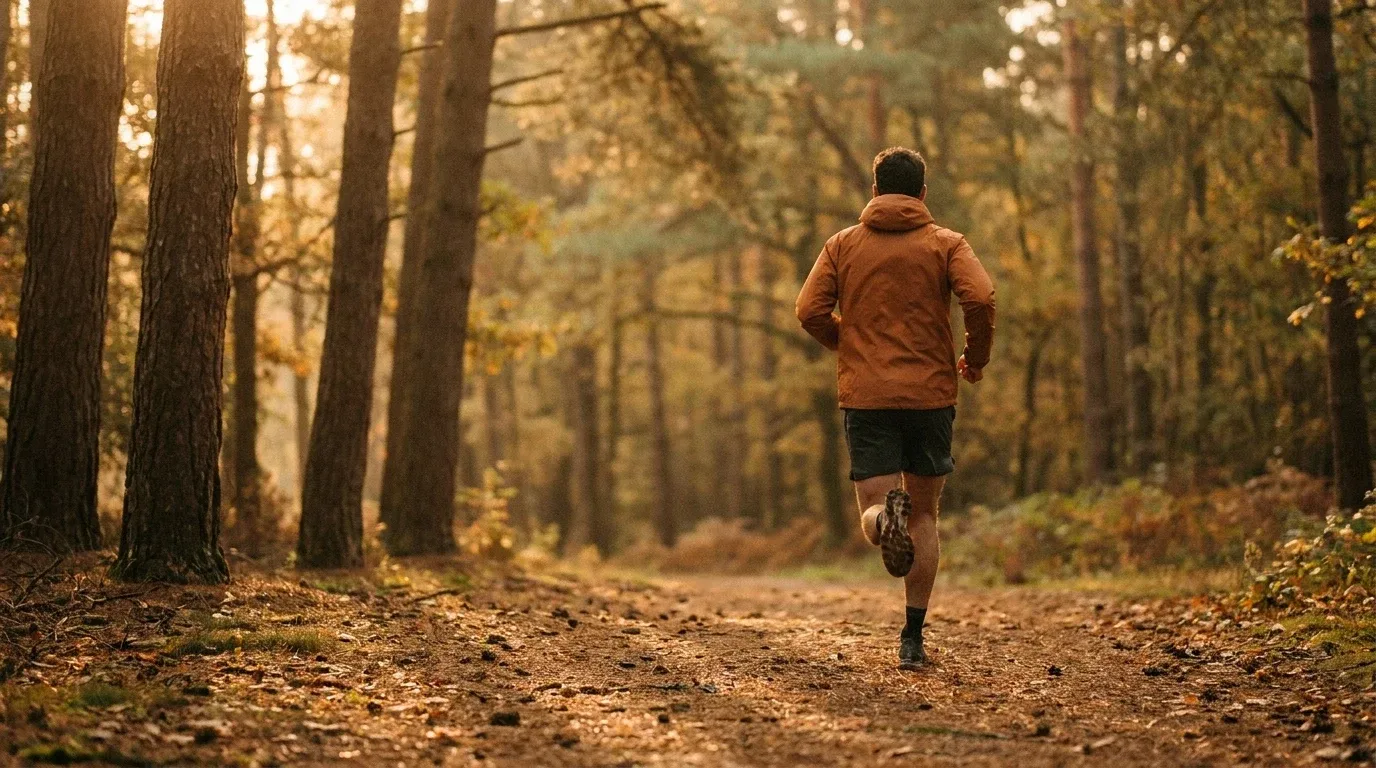
The Turkey Trot is probably the most socially forgiving race on the running calendar. No qualifying time, no pressure, no one really keeping score. You show up, you move, you feel good about starting the holiday with a run. But if you've been doing the same flat road 5K every November, it might be worth considering what happens when you take that tradition off the pavement and onto the trails.
Trail Turkey Trots are growing fast. Race organizers across the US, UK, Canada, and Australia have added trail-based Thanksgiving and holiday weekend events to meet demand from runners who want something more scenic and physically engaging than a neighborhood loop. And the case for trail over road this time of year is stronger than you might think.
Why Trails Make the Turkey Trot Better
Trail running isn't just about scenery, though the scenery doesn't hurt in late November. The varied terrain forces your body to work differently than it does on a flat road. You're constantly adjusting foot placement, engaging stabilizer muscles in your ankles, hips, and core, and responding to changes in gradient that a road 5K never demands.
Research consistently shows that trail running burns roughly 10 percent more calories than road running at the same pace. That gap comes from the energy cost of terrain variability and the extra stabilization work your body performs with every step on uneven ground. On a day when you're heading into a large meal, that additional caloric output is a genuine, measurable difference. Not a trick. Not a rationalization.
Beyond the numbers, trail events tend to attract a different crowd energy. The competitive edge softens. People hike the uphills without embarrassment. Runners chat on the descents. It feels less like a race and more like a group outing, which makes it ideal for bringing along friends or family members who don't consider themselves "real runners."
Finding a Trail Turkey Trot Near You
Your first step is simply searching "trail Turkey Trot" or "trail run Thanksgiving" along with your city or region. Event aggregator sites like UltraSignup, RunSignup, and local running club websites are reliable sources. Many trail events are organized by running clubs rather than commercial race companies, so they tend to stay smaller, cheaper (often $20 to $40 registration), and more community-focused.
If you can't find a formal event, it's entirely reasonable to plan your own route. Many trail runners use apps like AllTrails or Strava's route builder to map a 5K or 10K loop through a local park or nature reserve. Bring a few people, designate a start time, and you've got yourself an unofficial event. The structure matters less than the movement.
When evaluating a trail event, check the elevation profile before you commit. A trail labeled "beginner-friendly" can still include 300 feet of cumulative climb, which will feel very different from a road 5K if you haven't been training on hills. Know what you're signing up for.
Pacing Strategy on Trail: Slower Is Smarter
This is where most road runners go wrong in their first trail race. They set off at their usual 5K pace, hit the first climb two minutes in, and immediately blow up. Trail pacing requires a completely different approach, and the sooner you internalize that, the better your experience will be.
The core principle is simple: start conservative, walk the climbs, use the descents. On a trail with any meaningful elevation gain, effort-based pacing beats pace-per-mile pacing every time. Your heart rate on a steep uphill at a walking pace can match what it would be running at 8:30 per mile on flat ground. Walking the climbs isn't a failure. It's the tactically correct choice, and it's what experienced trail runners do regardless of fitness level.
On descents, let gravity do some work. Shorten your stride, stay light on your feet, keep your eyes scanning about six to ten feet ahead rather than directly below you. Your brain needs that visual lead time to process the terrain. Braking hard on downhills fatigues your quads quickly and increases your risk of a slip or stumble.
If you're newer to trail running and thinking about how effort calibration translates across different training contexts, the principles in How Hard Should You Actually Train at the Gym? apply here too. Perceived exertion is a more reliable guide than any number on your watch when the terrain keeps changing beneath you.
For a Turkey Trot distance of 5K, your total finishing time on trail will likely be 15 to 25 percent slower than your road 5K time. That's normal. Don't chase the clock. Chase the experience.
Gear Checklist for a Trail 5K
A trail 5K doesn't require specialized ultrarunning gear, but a few adjustments from your road setup will make a real difference.
- Trail shoes: The single most important upgrade. Road shoes on wet trail are a liability. Trail-specific shoes with a lug sole give you the grip to push confidently on loose or leaf-covered surfaces. Brands like Salomon, Brooks Cascadia, or Hoka Speedgoat offer entry-level trail options in the $120 to $160 range.
- Moisture-wicking layers: Late November can be cold and damp. A lightweight base layer under a breathable mid-layer handles most conditions. Avoid cotton entirely.
- Gloves and a hat: Your extremities cool down fast when you stop at aid stations or slow on uphills. Lightweight running gloves cost very little and make a big difference.
- Gaiters (optional): Low-cut trail gaiters keep debris and wet leaves out of your shoes. Unnecessary on clean, well-groomed trails. Worthwhile on anything loose or leaf-heavy.
- Charged phone: Even for a short event, trails can disorient first-timers. Have navigation available.
Pre-Race Prep the Morning Of
Thanksgiving morning logistics are real. You've probably got food to prep, family arriving, and a race start time that doesn't care about any of it. Keep your pre-race routine simple and familiar. Don't eat anything new or heavy before the run. A small meal of easily digestible carbohydrates, something like a banana and a piece of toast with peanut butter, eaten 60 to 90 minutes before the start, is reliable and low-risk.
Hydration matters more than most runners realize on cold mornings. You feel less thirsty in the cold, but you're still losing fluid through breath and sweat. Drink 12 to 16 ounces of water in the hour before your race. Skip the energy drinks.
If you're considering a caffeine boost before the race, it's worth knowing that the evidence-backed performance dose sits around 3 to 6 milligrams per kilogram of body weight, consumed 30 to 60 minutes before effort. Caffeine and Exercise: How Much Is Too Much? breaks down the dosing science and the risks of going overboard, which is easy to do on a morning when you've already had two cups of coffee.
Post-Run Recovery Before the Big Meal
This is the detail most Turkey Trot runners skip entirely, and it's worth paying attention to. What you do in the 30 minutes after finishing sets the tone for how your muscles recover and how you feel for the rest of the day.
Exercise creates microscopic muscle damage that your body begins repairing immediately. That repair process depends on protein availability. Research on post-exercise nutrition consistently points to a window of roughly 30 to 60 minutes after finishing as the period when muscle protein synthesis is most responsive to protein intake. Getting 20 to 30 grams of protein during that window, before the main meal, meaningfully supports recovery.
On Thanksgiving, this doesn't have to be complicated. A Greek yogurt, two or three eggs, a protein shake, or a handful of turkey slices from whatever's already being prepared all qualify. You're not disrupting your appetite for the main meal. A 25-gram protein snack adds around 100 calories and digests quickly.
Beyond protein, prioritize rehydration. Replace fluids, change out of wet or cold gear promptly to avoid a chill, and do five to ten minutes of light stretching focused on your calves, quads, and hip flexors. Trail running loads those areas differently than road running, and you'll feel better later in the day for taking the time.
Trail running's physical demands, particularly the lateral movement and stabilization work, can be harder on joints than road running over time. If you're newer to trails or have existing knee or ankle concerns, it's worth reading HYROX Is Great for Fitness. It's Brutal on Your Joints. for a useful perspective on how to manage load when you're asking your body to work in unfamiliar movement patterns.
The Real Point of All This
The Turkey Trot exists because movement before a big meal feels good, both physically and psychologically. It's a low-barrier entry point to a running community, and doing it on trails instead of roads makes the experience richer without raising the difficulty ceiling by much.
You don't need a fast finishing time. You don't need trail experience. You need a reasonable pair of shoes, a sensible pace, and a protein snack ready for when you cross the finish line. The rest takes care of itself.
Events like NYC Marathon 2026, which broke its finisher record and charity fundraising goal, are a reminder that running at every level is growing. The Turkey Trot is where a lot of those runners start. Make yours a good one.