
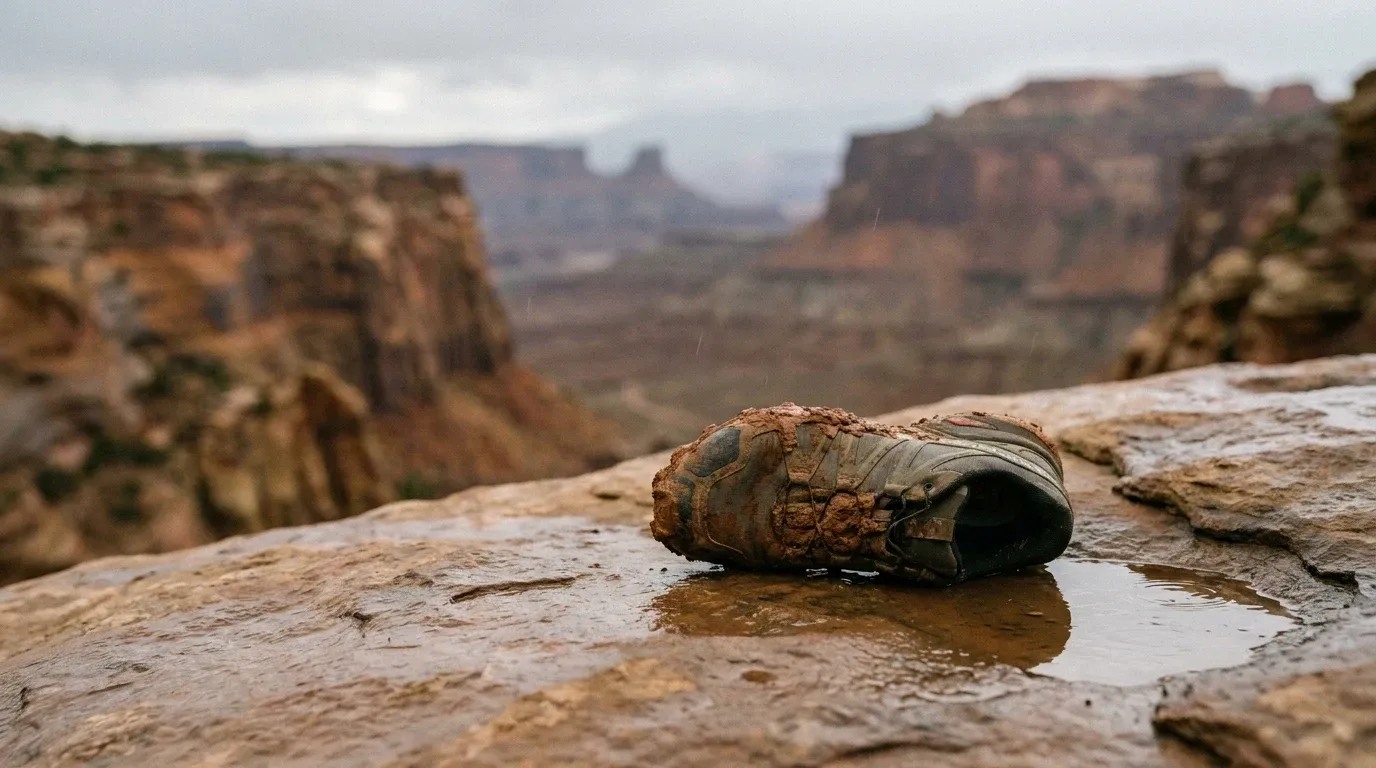
On October 13, the Moab 240 didn't just get canceled. It collapsed mid-race, with athletes scattered across 386 kilometers of eastern Utah desert while Tropical Storm Rachel's remnants tore through the region. Aid station tents were shredded by wind. Running paths flooded. Temperatures dropped sharply enough to turn a grueling ultramarathon into a survival situation. For the runners still on course, this wasn't a race-day disappointment. It was an emergency.
Here's what actually happened, what it reveals about ultra race safety, and what every runner who lines up at an event like this needs to understand before the starting gun fires.
What the Storm Actually Did to the Course
Tropical Storm Rachel brought flash flooding and freezing temperatures to a landscape that's already unforgiving under calm conditions. The Moab 240, one of the most demanding ultra events in North America, winds through canyon country where terrain changes fast and shelter is sparse. When the storm hit, it didn't just make running harder. It made the course actively dangerous.
Aid station structures, which are the lifeline of any ultra, were destroyed by wind. The stations aren't simply water tables. They're staffed checkpoints with food, medical support, crew access, and in some cases, sleep areas. When those structures go down, athletes lose their navigation anchors and their safety nets simultaneously.
Running paths turned into rivers. In flash flood conditions, arroyos and dry washes fill within minutes. A runner who has trained for months and studied the course map can find themselves facing moving water with no clear way forward and no way back. Several athletes, including British Columbia runner Lance Rogan, were stranded on course. Getting them out required coordination between race officials, local emergency services, and support crews who were themselves navigating dangerous road conditions.
The Silence Before the Cancellation
One of the most disorienting aspects of a mid-race cancellation isn't the cancellation itself. It's the communication gap that precedes it. Runners deep on course often rely on a patchwork of satellite communicators, intermittent cell service, crew updates at aid stations, and word passed between athletes. When conditions deteriorate rapidly, that patchwork fails.
Athletes at Moab described moments of uncertainty where they didn't know whether to push forward, hold position, or try to self-extract. Some had crew who couldn't reach them. Others were relying on GPS devices to track their own location in terrain that looked nothing like it had during course reconnaissance. The race was eventually halted entirely, but by that point, the damage to athlete confidence and safety had already accumulated across hours of exposure.
This is the gap that race directors and governing bodies need to address more directly. Ultra events operate across massive geographic footprints. A storm that hits the northern portion of a course may not reach the southern section for hours, meaning some runners are still racing in decent conditions while others are in crisis. Uniform communication protocols simply don't work at this scale without significant investment in real-time tracking and direct athlete contact systems.
Ultra Safety Is Still Catching Up to Ultra Ambition
The trail running world is growing fast. Trail running is booming globally, drawing athletes from road racing backgrounds, from obstacle events, from gym culture. Many of them have serious fitness but limited backcountry experience. The Moab 240 attracts elite ultra runners, but also dedicated amateurs who have trained hard and prepared their logistics without necessarily having deep wilderness survival knowledge.
This creates a tension that race organizers are increasingly forced to reckon with. On one hand, ultra events pride themselves on testing human limits. On the other hand, the participant pool is broader and more varied than it was a decade ago. What constitutes adequate safety briefing for a 386-kilometer race crossing remote terrain in October, when weather windows can close fast?
Current standard practice typically includes mandatory gear lists, weather briefings at pre-race meetings, and aid station cutoffs that allow race officials to pull slower athletes before conditions worsen. But as Moab demonstrated, a storm of Rachel's speed and intensity can outpace all of those protocols. The gear you're required to carry might not be sufficient for a multi-hour stranding in freezing wet conditions. The cutoff system assumes the course remains passable. When it doesn't, the framework breaks down.
Wearable technology is one area where the gap is closing. Devices that track both athlete location and biometric data in real time, without requiring cell service, are becoming more accessible. Suunto's latest screenless tracker is one example of a product designed for exactly the kind of off-grid endurance context where traditional connectivity fails. Race organizers who require athletes to carry trackable devices gain situational awareness that could meaningfully reduce response times in emergencies.
What Runners Should Take From This
If you're training for an ultra, particularly one that crosses remote terrain in variable seasons, the Moab 240 situation is a direct message to review your personal emergency protocols. Not the race's protocols. Yours.
A few things worth building into your planning:
- Establish a communication plan with your crew that doesn't depend on cell service. Satellite communicators like the Garmin inReach allow two-way messaging from anywhere. If your crew knows your check-in schedule and has a clear escalation plan if you miss it, you've built a real safety layer.
- Know your self-extraction options at every major segment of the course. Study maps in advance and identify road crossings, trailheads, and access points where a crew or emergency vehicle could reach you. In a stranding scenario, knowing your nearest exit point is more useful than knowing your pace splits.
- Carry more cold-weather protection than the mandatory minimum. Required gear lists represent a floor, not an ideal. If conditions deteriorate, you want margin. A lightweight emergency bivy and an extra insulating layer weigh almost nothing against the cost of hypothermia.
- Have a personal cutoff conversation before race day. Decide in advance what conditions would cause you to stop and self-evacuate, independent of any official race decision. This is harder than it sounds when you've spent months training and thousands of dollars preparing, but it's the single most important mental preparation you can do.
That last point is where many experienced runners struggle most. The sunk cost of training, travel, and entry fees creates enormous psychological pressure to continue. Entry fees for 200-plus mile events often run $500 to $1,000 or more. Flights, accommodation, and crew logistics can push total trip costs well past $3,000. When you've invested at that level, the instinct to push through warning signs is powerful and well-documented in ultra running research.
Race nutrition preparation matters here too. Managing your pre-race fueling is one of the variables you actually control. In a situation where aid stations go down, the food and hydration you're carrying becomes your only resource. Runners who treat nutrition as an afterthought tend to be more depleted and less capable of clear decision-making when conditions turn.
The Race Director's Impossible Position
It's worth being fair to the organizers of events like Moab 240. Canceling a race mid-event is not a simple call. Athletes have trained for years. Some have traveled from other countries. The logistical operation of pulling hundreds of runners off a 386-kilometer course in a storm, with damaged roads and downed aid stations, is genuinely complicated. Race directors are often making real-time decisions with incomplete information, under pressure from athletes, crews, and local emergency services simultaneously.
The right response isn't to blame organizers for what happened at Moab 240. It's to use this event as a forcing function for better systems. That means pre-race weather contingency briefings that go beyond "we may adjust cutoffs." It means direct communication channels to athletes on course, not just posted updates on social media. It means established decision trees for partial and full race cancellations, shared with participants in advance so that when a call is made, everyone understands what it means and what they're expected to do.
If you're weighing what races to target after a big season, choosing your next event carefully includes looking at how organizers have handled past crises. That's now a legitimate part of the research process.
What Comes Next for Moab and the Ultra World
The ultra community is already processing what happened. Forums and athlete social media accounts have been filled with firsthand accounts that reveal both the chaos of the situation and the genuine camaraderie among stranded runners. People helped each other. Crews drove toward danger to reach their athletes. Volunteers stayed at damaged aid stations longer than was safe to make sure no one was left without support.
That culture is real and it matters. But culture doesn't replace protocol. The ultra calendar keeps moving, with races running through the fall and into winter conditions across North America and beyond. Every event on that calendar now has a reason to look harder at its emergency communication systems, its mandatory gear standards, and its athlete education around personal decision-making in extreme weather.
What happened at Moab 240 wasn't a freak occurrence that can be dismissed as an outlier. It's a preview of what more frequent and more intense weather events will mean for races built on the premise of pushing human limits in wild places. The runners who were stranded there deserve better systems going forward. So do you.