
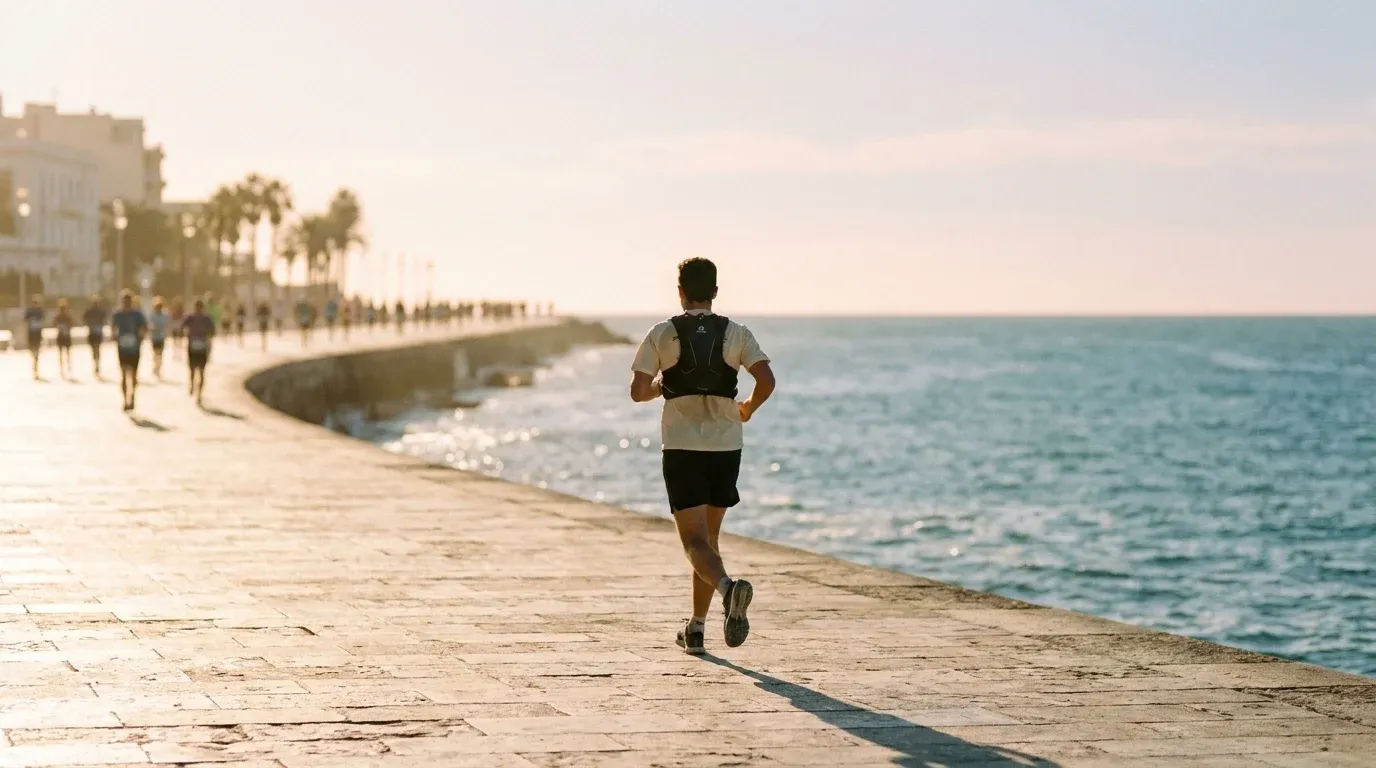
Some races sell out because they're fast. Others sell out because they're flat. The 18th Marathon des Alpes-Maritimes Nice-Cannes sells out because it's stunning. And in 2026, it's doing so at a scale the event has never seen before.
Over 25,000 participants are registered for this edition, with more than 15,000 entered in the full 42.195km distance. That's not just a new record for this race. It's a signal about where mass-participation running is heading globally.
A Route Built for the Senses
The Nice-Cannes course has always been its own best marketing tool. Running from the center of Nice westward along the French Riviera to Cannes, approximately 95% of the route runs directly alongside the Mediterranean Sea. That's not a stretch of coastal scenery. That's the whole race.
You're rarely more than a few meters from the water. The course tracks the famous Promenade des Anglais out of Nice before following the shoreline through Antibes and Juan-les-Pins and finishing on the Boulevard de la Croisette in Cannes. On a clear November morning, with the sea on one side and the Alpes-Maritimes rising in the distance, it's difficult to find a comparable setting anywhere in marathon running.
That visual appeal is a real competitive advantage in an era when runners increasingly factor experience alongside finish time when choosing events. A flat, fast urban course can get you a personal best. A course like Nice-Cannes gives you something you'll talk about for years.
Managing 25,000 Runners Safely
Organizing a field of this size requires more than enthusiasm. The race organizers have implemented staggered start waves spread across 75 minutes to safely manage the volume of participants at the start line and across the early kilometers of the course.
It's a proven approach. Major marathons worldwide have moved to wave starts not just for logistics, but for safety. Crowded early miles increase injury risk, disrupt pacing strategies, and create bottlenecks on narrow sections of course. Spreading the field over 75 minutes allows each group of runners to settle into their own space and rhythm before the route narrows along the coastal road.
For runners targeting specific finish times, the wave system also means more accurate chip timing and less early-race congestion. If you're chasing a sub-4 or a first-ever marathon finish, you want clear road, not a wall of bodies at kilometer two.
The full marathon field exceeding 15,000 is particularly notable. Many large events pad their numbers with shorter distances. Here, the majority of participants are committing to the full 42km, which reflects genuine demand rather than a numbers trick.
Why Scenic Marathons Are Winning the Registration Race
Nice-Cannes is not an isolated story. Across Europe and globally, coastal and scenically routed marathons are outpacing traditional city-center events in registration demand. Events in Barcelona, Lisbon, and along the Scottish coast have all reported record or near-record fields in recent cycles. The pattern is consistent enough to be a trend, not a coincidence.
Several forces are driving this. Post-pandemic running participation surged and hasn't fully receded. First-time marathon runners now make up a larger share of race fields than at any point in the last two decades, and that demographic tends to prioritize experience over pure performance metrics. When you're running your first marathon, a breathtaking coastal route matters as much as a fast course.
Travel running has also become its own category. Runners increasingly plan international trips around target races, turning a marathon into a five-day destination experience. The French Riviera in November is a compelling proposition: mild temperatures, clear skies, and a finish line in one of the world's most recognizable resort cities. Registration demand reflects that appeal directly.
The growth in women's participation has reinforced this trend further. Women now represent a growing proportion of marathon finishers globally, and research consistently shows that female runners place high value on route aesthetics, event atmosphere, and community feel when selecting races. Scenic coastal events check every one of those boxes.
If you want to see what this looks like at the elite level, six French women chasing a 30-year national record at the Paris Ekiden illustrates how competitive ambition and event spectacle can coexist in the same running culture.
Training for a Race Like This
The Nice-Cannes course is largely flat, which makes it genuinely accessible for a wide range of ability levels. But flat doesn't mean easy. Running 42km on coastal road, often with sea wind and variable humidity, demands the same disciplined preparation as any major marathon.
If you're targeting this race in November 2026, your training block is either underway or approaching. Building a structured base through the summer months, adding marathon-specific long runs through September and October, and then tapering into race week is the standard framework. The key variable most runners underestimate is nutrition.
Endurance performance is heavily influenced by what you're consuming before and during training, not just on race day. Electrolyte balance, carbohydrate timing, and recovery nutrition all compound over a 16 to 20-week build. Understanding what supplements actually work versus what's overhyped can save you money and improve your results. Sorting evidence from hype on magnesium, biotics, and shatavari is a useful starting point if you're reviewing your supplement stack ahead of a long build.
Strength training is the other underused tool. Runners who incorporate lower-body and core work during their marathon build consistently show better late-race form and reduced injury rates. If you haven't structured that into your preparation yet, planning a winter strength block now gives you time to build a meaningful base before the final marathon-specific phase kicks in.
The Bigger Picture for Running Events
The 25,000 figure at Nice-Cannes means something beyond this specific race. Global marathon participation has been climbing steadily, and the bottleneck is no longer interest. It's capacity. Events in the $100 to $200 entry fee range are routinely oversubscribed, lottery systems have become standard for the most desirable races, and organizers are having to think harder about how to grow without compromising the runner experience.
Nice-Cannes has made a deliberate choice to grow. The 75-minute wave window, the investment in logistics, the positioning as a destination event rather than just a local race. That's an organizational model other events will study.
The contrast with some elite-focused marathons is worth noting. While scenic mass-participation events see surging demand, elite circuits are facing their own separate questions about depth, prize money, and broadcast reach. What elite runners are saying ahead of NYC Marathon 2026 gives a sense of how the competitive tier thinks about these large urban events, and how different that calculus is from the experience-driven runner choosing Nice-Cannes.
Both things are true at once. Marathon running is becoming more elite at the top and more accessible and experiential in the mass field. Nice-Cannes in 2026 sits squarely in that second category, and it's thriving there.
What to Expect if You're Running
If you're registered for the 18th edition, here's what the race experience looks like in practical terms.
- Start location: Nice city center, with waves departing across a 75-minute window. Confirm your wave assignment and arrive with enough buffer to get to your corral without rushing.
- Weather: Late November on the Riviera typically means temperatures between 10 and 16 degrees Celsius. Light layers at the start that you can shed or tie around your waist work well.
- Wind: The coastal route can be exposed. A westerly wind behind you is a gift. A headwind into Cannes in the final 10km is a mental test. Build that into your pacing plan rather than being surprised by it.
- Nutrition on course: Aid stations are placed at regular intervals. Carry your preferred gels for the first half and rely on course nutrition once you've confirmed what's available. Don't experiment with anything new on race day.
- Finish: The Boulevard de la Croisette finish is iconic. Take a moment to look around before you cross. You've earned it.
The Nice-Cannes Marathon has always offered something different from the standard metropolitan race experience. In 2026, with a record field and a logistical framework built to match it, the event is making an argument that scenic coastal marathons aren't a niche category. They're the future of mass-participation running.