
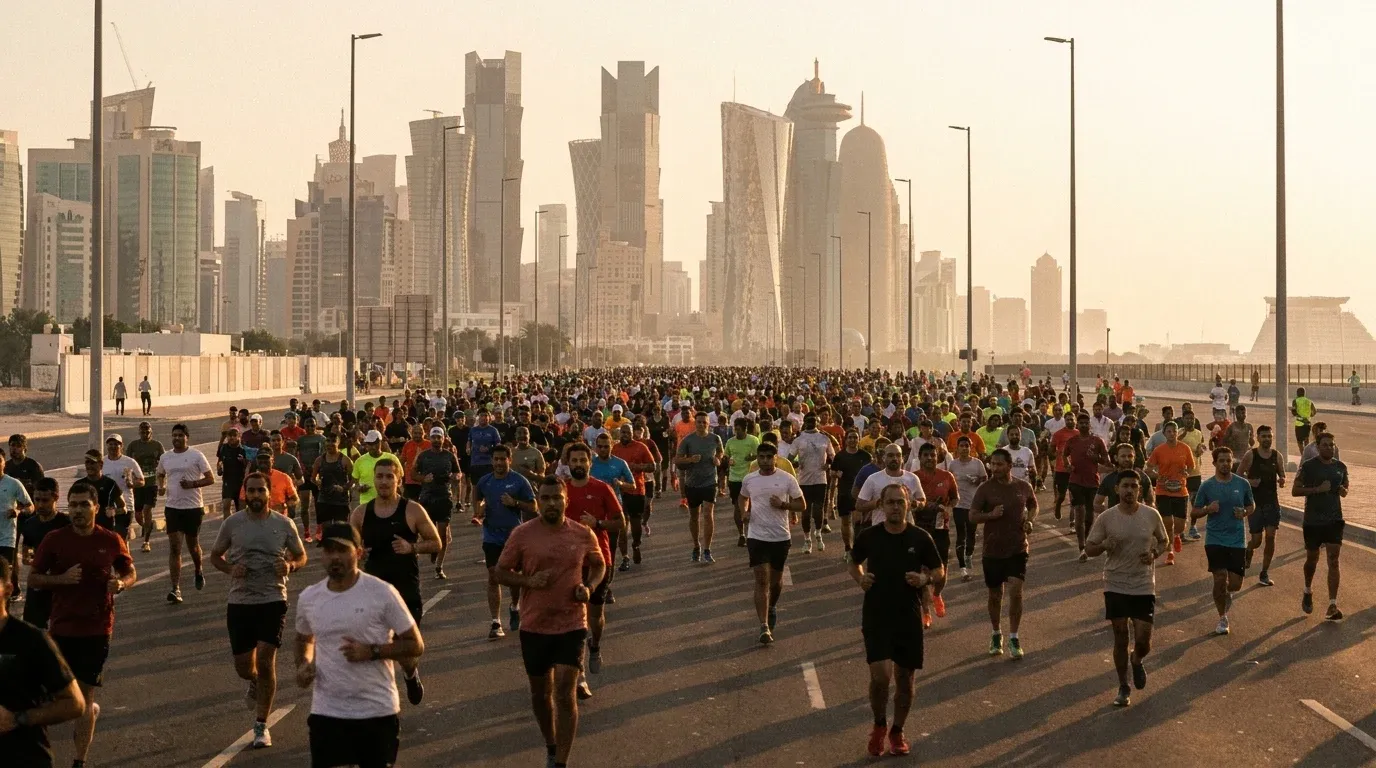
Paris Saint-Germain has built its brand on spectacle. Superstar signings, global tours, lifestyle drops. Now the club is moving into territory that few football institutions have seriously occupied: the mass-participation running event. WE RUN DOHA, PSG's first branded race, is scheduled to take place in Doha, Qatar, and it represents something more interesting than a club trying to sell more jerseys. It's a signal that elite sports franchises are beginning to treat the running community as an audience worth building, not just an afterthought.
For runners, this deserves a closer look. Not just because of who's behind the event, but because of what it suggests about where mass-participation running is heading as a global industry.
What Is WE RUN DOHA?
WE RUN DOHA is a PSG-branded road running event set in Qatar's capital city. The event is designed as a mass-participation race, meaning it's built for everyday runners rather than elite competitors. Multiple distances are expected to be offered, catering to beginners through to seasoned half-marathon runners. PSG's branding will be woven throughout the race experience, from registration to finish line, giving the club a physical, participatory touchpoint with fans and fitness enthusiasts in the Gulf region.
It's one of the most high-profile club-to-running crossovers in sport. While other football clubs have dabbled in charity fun runs or stadium laps, this is a fully branded, standalone race event. PSG is treating it like a product launch, not a community day.
The event aligns with a broader shift you're seeing across the industry. For context, the global running events market has grown significantly in the post-pandemic period, with mass-participation races reporting record registration numbers in 2024 and 2025. Quebec's Beneva Marathon breaking both speed and attendance records is one recent example of how appetite for organized running continues to climb, even in markets that had long since plateaued.
Why Doha? The Strategic Logic Behind the Location
Doha is not an arbitrary choice. Qatar spent years and billions of dollars positioning itself as a global sports hub in the lead-up to the 2022 FIFA World Cup. The infrastructure built for that tournament, including roads, transportation links, public spaces, and international hospitality capacity, didn't get mothballed afterward. Qatar has actively sought to use it.
Since 2022, Doha has hosted major athletics meets, cycling events, and international motorsport. The city has demonstrated it can organize large-scale sporting events to international standards. For PSG, that matters. You don't want your first branded race to suffer from logistical failures that damage the brand. Doha offers a controlled, well-resourced environment where execution is likely to be tight.
There's also the fan geography to consider. PSG's ownership structure, under Qatar Sports Investments, means there's a deeply embedded institutional relationship between the club and the Gulf state. WE RUN DOHA isn't just PSG entering the running market. It's PSG launching in a city where the political and commercial alignment is as close to frictionless as it gets.
And Doha has a running community worth reaching. The city's expatriate population, estimated at over 80% of residents, skews toward professionals with disposable income and active lifestyles. Running participation in the Gulf has grown substantially over the past decade, with local race series attracting thousands of participants. This isn't a cold market.
The Bigger Trend: Sports Brands Moving Into Fitness Events
PSG isn't operating in a vacuum here. What you're watching is a broader strategic shift across sports entertainment. Clubs and leagues are realizing that their fanbases are large, global, and highly engaged, but the touchpoints for monetization have historically been narrow. Broadcast rights, merchandise, stadium attendance. That's about it.
Mass-participation fitness events offer something different: direct, physical engagement with fans who are willing to spend money on experience-based products. The HYROX model has demonstrated this clearly. HYROX built a global events business around functional fitness racing, attracting tens of thousands of participants across dozens of cities annually. It's a format that generates revenue from entry fees, merchandise, sponsorship, and media, while also building community loyalty that's arguably stronger than passive viewership. Industry partnerships like Sportograf joining The Running Conference 2026 as a global partner point to how seriously the events ecosystem is being taken by media and technology companies.
PSG is applying a version of this logic to running. The club already has an enormous global audience. Millions of fans in Asia, Africa, the Middle East, and the Americas follow PSG without ever setting foot in Paris. A running event series that rolls through cities where those fans live is a way to convert passive audience members into active, paying participants.
If WE RUN DOHA succeeds, expect more cities. That's the template.
What This Means for the Running Industry
For established race organizers, this is a moment to pay attention. Football clubs bring marketing budgets, global brand recognition, and social media reach that most independent race directors can't match. PSG has over 70 million Instagram followers. A single post promoting a race registration window reaches an audience most running events never touch.
That said, brand awareness doesn't automatically translate to quality race experience. The running community has high expectations. Timing accuracy, well-stocked aid stations, safe courses, medal quality, post-race atmosphere. These things matter to runners, and they've seen enough poorly organized events to be skeptical of brands entering their space from the outside.
WE RUN DOHA will be judged by the same standards as any other mass-participation event. If the execution is strong, PSG earns credibility in the space and potentially unlocks a significant new business vertical. If it's sloppy, the backlash will be loud and the brand association with running will be a negative one. There's real risk here, which is also why serious preparation is evident in the Doha launch choice.
For runners considering participating, the questions you'd ask of any race apply here. What's the course profile? What distances are offered? What's the registration cost, and what does it include? What's the medal and finisher experience? These answers will determine whether WE RUN DOHA earns repeat participants or becomes a one-time novelty.
Running as a Global Cultural Product
There's a larger point worth making. Running is no longer just a sport. It's a cultural product with a global community, a thriving media ecosystem, and a commercial infrastructure that continues to mature. The rise of events like HYROX, the growth of trail running, and the explosion of content around performance and wellness have all contributed to a running culture that's extremely attractive to brands with resources to invest.
Athletes pushing the boundaries of what's possible, like those targeting a sub-2-hour marathon finish, generate media interest that rivals mainstream sport. And at the participatory level, millions of everyday runners are spending real money on entry fees, gear, coaching, and travel for destination races. That's a market worth entering.
PSG's move into this space with WE RUN DOHA is a logical extension of where sports business is heading. Entertainment brands that can offer fans a participatory experience, not just a passive one, will build deeper loyalty and unlock revenue streams that broadcast and merchandise alone can't provide.
The model is already working in adjacent spaces. Amateur runners investing serious time and money into ultramarathon preparation are exactly the kind of highly committed fitness consumers that events brands, including football clubs, want to attract. The runner who pays $150 to enter a half marathon, buys the race kit, books a hotel, and posts their finish photo is doing a lot of marketing work on behalf of the event organizer. PSG understands that equation.
What to Watch For
Here's what will tell you whether WE RUN DOHA is a meaningful development or a publicity stunt.
- Registration numbers. A strong field in year one would validate the demand and set the foundation for a recurring event or a series in other cities.
- Course and logistics quality. Running communities talk. If the experience is poor, that information spreads fast on social and in running forums. If it's excellent, the word-of-mouth carries real weight.
- Whether PSG announces additional cities. A single event in Doha could be a brand activation. A multi-city series would signal a genuine commitment to the running events business.
- Sponsorship and partner brands. Who PSG brings in as race sponsors will indicate the commercial ambition behind the event. Major running gear or nutrition brands signing on would signal that the industry takes the event seriously.
- Timing and results infrastructure. Whether PSG invests in professional timing and results platforms matters to serious runners and is a good proxy for overall event quality.
WE RUN DOHA is worth watching whether you're a runner, a race organizer, or someone interested in where sports business is heading. It may be the first race with PSG branding on it. It almost certainly won't be the last.