
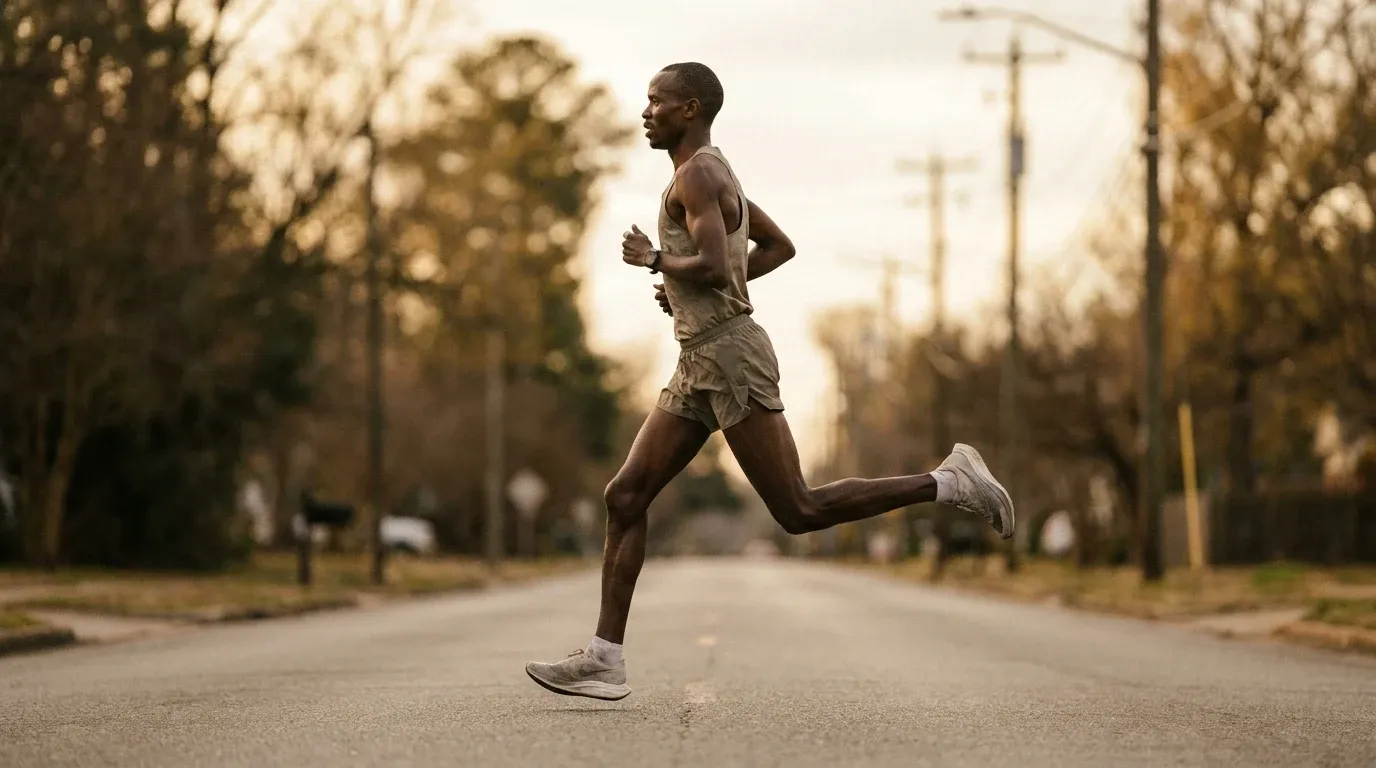
John Korir Sawe has never been shy about his ambitions. But his latest claim, that he's convinced he can run a marathon in under 1 hour and 59 minutes, has sent a genuine ripple through the distance running world. After a string of elite performances that have put him squarely in the conversation for the sport's fastest, the question isn't whether Sawe is dreaming. It's whether the conditions for that dream to become reality could actually exist.
Sub-2 talk is back. And in 2026, it feels more urgent than ever.
Where Sawe Stands Right Now
Sawe has emerged as one of the most compelling marathon talents of the current era. His recent race results place him among a very small group of runners capable of sustaining the pace required to approach the two-hour barrier. He's shown the kind of late-race strength that separates physiological outliers from merely excellent runners.
His public statement about breaking 1:59 wasn't a throwaway line in a post-race interview. He said it with conviction, and the people around him, coaches, physiologists, training partners, haven't pushed back. That silence speaks volumes in a sport where unrealistic goals get quietly corrected by the people closest to the athlete.
If you've been following the marathon circuit, you already know that the gap between a 2:01 and a 1:59 is not just two minutes. It's a physiological chasm that most elite runners will never cross, no matter how hard they train or how perfectly they race. Sawe believes he's on the right side of that line.
What Kipchoge Actually Did in 2019
Any serious conversation about sub-2 starts with October 12, 2019, in Vienna. Eliud Kipchoge crossed the finish line of the INEOS 1:59 Challenge in 1 hour, 59 minutes, and 40 seconds. It was one of the most extraordinary athletic achievements in human history. It was also not ratified as an official world record.
The reasons are straightforward. World Athletics requires a race to be open to all athletes, not organized specifically around one competitor. The Vienna event used rotating pacemakers, a laser-guided light to set rhythm, and a course optimized for speed. These conditions, while brilliant in their engineering, fell outside the rules governing official records.
Kipchoge's official marathon world record, set in Berlin in 2023, stands at 2:00:35. That's the number that counts in the record books. The 1:59:40 in Vienna remains the benchmark for what's humanly possible, but it exists in a different category. It's proof of concept, not official history.
That distinction matters enormously when you ask whether Sawe, or anyone, can go sub-2 under conditions that would actually count.
The Physiology of Two Hours
Running a marathon in under two hours requires sustaining a pace of approximately 2:50 per kilometer, or 4:34 per mile, for 42.195 kilometers. The aerobic and biomechanical demands are almost absurd when written out in those terms.
Research has consistently shown that athletes capable of approaching this threshold share a specific combination of traits: an exceptionally high VO2 max (typically above 84 ml/kg/min), elite running economy, a high lactate threshold relative to their maximum oxygen uptake, and the ability to sustain fat oxidation at race pace to spare glycogen stores. These factors don't just add up. They compound.
Sawe's profile, based on his race performances and the paces he's demonstrated late in marathons, suggests he possesses several of these traits at an elite level. Whether all of them align to the degree required for sub-2 is still an open question. But it's no longer a ridiculous one.
Footwear technology has also continued to evolve. Carbon-fiber plate shoes have demonstrably improved running economy by a meaningful margin, with studies suggesting efficiency gains in the range of 4 percent compared to traditional race flats. Those gains are already baked into the times being run today. Any future sub-2 attempt will benefit from further refinements in that space.
The Official Race Conditions Problem
Here's where the realistic optimism hits a wall. Kipchoge's 1:59:40 required conditions that World Athletics simply won't sanction for record purposes. Rotating pacemakers alone are a disqualifying factor under current rules. A sub-2 in an official race means running that pace with a realistic pacemaking setup, without a laser guide, and on a course that meets standard eligibility criteria.
The current official world record of 2:00:35 is already extraordinary. Shaving 36 seconds off that, under sanctioned conditions, would represent a leap that most exercise scientists consider highly improbable within the next few years. Not impossible. Improbable.
That said, the sport has a habit of humiliating probability. The four-minute mile was once described in similar terms. Kipchoge himself broke 2:01 in a race that almost no one had penciled as a realistic target before it happened.
The conversation is also broader than just one athlete. Chicago Marathon 2026 produced results and performances that reinforced just how deep the elite marathon field has become globally. Multiple athletes are now regularly competing in the 2:01 to 2:03 range, which was unthinkable territory even a decade ago. The ceiling is rising faster than most predicted.
What Would a Realistic Sub-2 Attempt Look Like?
If Sawe is serious, and the evidence suggests he is, the pathway to sub-2 under official conditions involves a few non-negotiable elements.
- Course selection: A flat, fast course with minimal turns and ideally a net-legal elevation drop. Berlin remains the gold standard, though a purpose-selected route could theoretically be designed to meet record eligibility criteria.
- Weather: Cool temperatures, ideally between 8 and 12 degrees Celsius (46 to 54 degrees Fahrenheit), low humidity, and a tailwind within legal limits. These conditions are rare and cannot be manufactured.
- Pacing structure: Without rotating pacers, Sawe would need a small, extremely capable group of pacemakers capable of maintaining sub-2:50 per kilometer for the first 30 to 35 kilometers. Finding runners who can do that and stay legal is genuinely difficult.
- Physical peak: Athletes at this level have narrow windows of peak form. Timing a sub-2 attempt to land within that window, while managing injury risk during preparation, is an enormous logistical and physiological challenge.
Preparation for a record attempt of this magnitude also demands an almost clinical approach to training load and recovery. If you want to understand what elite marathon preparation looks like at its most demanding, the final peak week of marathon training is where champions are made or broken.
Who Else Is in the Conversation?
Sawe isn't alone in this territory, and he'd be the first to acknowledge it. The post-Kipchoge era has produced a cluster of athletes running times that would have been considered generational just fifteen years ago. Several Kenyan and Ethiopian runners have posted performances that put them within theoretical striking distance of the barrier.
What distinguishes Sawe's claim from the noise is the specificity. He didn't say he thinks he can run 1:59 eventually, in the abstract. He said he believes he can do it. That's a different kind of statement, one that tends to come from athletes who have done the physiological testing and the honest self-assessment required to back it up.
The women's marathon landscape is evolving just as rapidly. Women-only racing events are growing in 2026, partly because the female elite marathon field is producing performances that deserve their own spotlight, not a secondary conversation.
The Bigger Picture for Running in 2026
Sub-2 talk matters beyond the record itself. It raises questions about the limits of human performance, the role of technology in sport, and what elite athletics will look like in the next decade. When Kipchoge ran 1:59:40 in Vienna, it changed the psychological landscape for every marathon runner on earth. The barrier became imaginable in a way it never had been before.
Sawe's conviction does something similar. It keeps the conversation alive and reminds the running world that the next breakthrough might not be as far off as the record books suggest.
The sport has always moved forward on the back of athletes who refused to treat existing limits as permanent. Whether Sawe is the one to break 1:59 officially, or whether that honor belongs to someone else entirely, his belief that it's possible is itself a meaningful data point. The humans running these distances are getting faster. The science supporting them is getting sharper.
For anyone serious about understanding what the body is capable of, this is one of the most compelling stories in sport right now. And it's far from over. Inspiration takes different forms. Sometimes it looks like a runner returning from a shattered leg to complete a 160K ultra. Sometimes it looks like a man telling the world he intends to break a barrier most thought would stand for a generation.
Either way, the finish line keeps moving. And that's exactly the point.