
Sabastian Sawe ran the first sub-2-hour marathon in race history. 1:59:30. London, April 26, 2026. The result is in the books. But how exactly did he do it?
Here's the technical breakdown — pacing strategy, shoe science, course factors, and what this performance actually means for the sport.
The Pacing: Near-Machine Consistency
To run 1:59:30 over 26.2 miles, Sawe needed to hold an average pace of roughly 4:34 per mile (2:50 per kilometer) for the entire race. No margin for error. No slow miles to coast through.
For the first 25 miles, Sawe and Yomif Kejelcha ran shoulder to shoulder, carried by rotating groups of elite pacemakers who handed off every 5 to 10 kilometers. The strategy was disciplined: no surges, no gaps, no tactical chess. Just two athletes locked into a pace that no human had ever sustained in a legal marathon.
What makes it remarkable: Sawe said he didn't realize he was on sub-2-hour pace until he spotted the clock near the finish. Only then did he accelerate — his one and only pace variation across the entire race.
Kejelcha crossed in 1:59:41. His first-ever marathon. Jacob Kiplimo finished third in 2:00:28 — a time that would have been a world record one month earlier. Before April 26, only 4 men had ever broken 2:02. By the end of the race, there were 9.
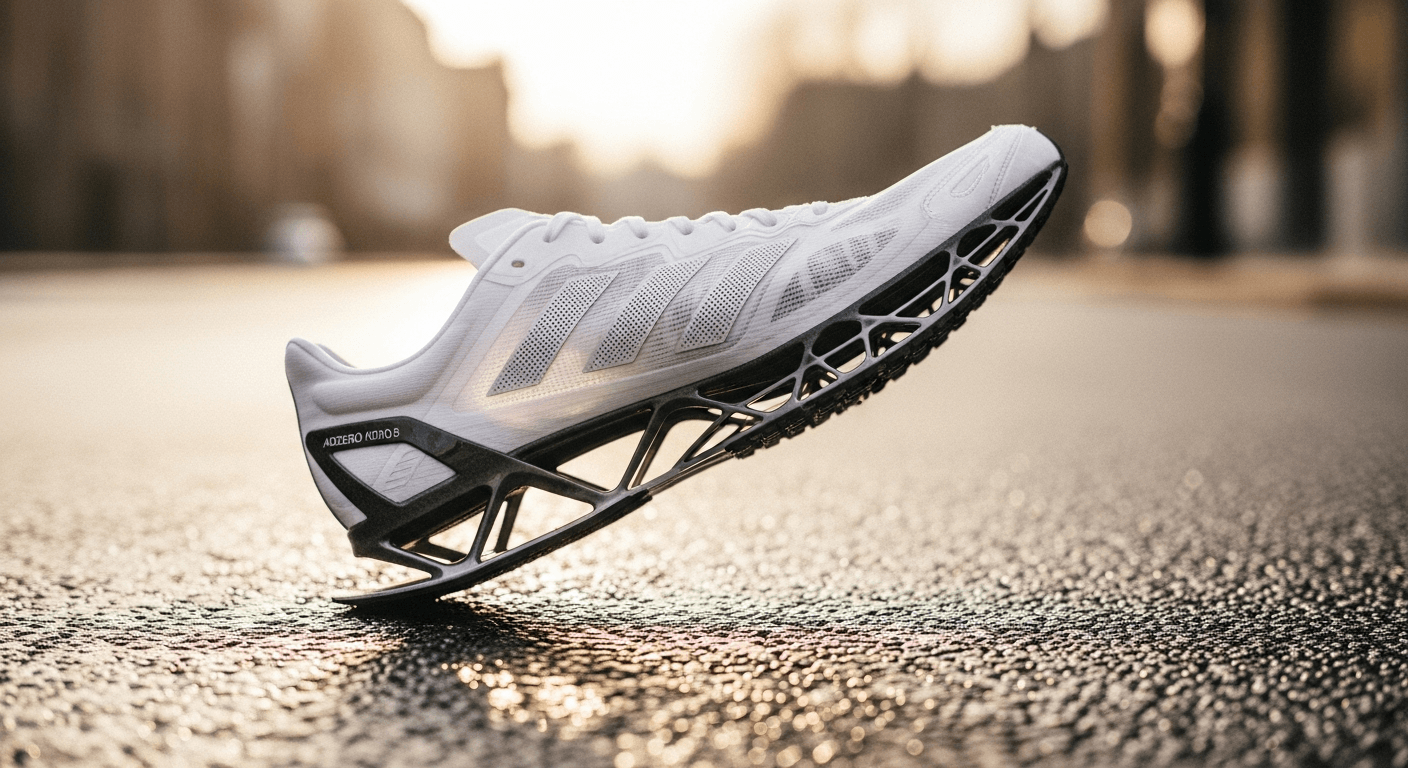
The Adidas Adizero Adios Pro Evo 3: 97 Grams of Race Science
All three podium men wore the same shoe. Tigist Assefa, who shattered the women's world record in the same race, wore it too.
The Adidas Adizero Adios Pro Evo 3 weighs 97 grams. That's the lightest competition-legal running shoe ever built. Its predecessor — already a record-setter — was 30% heavier.
What that weight reduction means in practice: a marathon runner takes roughly 20,000 strides during 26.2 miles. Every gram saved translates to roughly 44 pounds less total weight lifted across the race. At 97 grams per foot, the energy savings add up fast.
The shoe's structure relies on a carbon-fiber plate embedded in Adidas's LIGHTSTRIKE PRO foam — the most responsive midsole material the brand has produced. The geometry is tuned to maximize energy return at ground contact. Research on carbon-plate shoes consistently shows 4 to 5% metabolic efficiency gains compared to traditional racing flats.
Could Sawe have broken 2 hours without this shoe? Impossible to know. But the fact that all four top finishers wore carbon-plate supershoes — and the top three wore the exact same model — tells you the technology isn't a marginal edge anymore. It's a baseline requirement at this level.
The London Course: What the Headlines Missed
London isn't traditionally the go-to course for world records. Berlin has long been the benchmark. So why London in 2026?
A set of factors aligned on race day.
The weather: 12°C, overcast, moderate humidity. Close to physiological ideal for thermoregulation during maximal effort. Heat is one of the biggest performance limiters in marathons; London's April slot consistently delivers cooler conditions than fall marathons in warmer climates.
The course profile: flat, World Athletics-certified, with wide turns that don't break stride rhythm. The city streets provide natural wind shelter during key segments.
The pacer setup: a carefully selected relay of elite athletes — several of them among the world's best marathoners — who maintained target pace with watch-precision across the full distance.
Sawe vs. Kipchoge in 2019: Same Time, Different World
In October 2019, Eliud Kipchoge ran 1:59:40 in Vienna as part of the INEOS 1:59 Challenge. The run wasn't ratified as a world record: it wasn't a competition, the pacemakers ran in a rotating V-formation, and Kipchoge was handed drinks from a vehicle.
Sawe ran 10 seconds faster, in an open race, against other athletes, under standard competition rules.
The comparison isn't even close. What Kipchoge proved was theoretically possible, Sawe proved in the arena.
What This Shifts for Elite Marathon Running
Before April 26, only 4 men had run sub-2:02. After race day, there were 9.
That number signals a shift in what the sport's ceiling looks like. Shoe technology, training methodology, nutrition science, and pacer systems are converging to create a new performance standard.
Sawe has already said he's targeting 1:58. Six months ago, that would have sounded absurd. Today, it sounds like a training goal.
For recreational runners, the takeaway isn't the absolute numbers — it's the method. Consistent pacing beats heroic surges. Optimized gear matters at every level. Conditions are variables you can plan for. These principles apply whether your goal is a first marathon finish or a 3-hour qualifier.