
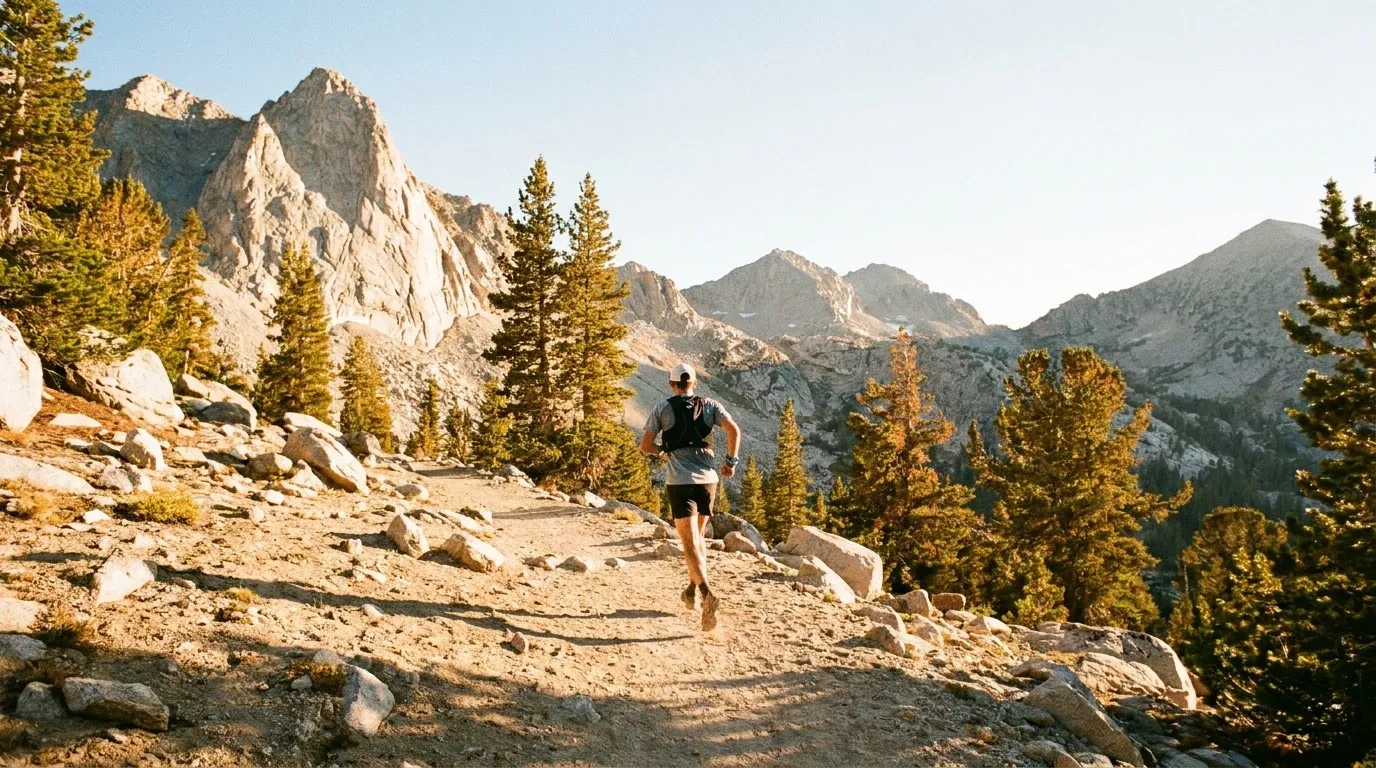
Stringbean Sets a New John Muir Trail FKT — and It's a Masterclass in Mountain Pacing
Joe "Stringbean" McConaughy did it again. On September 21, 2026, he crossed the finish line of the John Muir Trail with a new men's supported fastest known time in hand, cementing his place as one of the most accomplished long-distance record holders the sport has ever produced. The run wasn't just fast. It was a clinic in how to move efficiently over brutal terrain for days on end.
If you care about trail running, FKTs, or simply what human endurance looks like at its ceiling, this one is worth paying attention to.
What the John Muir Trail Actually Demands
The John Muir Trail stretches approximately 211 miles through California's Sierra Nevada, running from Yosemite Valley south to the summit of Mount Whitney, the highest peak in the contiguous United States at 14,505 feet. It's not just long. The cumulative elevation gain across the route exceeds 47,000 feet, meaning runners are constantly climbing or descending through high-altitude passes with no flat recovery miles to lean on.
The terrain punishes poor pacing. Go out too fast on the early passes and your legs won't carry you through the brutal southern stretch. Miscalculate your nutrition at altitude and your output drops sharply. The JMT doesn't forgive the same errors a road ultramarathon might absorb.
For anyone curious about how the body's nutritional demands shift in that kind of environment, eating at altitude changes your body's needs in ways most runners underestimate. Caloric demand rises. Appetite often drops. Managing that gap is a skill in itself.
Who Is Stringbean, and Why Does This Record Matter
McConaughy earned the nickname "Stringbean" for his lean frame, but his resume is anything but slight. He previously set the fastest known time on the Appalachian Trail, a 2,190-mile route through the eastern United States, making him one of the few athletes to hold elite FKTs on multiple major American long trails. The JMT record adds to a body of work that places him in a category of his own in the long-distance running world.
His approach has always been methodical. He's not a runner who blows the doors off early and hopes to hold on. He builds pace deliberately, protects his body through the middle miles, and tends to get stronger as lesser-prepared attempts fall apart around him.
That kind of aerobic discipline is rooted in something most recreational runners overlook. your easy runs are the foundation every hard effort is built on, and elite FKT athletes internalize this better than almost anyone. McConaughy's ability to sustain output across multiple days comes from years of building and protecting his aerobic base, not just racing hard.
Supported Format: What It Means and Why It Matters
The JMT FKT record McConaughy broke falls under the "supported" category, which is one of three formats recognized in FKT tracking: unsupported, self-supported, and supported. In a supported attempt, a crew manages logistics, including food drops, gear, sleep arrangements, and medical checks. The athlete's only job is to keep moving and recover between efforts.
That might sound like an advantage that diminishes the achievement, but consider what it actually demands. When you remove logistical cognitive load from an athlete mid-attempt, you're not making the physical effort easier. You're allowing them to direct every ounce of mental and physical energy toward movement and recovery. The pacing decisions, the effort management, the pain tolerance required across 211 miles of mountain terrain. none of that gets easier because someone handed you a sandwich at a trail junction.
The supported format also puts a premium on crew communication and team strategy, which is its own layer of complexity. A poorly organized crew can cost a runner hours. A well-run operation lets the athlete stay in a performance state rather than problem-solving mode.
FKT Culture Is Exploding — Here's Why
FKT attempts have surged dramatically since 2020, and the growth hasn't slowed. Trail running participation increased sharply during the pandemic years as runners sought outdoor alternatives to canceled races, and many of them never went back to the traditional race calendar. FKTs offered something races couldn't: a record attempt on your own terms, on terrain you chose, measured against history rather than a field of competitors.
The FKT tracking site now logs thousands of routes across dozens of countries, and high-profile attempts regularly pull significant media attention and sponsorship interest. It's one of the fastest-growing corners of the sport, sitting somewhere between organized competition and pure exploration.
This shift in how runners define achievement connects to a broader cultural moment in trail running. trail running's future depends on expanding beyond its established hubs, and FKTs are part of that expansion. They don't require race permits, course markings, or entry fees. They democratize the record book in a way traditional race structures never could.
What Stringbean's Pacing Strategy Teaches Everyday Runners
You're almost certainly not planning a JMT FKT attempt. But the principles McConaughy applies at the extreme end of endurance translate directly to how you approach long trail days, ultras, and even road races.
Here's what his approach reveals:
- Effort by feel over pace by number. At altitude with variable terrain, GPS pace is largely meaningless. McConaughy has spoken about running to perceived effort, which is a skill most runners never fully develop because they're too attached to their watch data.
- Sleep and recovery are not optional. Supported FKT athletes plan rest windows strategically. Skipping sleep to gain miles sounds logical until cognitive function degrades and foot placement suffers. Short, timed rest outperforms grinding through exhaustion.
- Nutrition starts before you're hungry. By the time you feel depleted at elevation, you're already behind. The same principle applies at any race distance. Front-loading fuel during comfortable sections builds a buffer for harder miles later.
- Slow early, fast late. The most consistent long-distance runners share one trait: patience in the opening miles. What looks like conservative early pacing from the outside is actually the entire strategy.
For runners building toward long events, footwear and gear decisions matter more than most people account for. in the longest trail races, footwear technology has become a significant factor in who actually finishes, and that's just as true on a multi-day FKT attempt as it is in a 200-mile race.
The Physiological Reality Behind the Record
Running 211 miles with 47,000-plus feet of elevation gain isn't just a matter of willpower. It requires specific physiological adaptations: a high VO2 max, exceptional fat oxidation capacity, superior muscular endurance in the quads and glutes, and the ability to maintain motor control under extreme fatigue.
Research consistently shows that elite ultra-endurance athletes aren't simply running harder than recreational athletes. They're running more efficiently at lower relative intensities, burning fat rather than carbohydrates as their primary fuel source, and maintaining neuromuscular coordination long after recreational runners would see their form collapse.
That neuromuscular component is worth highlighting. When form breaks down, injury risk climbs and energy cost rises. Keeping your stride efficient through hours of accumulated fatigue is trainable, but it takes deliberate practice at genuinely easy paces. Most runners run their easy days too fast to build this adaptation properly.
Even short efforts at genuinely low intensity carry measurable benefits. just ten minutes of slow jogging produces meaningful changes in brain chemistry and mood, which hints at why low-intensity volume is such a durable training tool even for athletes targeting extreme events.
What This Record Signals for the Sport
McConaughy's JMT FKT isn't just a personal achievement. It's a signal about where elite long-distance running is heading. Records on major American trails are being tracked with the same seriousness as podium finishes at marquee ultramarathons. Sponsors are paying attention. Media coverage is growing. The FKT record book is becoming a legitimate stage for elite competition.
At the same time, FKTs remain accessible to ordinary runners in a way that elite ultramarathon podiums never will be. You can set a fastest known time on a local trail with no entry fee, no race bib, and no competitors. You're racing the record, and if there isn't one yet, you set the benchmark yourself.
That accessibility, combined with the visibility of attempts like McConaughy's JMT run, is pushing more runners toward goal-oriented exploration of the trails around them. It's a healthy direction for a sport that sometimes loses sight of the fact that the mountains don't care about your finishing time. They only ask whether you showed up prepared.
McConaughy showed up prepared. The record reflects it.