
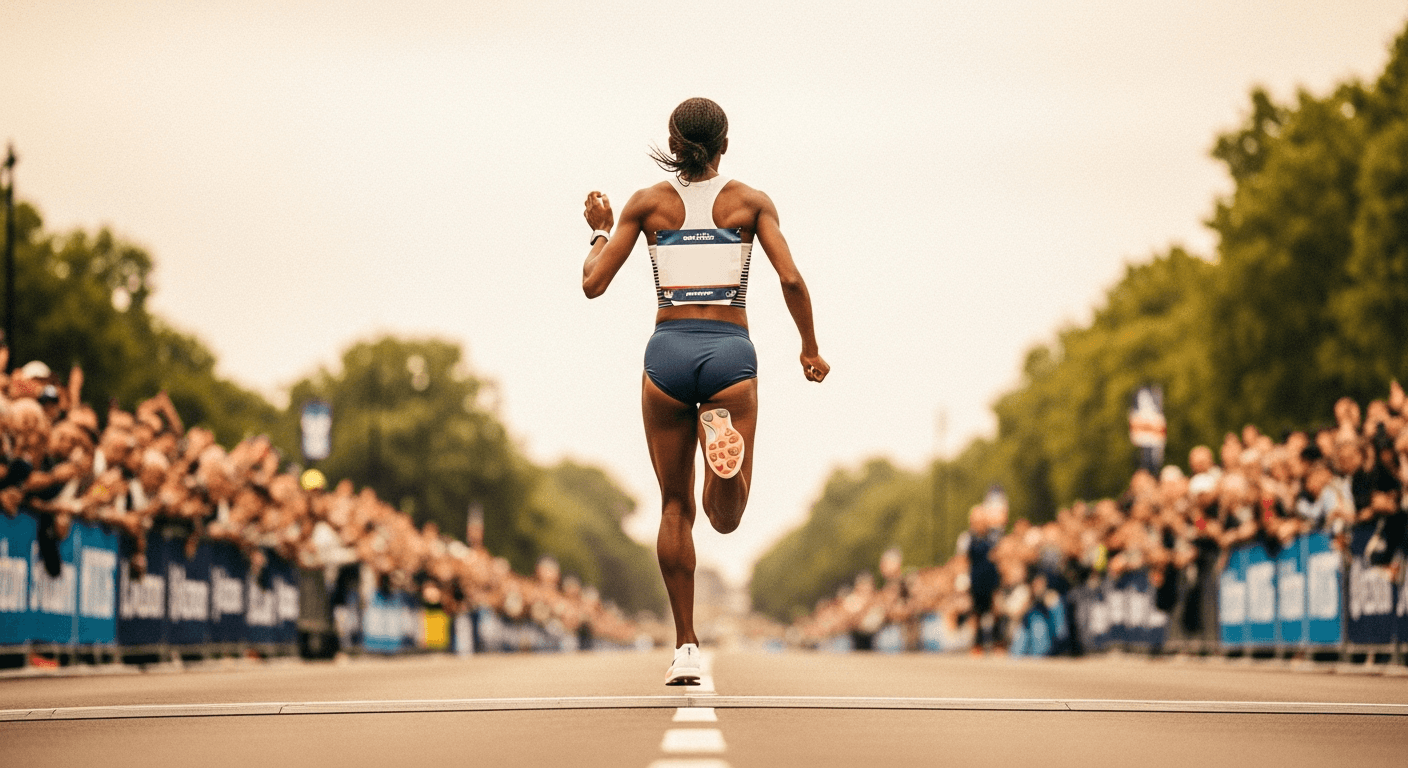
Tigist Assefa Shatters the Women's Marathon World Record at London 2026
On a Sunday morning in London that will be remembered as the most record-breaking day in marathon history, Tigist Assefa crossed the finish line in 2:15:41. Two men broke the two-hour barrier on the same course. Headlines split in a dozen directions. And yet, quietly and completely, Assefa delivered one of the greatest women's marathon performances ever run.
It's worth stopping to fully absorb what that time means. Not just as a number, but as a statement about where women's distance running is heading and how fast it's getting there.
What Happened in London
Assefa defended her London Marathon title while simultaneously lowering the women's-only world record, a category that carries specific and significant meaning in the sport. Her 2:15:41 bettered her previous mark and placed her in a tier of performance that, just a few years ago, few believed was physiologically possible for women running without male pacemakers.
For a full breakdown of how the day unfolded across both fields, the London Marathon 2026 results and final standings capture every split and finish from one of the most extraordinary days the sport has ever produced.
Assefa ran controlled and purposeful through the first half before building pressure on the second. Her execution was near-perfect. She didn't fade. She accelerated. That kind of negative-split racing at world-record pace reflects a level of preparation and physical conditioning that sits at the very edge of human capability.
Why the Women's-Only Record Matters
The women's marathon world record exists in two forms. The open record, currently held by Brigid Kosgei at 2:14:04, was set in Chicago in 2019 with male pacemakers helping to shield her from wind and set an aggressive tempo. The women's-only record applies to races run without male assistance, in a fully competitive field. It's the more contested category because it reflects exactly what women can do against women, on equal terms.
Assefa's 2:15:41 in London falls into this second category and represents a benchmark that matters differently than a time trial. It means she ran that fast in a race, under pressure, without any external drafting advantage from men. That context elevates the performance considerably.
Critics have long argued the open record is a hollow benchmark because the conditions are manufactured. Assefa's London time answers that argument directly. She didn't need manufactured conditions. She ran through them.
A Trajectory That Rewrites the Curve
To understand how remarkable this is, you need to look at where Assefa started. In 2022, she ran 2:21:01 at the Berlin Marathon in her debut. It was a world debut record at the time, and it announced her as a future great. But 2:21 to 2:15:41 in four years is a different kind of progression.
Elite women's marathon times don't typically improve at that rate. Training adaptations compound slowly. The marathon is physiologically brutal in ways that limit how quickly even the most gifted athletes can push their ceiling. An improvement of more than five minutes across four years, at the elite level, is one of the steepest climbs the sport has ever documented.
Her development mirrors broader trends in women's endurance training, where advances in altitude preparation, personalized load management, and nutritional science are allowing athletes to extend their peak performance windows. Fueling for elite-level training has become increasingly precise. The relationship between protein intake, glycogen management, and recovery is better understood now than it was even five years ago. If you're curious how those principles apply beyond elite sport, how much protein you actually need per day in 2026 breaks down the latest evidence-based recommendations for endurance athletes at every level.
The Most Record-Breaking Marathon Day in History
Assefa's run happened on a day that already had history written into it before the gun went off. Two male runners broke the two-hour barrier in the open division, a threshold that has defined the frontier of human endurance performance since Eliud Kipchoge's assisted 1:59:40 in 2019. Their times made the morning feel seismic.
But the framing that treated Assefa's performance as secondary reveals something worth challenging. She ran 2:15:41 in a women's-only competitive setting. That's not a footnote to the men's results. It's a parallel chapter of the same story, and in some ways a more nuanced one because her record carries no asterisks about pacing assistance.
The fact that all three world records fell on the same day, on the same course, under the same conditions, says something significant about how London has positioned itself as the proving ground for the sport's outer limits.
What Her Dominance Means for 2026 and Beyond
Assefa is 27 years old. She is, by most physiological models, somewhere near or approaching her performance peak for the marathon distance. That combination of current dominance and developmental runway makes her the most compelling figure in women's distance running right now.
Her London victory also sets a competitive bar that few others are currently equipped to challenge. A small group of Ethiopian and Kenyan runners has come within a few minutes of her marks, but the gap between Assefa and the rest of the women's field in London was not particularly close. That kind of separation at world-record pace is rare.
The question her performances are now forcing is one that felt premature until recently. Is a sub-2:10 women's marathon possible, and if so, on what timeline?
Is Sub-2:10 a Real Target?
The honest answer is yes, probably, but not soon. Here's how the math works. The improvement curve in women's marathon times has accelerated sharply over the past decade. The current women's-only world record sat above 2:17 as recently as 2023. Assefa has moved it by nearly two minutes in that span. If that rate of improvement continues, even partially, times in the 2:12 to 2:13 range become plausible within three to five years.
Getting to 2:10 requires something beyond what current training models produce. It likely requires a combination of factors: a runner with Assefa's economy and aerobic capacity, a near-perfect racing day, continued advances in footwear technology, and optimal course conditions. None of those are guaranteed to align. But none of them are impossible either.
The men's two-hour barrier sat in roughly the same category of "theoretically possible but not imminent" for years before it fell. Women's marathoning is tracking a similar arc, just offset by time and historical underinvestment in elite female athlete development.
It's also worth noting that Assefa's dominance could inspire a generation of younger Ethiopian and Kenyan runners currently in junior competition. The effect of a visible ceiling-breaking performance on the next wave of talent is hard to quantify but historically significant. When a record moves sharply, it often signals that the field is about to get faster around it.
What You Can Take From This
For most runners, a 2:15 marathon might as well be a different sport. And in terms of raw physiology, it largely is. But the principles behind Assefa's performance are not entirely alien to anyone serious about improving their running.
The discipline of training consistently across years, not chasing fitness peaks in months. The commitment to race-specific preparation. The willingness to run the second half faster than the first when everything in your body is telling you to back off. These are not elite-only concepts.
If you're building toward a serious race goal this year, the approach to structured preparation applies whether you're targeting a sub-four marathon or something more niche. The mental architecture of long-term athletic development shows up across disciplines, and the training principles in resources like how to make the switch from road to trail running in 2026 reflect similar frameworks of patience and specificity.
And if your targets extend beyond road racing entirely, the same logic of incremental structured load applies. Athletes preparing for events like HYROX use comparable models of progressive overload and race-day execution. The complete race prep guide for HYROX training walks through those principles in detail for anyone making that transition.
A Record That Deserves Its Own Moment
Tigist Assefa ran 2:15:41 at London 2026. She defended her title. She reset the women's-only world record. She did it on the same day two men made history and didn't let that noise diminish what she built over four years of extraordinary development.
Women's marathon running is in one of the most exciting periods in its history. The records are moving. The depth of competition is growing. And right now, Assefa is leading all of it from the front.
Watch this space. The next record won't take long.