
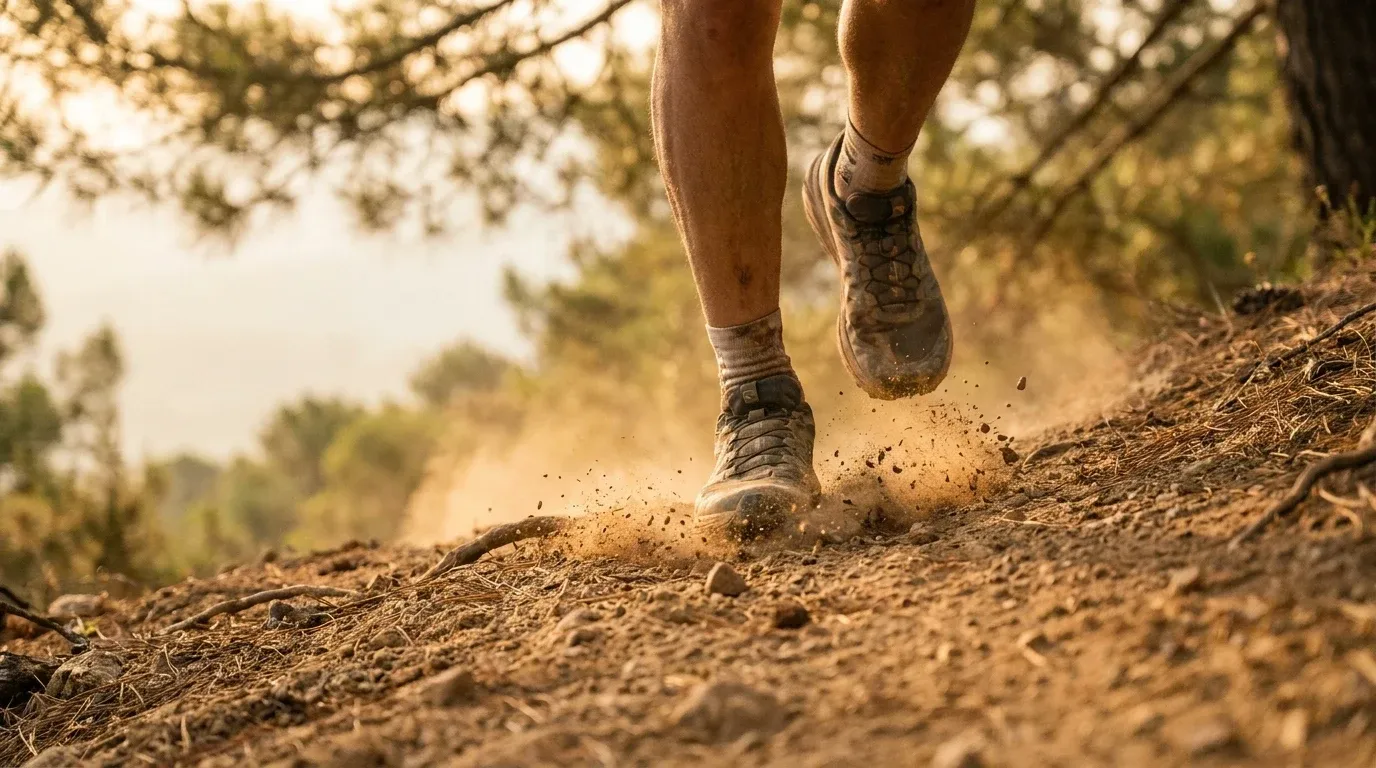
Every trail runner has heard the accusation at some point. You're at a trailhead, lacing up, and a hiker or land manager gives you the look. The implication is clear: you're part of the problem. You're churning up the soil, widening the path, sending dirt into the streams below. But how much of that is actually true? A year-long field study conducted in Spain's Sierra de Guadarrama National Park has now produced hard numbers, and the results are more nuanced than the conventional wisdom suggests.
The Study That Put Trail Users Head to Head
Researchers in Sierra de Guadarrama set up a controlled field experiment across a range of trail gradients and surface types. Over twelve months, they tracked erosion caused by three groups: trail runners, mountain bikers, and hikers. They measured soil displacement, rut formation, trail widening, and sediment loss under real-world conditions. Not simulations. Not lab estimates. Actual trails, actual users, actual weather.
The study design accounts for something most anecdotal debates miss: gradient. A flat trail behaves completely differently from a 25-degree descent when a mountain bike tire or a trail shoe hits it at speed. The researchers controlled for this, and it's where the data gets genuinely interesting.
The findings have since circulated through the trail management and ultrarunning communities, prompting race directors and national park authorities to reassess how they categorize user impact. If you organize trail events, manage a running club, or simply care about keeping your favorite singletrack open, the details matter.
Mountain Biking on Steep Ground: The Clear Outlier
The study's most definitive finding is that downhill mountain biking on steep gradients causes significantly more erosion than any other trail user group measured. The mechanism is straightforward: a braking tire under load drags across the soil surface, displacing material laterally and creating ruts. Those ruts then act as channels. When rain arrives, water follows the ruts rather than spreading across the trail surface, which accelerates erosion exponentially.
On gradients above roughly 15 degrees, the difference between mountain bikers and trail runners was not marginal. It was categorical. Rut depth, soil compaction patterns, and sediment loss all pointed in the same direction. Downhill biking at speed on steep, loose, or clay-rich soils generates a level of surface disruption that trail runners, even in large groups, don't replicate.
This doesn't mean mountain biking is inherently destructive. On moderate gradients and hardpack surfaces, the impact differentials narrow considerably. Context matters. But the blanket assumption that "all non-hikers damage trails equally" doesn't hold up to measurement.
What Trail Runners Actually Leave Behind
Trail runners occupy a meaningfully different position in the erosion data. Their footprint is lighter than mountain biking on steep terrain, and in most conditions it's comparable to or only marginally worse than hiking, particularly when group sizes are controlled.
The primary mechanism of runner-caused erosion is repeated foot strike in the same narrow corridor. Over time, this compacts and destabilizes the surface layer, particularly on wet trails with soft or organic-rich soils. Switchback cutting is another documented issue: runners taking the straight line instead of the zigzag corner remove vegetation, expose bare soil, and create new erosion vectors that weren't part of the original trail design.
That said, the study found that a solo trail runner, or even a small group, leaves a measurably lighter mark than the mountain bike scenarios that generated the most damage. The key variable for runners is volume. A well-organized 500-person trail race passing through the same section in a compressed time window creates cumulative impact that a single runner never would. Timing, trail surface, and seasonal conditions all shape how much any given event actually costs the landscape.
If you're pushing your limits on mountain trails and thinking about how to perform at altitude, fueling correctly for high-elevation runs is one of those details that makes the difference between a strong finish and a death march, and it's worth getting right before race day.
What This Means for Race Planning
The Sierra de Guadarrama data has direct implications for how trail races should be designed and permitted. The research points toward several variables that race directors can actually control.
- Trail gradient selection: Routing races along moderate gradients where possible reduces per-runner impact significantly. Steep descents are where soil displacement spikes.
- Seasonal timing: Wet soils are dramatically more vulnerable. Running 400 people over a trail in February after a week of rain is not the same as running them over the same trail in dry July conditions.
- Surface type: Rocky, hardpack, and well-drained trails tolerate traffic far better than clay or organic soils. Course designers who factor in surface geology are making a measurable difference.
- Field recovery periods: The study reinforces the case for rotating race routes across seasons rather than hammering the same corridors year after year.
- Group density management: Wave starts and controlled runner spacing reduce the concentrated impact of large fields on vulnerable sections.
None of this is radical. But it represents a shift from treating trail erosion as a fixed cost of running events to treating it as a variable that good planning can actually manage.
Trail Advocacy and the Numbers You Need
One underappreciated value of this research is that it gives trail runners and race organizations something concrete to bring to land management conversations. If a national park authority is considering restricting trail running events, the argument "trust us, we're not that bad" is weak. The argument "here's peer-reviewed field data showing our impact relative to other user groups, and here's how we plan to mitigate the specific risk factors" is a fundamentally different conversation.
Trail running has grown fast. The sport looks nothing like it did fifteen years ago in terms of participation numbers, race frequency, and geographic reach. Women winning ultras outright is just one marker of how the sport has matured. That growth has brought legitimate scrutiny. The response that serves runners best is not defensiveness but evidence-based engagement.
Park managers and conservation bodies are generally not anti-runner. They're trying to manage finite resources under pressure from multiple user groups, and they respond to organizations that take the science seriously. Running clubs and race directors who show up with monitoring plans, post-event trail assessments, and a willingness to modify routes when damage thresholds are exceeded will keep access open. Those who don't will eventually lose it.
Individual Runners Have a Real Role Here Too
It's easy to frame trail impact as purely an organizational issue, something for race directors and park authorities to sort out while you just run. But individual choices compound across thousands of runners and hundreds of thousands of trail hours per year.
Staying on the marked trail rather than cutting corners is the single most effective thing you can do. It sounds obvious, but switchback shortcuts are one of the most documented sources of trail damage in mountain environments. After heavy rain, choosing a different route or postponing your run matters. Wet soils can sustain damage in a single session that takes months to recover.
Strength and conditioning also plays a role that's rarely discussed in this context. Runners with stronger hips, glutes, and ankles have better control on technical terrain, which means less stumbling, fewer uncontrolled footfalls, and less inadvertent surface disturbance. The minimum effective dose of strength training is lower than most people assume, and the trail benefits extend well beyond injury prevention.
Running form under fatigue matters too. When you're exhausted late in a long effort, your foot strike gets heavier and less precise. Structured training that builds fatigue resistance, including the kind of compromised running that HYROX athletes use to build late-race resilience, has practical implications for how gently you land on the trail when it counts most.
The Bigger Picture
The Sierra de Guadarrama study won't settle every argument about trail access or user responsibility. But it moves the conversation from opinion to evidence, and that's exactly where trail running's future depends on it being.
The sport's relationship with public land is not guaranteed. It's earned, continuously, through the decisions that runners, race organizers, and advocacy groups make every season. The science now shows that trail runners, managed well, are not the destructive force that the loudest critics claim. The challenge is making sure the sport's behavior matches what the data shows is possible.
That means smarter race planning, better individual habits, and a willingness to engage with land managers on their terms rather than ours. The trails are worth it.