
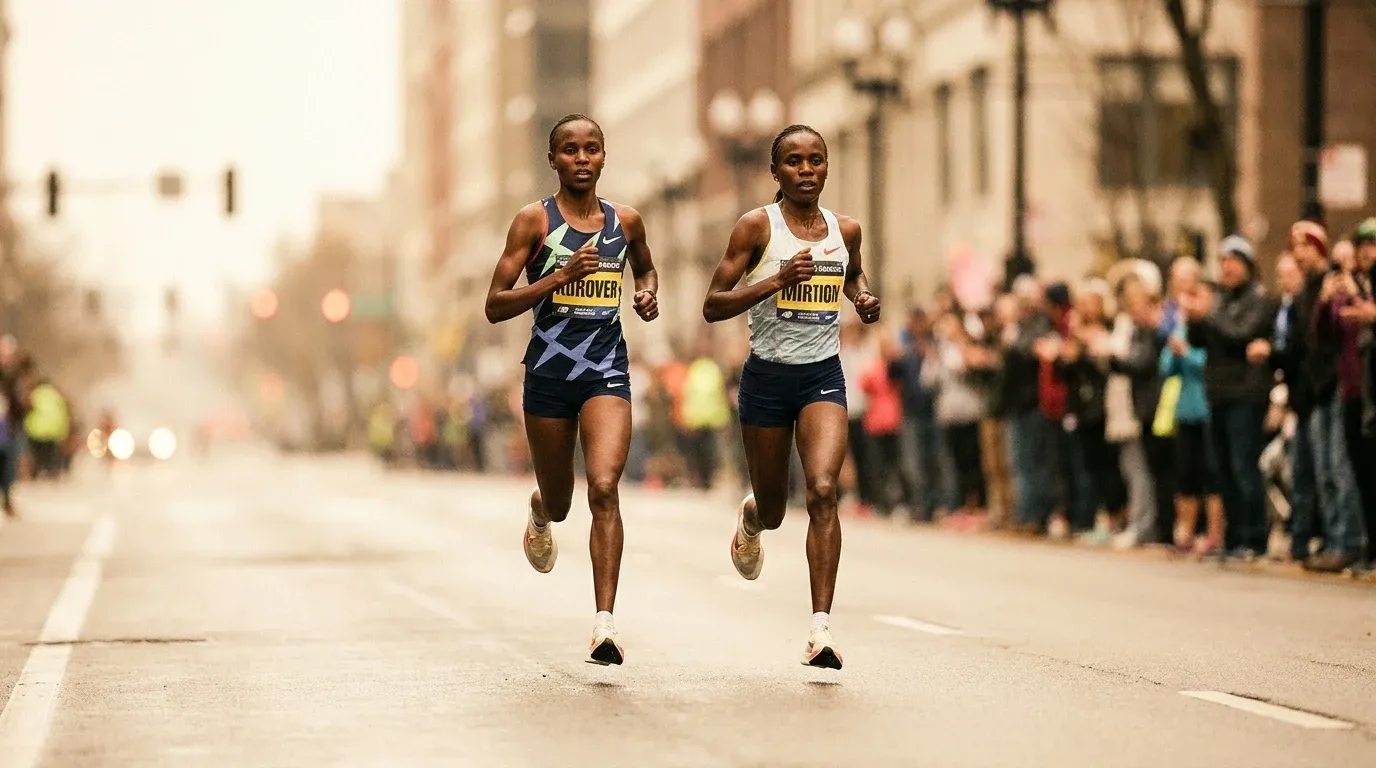
Something is shifting in women's marathon running. Not gradually, not quietly. The times being posted in 2026, the depth of the fields, and the names on the start lists suggest this may be the most competitive year the event has ever seen. If you've been paying attention, you already feel it. If you haven't, now's the time to start.
Jepchirchir Sets the Tone in Sydney
Peres Jepchirchir's victory at the 2026 Sydney Marathon was the kind of performance that reframes a season. The reigning Olympic champion crossed the line in dominant fashion, adding another world-leading result to a year that has already seen multiple women break or approach the sub-2:16 barrier. Sydney wasn't a standalone moment. It was a confirmation.
Jepchirchir has built her career on racing intelligently, not just physically. She reads fields with unusual precision, conserves when the pace demands it, and accelerates at moments that expose the limits of everyone around her. Sydney showed all of that again. She's not declining. She's refining.
What makes this season remarkable is that Jepchirchir's win is one of several world-class women's performances in 2026, not the only one. The depth behind her is unprecedented. On any given race weekend, you're watching six or seven women capable of running times that would have represented national records for most countries a decade ago.
Hassan vs. Jepchirchir: NYC Marathon Is the Main Event
The New York City Marathon in November is shaping up as the most anticipated women's matchup in years. Sifan Hassan, the Dutch distance phenom who holds world records across multiple distances and claimed marathon gold at Paris 2024, is slated to face Jepchirchir on a course that rewards tactical discipline and raw endurance in equal measure.
Hassan brings something different to every race she enters. Her background as a track specialist, particularly her middle-distance work, gives her a finishing kick that most pure marathoners simply can't match. When the pace is honest and the field stays together through 20 miles, Hassan becomes extremely difficult to beat in the final loop through Central Park.
Jepchirchir knows this. Her strategy will likely involve pushing the pace earlier, stretching the field before the final miles, and removing the race from Hassan's preferred finishing scenario. That tactical tension, two elite competitors whose strengths directly cancel each other out, is exactly what makes this matchup so compelling.
It's the kind of rivalry that doesn't just matter to runners. It matters to anyone who follows competitive sport. Expect the NYC women's start to draw a level of broadcast and streaming attention that would have been unthinkable for a women's marathon race ten years ago.
Prize Parity and the Sub-2:20 Ecosystem
Elite performance doesn't emerge in a vacuum. The conditions that produce it matter, and in women's marathon running, those conditions have improved substantially over the past three years.
Major marathons, including the Abbott World Marathon Majors, have moved closer to full prize parity between men's and women's fields. Several races now offer identical winner's purses, with top prizes at the largest events reaching $100,000 or more. That financial signal has accelerated professional development. Women who might have transitioned out of distance running in their late twenties are now staying in the sport longer, training harder, and racing more selectively.
The result is a sub-2:20 club that has grown faster in 2026 than in any previous year. More women achieving that benchmark means more competition at every race tier, faster average finishing times, and more pressure on the athletes at the very front. Records at the elite level tend to fall when the pack chasing them gets dense enough. Right now, the pack is dense.
This systemic shift is also changing what brands are willing to invest in. Shoe and apparel sponsorships for elite women marathoners have increased significantly, with multi-year deals that fund full training programs, altitude camps, and specialist coaching teams. The infrastructure of elite women's running looks different now than it did in 2020, and performance data shows it.
What's Driving the Depth
Several factors are converging to produce this moment. Training methodology has evolved, with more elite women integrating strength and mobility work alongside high-mileage blocks. Nutrition science is better understood and better applied at the professional level. Recovery protocols are more sophisticated.
Geography matters too. East African programs, particularly in Kenya and Ethiopia, continue producing exceptional talent. But the pipeline has widened. Dutch, British, American, and Japanese women are consistently placing in the top ten at majors. That geographic diversity changes race dynamics. You're no longer watching a field with one dominant nationality setting terms from the front.
The accessibility of performance data has also played a role. GPS tracking, lactate threshold testing, and detailed race analytics are now standard tools for professional programs across the globe. Athletes know more about their own bodies than they did ten years ago, and training is more precisely calibrated as a result.
The Ripple Effect on Recreational Runners
Elite visibility is measurable in participation data. Race registrations among women aged 25 to 44 have surged in 2026, with several major city marathons reporting that women now account for more than 50 percent of their entrant pool for the first time. That's not a coincidence. It correlates directly with the rise in elite women's coverage and the cultural moment those athletes are creating.
When you see Sifan Hassan run 26.2 miles at a pace most people can't sustain for 400 meters, something shifts in how the distance feels. It becomes more imaginable, not less. Elite performance, when it's visible and celebrated, functions as a kind of permission. It tells recreational runners that the marathon is a serious endeavor worth investing in.
That investment shows up in how recreational women are training. More structured programs, more attention to fueling, more willingness to join organized communities. If you're planning a fall race and looking for company, 60+ free group runs to kick off your fall season is a strong place to start building your training environment.
The broader participation boom extends beyond marquee city races. Local and regional marathons are also seeing record fields, part of a wider trend documented across the sport. Distance running's boom is lifting local marathons at every level, not just the events with global broadcast deals.
Choosing Your Race in This Moment
If the 2026 season is inspiring you to commit to your own marathon, the timing is good. Fields are energized, communities are active, and there's a genuine cultural current behind women's distance running right now. The challenge is picking the right event for where you are in your training and what kind of experience you want.
Course profile, travel logistics, field size, and qualifying standards all factor in. How to pick the right fall marathon for you in 2026 breaks down those variables clearly if you want a structured framework for the decision.
For those drawn to longer and more adventurous formats, the ultra circuit is experiencing its own surge in women's participation. Events like Ultra X Slovenia 2026, which drew 38 nations to the start line, are a signal that women's appetite for endurance challenges extends well beyond the 26.2 standard.
Why This Year Matters Beyond the Finish Line
The 2026 women's marathon season is not just a sports story. It's a story about what happens when investment, visibility, and competitive depth align. Prize parity attracts talent and extends careers. Extended careers produce more races, more rivalries, and more world-class performances. Those performances generate media coverage. That coverage draws recreational runners in. And those recreational runners fill the fields that fund the prize money.
It's a cycle that has taken years to build and is now accelerating noticeably. The Hassan vs. Jepchirchir showdown at NYC is the headline, but the real story is structural. Women's marathon running has developed an ecosystem that can sustain elite competition at a level the sport hasn't seen before.
What you're watching in 2026 isn't a peak. It's a baseline. The times being run this year, the fields being assembled, and the athletes still in the middle of their primes suggest that what comes next will raise the standard further. Pay attention now, because this is the season you'll reference when explaining how it all changed.