
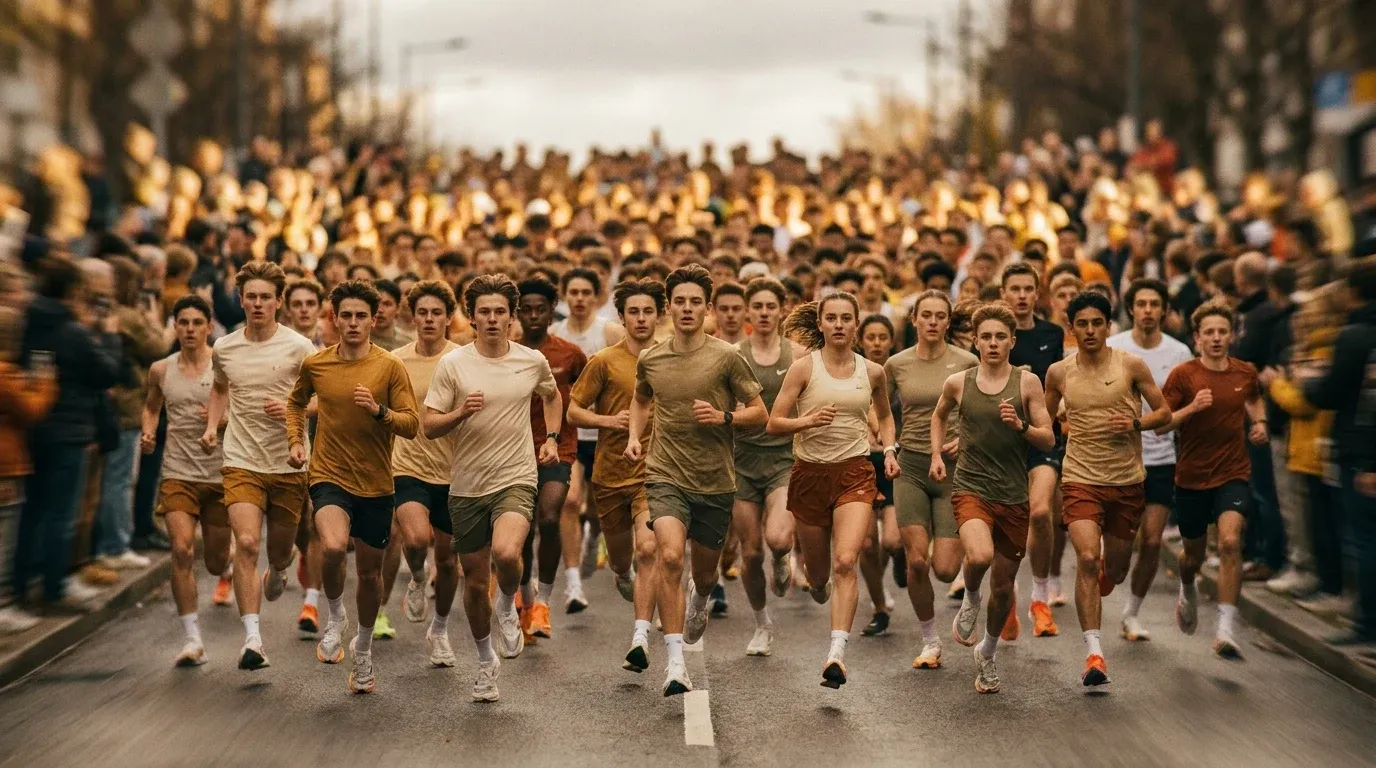
Something measurable is happening at start lines. Half marathon fields are up 20.9% in 2026, and the runners filling those corrals aren't the seasoned veterans you might expect. They're younger, many of them first-timers, and they're showing up in numbers that are forcing race organizers and running community leaders to rethink everything they thought they knew about participant demographics.
This isn't a blip. It's a structural shift, and understanding what's driving it is the difference between capitalizing on a generational wave and watching it pass you by.
The Numbers Are Hard to Ignore
Half marathons have long served as the entry point for competitive distance running. The format is achievable enough for a motivated first-timer but serious enough to feel like an accomplishment. That combination has always attracted younger runners, and the 2026 data confirms the format is doing exactly that at an accelerated pace.
A 20.9% increase in half marathon field sizes isn't just impressive on its own. It's significant because it tracks closely with participation data from younger age brackets. Race registration platforms have reported that the sharpest growth is concentrated among runners aged 18 to 34, a cohort that was largely absent from road races for much of the mid-2010s and early 2020s.
Even more telling is what's happening after the finish line. Churn rates among new registrants are unusually low. Runners who entered their first half marathon in 2024 or 2025 are coming back. They're signing up for longer distances, joining local running clubs, and in many cases recruiting friends into the sport. The pipeline isn't leaking. It's building.
This retention pattern matters enormously for the economics of race organizing. Acquiring a new participant costs significantly more than retaining an existing one, and a cohort that converts to repeat participation at high rates is the closest thing running has to a guaranteed growth engine.
What's Actually Pulling Young Runners In
Three forces are doing most of the structural work here: social media, run clubs, and a post-pandemic hunger for in-person connection that hasn't fully dissipated even years after restrictions lifted.
Social media has fundamentally changed how running looks to outsiders. Platforms like Strava, TikTok, and Instagram have made the sport visible in ways it never was before. A 24-year-old scrolling through content doesn't just see elite finish times. They see people their age crossing finish lines, posting GPS routes through their city, sharing fueling strategies, and building identities around running. The barrier between "runner" and "non-runner" has quietly collapsed for an entire generation.
Run clubs are accelerating that collapse. In major cities across the US, UK, Canada, and Australia, free and low-cost run clubs have become a genuine social institution. They offer something that gyms and fitness apps can't replicate: a reason to show up that has nothing to do with personal records. The social dimension is the product. Racing becomes a natural extension of a community you're already part of, not a solitary goal you have to psych yourself into pursuing.
The post-pandemic context is harder to quantify but impossible to dismiss. Young adults who spent formative years in isolation emerged with an acute awareness of what in-person community feels like when it's gone. Road races offer something rare in modern life: a shared physical experience with thousands of strangers, a collective effort that ends in a specific place at a specific time. That kind of event carries emotional weight that a fitness app simply can't manufacture.
This Has Happened Before, and the Scale Is Bigger Now
The early 2010s running boom is a useful reference point. Between roughly 2010 and 2014, US road race participation surged, driven largely by a younger generation of runners who had grown up watching events like the New York City Marathon gain cultural cachet. Half marathon finisher numbers roughly doubled during that period. Obstacle course races and charity-driven running events lowered the psychological entry bar, and social media was just becoming capable of spreading participation culture at scale.
The current wave mirrors that boom in its generational character but exceeds it in several meaningful ways. The social media infrastructure is far more sophisticated. Run clubs have grown from informal groups to organized communities with brand partnerships and dedicated coaching. And the post-pandemic social appetite adds an emotional driver that the early-2010s boom simply didn't have.
Race events are already reflecting this. Colmar Marathon 2026 drew 8,400 runners in a record edition, a figure that would have been unthinkable for a regional event a decade ago. Major city marathons are reporting waitlists. The demand isn't theoretical.
What This Means for Race Organizers and Community Leaders
If you're running a race series, managing a local running club, or building a fitness community, this generational shift has direct implications for how you should be operating right now.
Format diversity matters more than it ever has. Young runners aren't arriving with a fixed idea of what "real" running looks like. They're open to formats. Half marathons are the current entry point, but 10Ks, relay events, and mixed-format experiences are all viable on-ramps. If you're only offering a full marathon, you're fishing in a smaller pond than you need to be.
Community infrastructure is a competitive advantage. Races that feel connected to an ongoing running community retain participants better than standalone events. If your race doesn't have a digital presence on Strava, a relationship with local run clubs, or a social layer that extends beyond race day, you're leaving retention on the table.
First-timer experience design deserves serious investment. A young runner's first race experience will largely determine whether they become a repeat participant or a one-and-done. That means clear course signage, accessible pacing information, welcoming start corrals, and post-race social spaces that reward the community instinct that brought them there in the first place.
It's also worth paying attention to what's happening in adjacent spaces. Initiatives like ATHLOS, which is rethinking women's track from the ground up, are demonstrating that participation culture and elite visibility can reinforce each other. When running feels like a sport that reflects you, you're more likely to enter it.
Keeping Young Runners Long-Term
Bringing young runners to start lines is only half the challenge. Keeping them in the sport for years requires addressing the friction points that historically cause attrition: injury, burnout, and the feeling that you've plateaued.
Strength training has become a recognized pillar of running longevity, and the evidence behind it is strong. Research consistently shows that two hours of lifting per week carries surprising longevity benefits, including reduced injury rates and better long-term athletic capacity. Running communities that integrate strength education into their programming will retain members who might otherwise drop out after their first serious injury.
Nutrition is the other retention lever that's chronically underused. Young athletes, especially those training for their first half marathon, are frequently underfueling without knowing it. The performance and recovery consequences compound over time. Clubs and race organizers that offer basic nutrition guidance give their members a meaningful advantage over those who treat fueling as a personal responsibility. For younger athletes especially, addressing underfueling early can reframe an athlete's entire relationship with training.
The science is also increasingly clear that running itself has measurable cognitive benefits. Studies have found that runners show stronger brain connectivity than non-runners, which adds a layer of long-term appeal that goes well beyond finish times or weight management. For a generation of young adults who care deeply about mental health, that's not a minor footnote. It's a reason to stay.
The Window Is Open Now
Generational waves in sport don't stay at high tide indefinitely. The early-2010s boom plateaued and then contracted, partly because the infrastructure to capture and retain new runners wasn't robust enough to hold them. The run club ecosystem, the digital tools, and the social visibility of running are all stronger now than they were then. But the opportunity still has to be acted on deliberately.
If you're a race organizer, this is the moment to invest in first-timer programming, strengthen your community partnerships, and make sure your digital presence is meeting young runners where they already are. If you're a running community leader, the runners are coming. Your job is to make sure the experience they find is worth staying for.
The 2026 running boom isn't just bigger than what came before. It's structurally better positioned to last. But that outcome isn't automatic. It's built, one well-designed race and one well-supported runner at a time.