
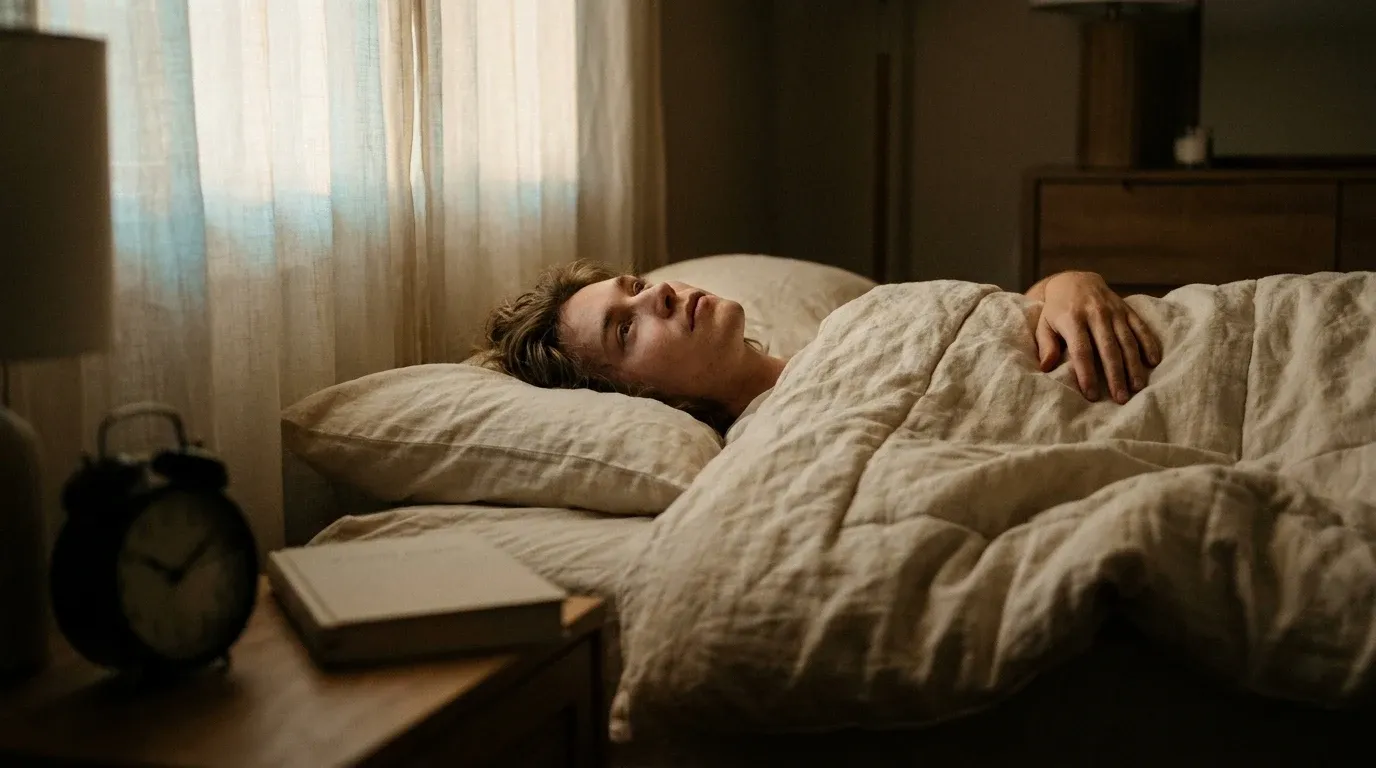
If you've ever been handed a sleeping pill prescription after a five-minute conversation with a doctor, you're not alone. It's the path of least resistance for both clinician and patient. But there's a treatment with stronger long-term outcomes, no dependency risk, and decades of clinical backing. It's called Cognitive Behavioral Therapy for Insomnia, or CBT-I, and most people who could benefit from it have never heard it mentioned.
A scoping review published in November 2026, synthesizing data from randomized controlled trials, now gives us the clearest map yet of exactly how CBT-I is delivered in practice. That's useful not just for researchers, but for you. Because understanding the structure of a treatment is how you stop accepting a watered-down version of it.
Why Sleeping Pills Are Not the Answer
Medication for insomnia works by suppressing the nervous system or altering neurotransmitter activity. It can help you fall asleep tonight, but it doesn't fix why you couldn't sleep in the first place. The behavioral patterns, the racing thoughts at 2 a.m., the anxiety around bedtime. Those remain untouched.
When you stop the medication, the insomnia often returns. Sometimes it's worse, a rebound effect that leaves people feeling dependent on a drug they never intended to use long-term. CBT-I takes the opposite approach. It targets the cognitive and behavioral roots of insomnia directly, and evidence consistently shows that its effects last well beyond the end of treatment.
Poor sleep also carries real physiological consequences over time. What restless nights actually do to your brain over time includes structural changes that accumulate gradually, which is precisely why a treatment that produces durable results matters so much more than one that just masks symptoms.
What the November 2026 Review Actually Found
The scoping review synthesized trial data across a large body of randomized controlled studies, making it the most current and comprehensive picture of how CBT-I is structured and delivered in clinical settings. What it confirms is that CBT-I is not a loose collection of suggestions. It's a defined, replicable protocol with consistent components across trials.
The standard delivery model is six sessions, each lasting approximately 60 minutes. When CBT-I is delivered in a group format, sessions typically extend to around 90 minutes to allow adequate time for discussion among participants. The majority of trials used a psychologist as the primary provider, though trained therapists and in some cases digital platforms have also been studied.
This level of specificity matters. It means that if someone tells you they're offering you "CBT-I" in two 20-minute appointments, that's not CBT-I. That's a shortcut, and knowing the difference is what allows you to advocate for the real thing.
The Four Core Components You Should Know
CBT-I is not a single technique. It's a structured combination of approaches, each targeting a different mechanism that perpetuates chronic insomnia. Here's what the evidence-based protocol actually includes.
- Stimulus control. This technique works by rebuilding the mental association between your bed and sleep. If you've spent months lying awake in bed scrolling your phone or watching TV, your brain has learned to treat the bedroom as an arousal environment rather than a sleep one. Stimulus control breaks that pattern through specific behavioral rules: get out of bed if you're not asleep within roughly 20 minutes, use the bed only for sleep and sex, and keep a consistent wake time regardless of how the night went.
- Sleep restriction therapy. Counterintuitive as it sounds, this involves temporarily limiting your time in bed to match your actual sleep time. If you're sleeping five hours but spending eight in bed, that gap creates fragmented, shallow sleep. By compressing time in bed initially and then gradually extending it as sleep efficiency improves, the technique rebuilds sleep drive and consolidates sleep architecture.
- Cognitive therapy. This is where the "cognitive" in CBT-I earns its place. Many people with chronic insomnia have deeply ingrained beliefs about sleep that perpetuate the problem. Thoughts like "I'll never function tomorrow if I don't sleep eight hours" or "I've always been a bad sleeper" create hyperarousal that makes sleep harder. Cognitive therapy works to identify, challenge, and restructure those beliefs.
- Sleep hygiene education. This is the component most people have encountered in some form, usually as a checklist of tips about caffeine, screen time, and bedroom temperature. Within CBT-I, it's one part of a broader system rather than a standalone fix. Sleep hygiene alone rarely resolves chronic insomnia, but combined with the other components, it reinforces behavioral change.
Who Delivers It and What to Expect
The trials synthesized in the 2026 review predominantly used psychologists as the lead providers. That said, CBT-I has also been delivered effectively by trained nurses, therapists, and via digital programs, some of which have strong trial support. The digital route is relevant for access: a qualified in-person CBT-I therapist can cost between $150 and $300 per session in the US, putting a full six-session course in the $900 to $1,800 range before insurance.
Digital CBT-I programs, some of which are FDA-cleared, typically run from $50 to $200 for a full course and have shown meaningful efficacy in randomized trials. They're not equivalent to working with a skilled clinician, but for people without access or facing long waitlists, they represent a legitimate option grounded in the same protocol.
What you should not accept is a single session that hands you a sleep hygiene pamphlet and calls it CBT-I. The treatment has a known structure, a known session count, and known components. If what you're being offered doesn't match that, ask specifically what protocol is being used and over how many sessions.
Sleep, Metabolism, and the Bigger Picture
Sleep doesn't sit in isolation from the rest of your health. Chronic insomnia is associated with elevated cortisol, impaired glucose regulation, increased appetite-stimulating hormone activity, and reduced capacity for physical recovery. These aren't minor inconveniences. They're pathways to metabolic dysfunction.
If you're trying to optimize your body composition, training performance, or metabolic health, poor sleep actively works against you. The connection runs in both directions. Exercise can improve sleep quality, partly through hormonal pathways. And poor sleep undermines the metabolic benefits of physical activity. Why diet and exercise together beat either one alone is a principle that extends to sleep as a third pillar. Remove it, and the whole system is compromised.
Similarly, if you're managing weight or have been following developments in obesity medicine, the overlap between sleep-disordered breathing and metabolic health is an active area of research. GLP-1 for sleep apnea: what the new data really means reflects how interconnected these systems really are, but CBT-I addresses a distinct and extremely common condition that sits upstream of many of those complications.
How to Ask for CBT-I
The first barrier is awareness, and you've cleared it. The second is knowing how to actually get access to the treatment. Here's what that looks like in practice.
Start by asking your primary care physician directly: "I'd like a referral for CBT-I delivered according to the standard protocol. Can you refer me to a provider who offers the full six-session structure?" That specificity signals that you know what you're asking for and reduces the chance of being redirected to a sleep hygiene handout.
You can also search the Society of Behavioral Sleep Medicine's directory, which lists providers in the US trained specifically in CBT-I. Some sleep clinics offer it as part of a broader program. Insurance coverage varies, but CBT-I delivered by a licensed psychologist or therapist is increasingly recognized as a reimbursable treatment. If you're using a digital program, look for ones that are FDA-cleared as prescription digital therapeutics or that explicitly reference the CBT-I protocol in their methodology.
If you've also been managing your sleep through lifestyle changes, it's worth knowing that the physical side of that equation matters. Your workout doesn't cancel out sitting all day. The same logic applies to sleep. A single good night doesn't undo the cumulative burden of chronic insomnia, and a single session of sleep advice doesn't deliver what a structured CBT-I program can.
The Standard Exists. Hold Providers to It.
What the November 2026 scoping review gives everyday readers isn't just academic interest. It's leverage. When a treatment has a documented structure, a known session count, and established components verified across randomized controlled trials, you have a baseline to measure against.
CBT-I works. It outperforms sleep medication on long-term outcomes. It has no withdrawal effects. And it's recommended as a first-line treatment for chronic insomnia by multiple clinical guidelines, including those from the American College of Physicians. The problem is that access is uneven, awareness is low, and what gets offered in its name doesn't always match what the evidence actually supports.
You're now equipped to tell the difference. Six sessions. Sixty minutes each. Stimulus control, sleep restriction, cognitive therapy, sleep hygiene. That's the protocol. If what you're being offered falls significantly short of that, it's worth pushing back, or finding a provider who can deliver the real thing.