
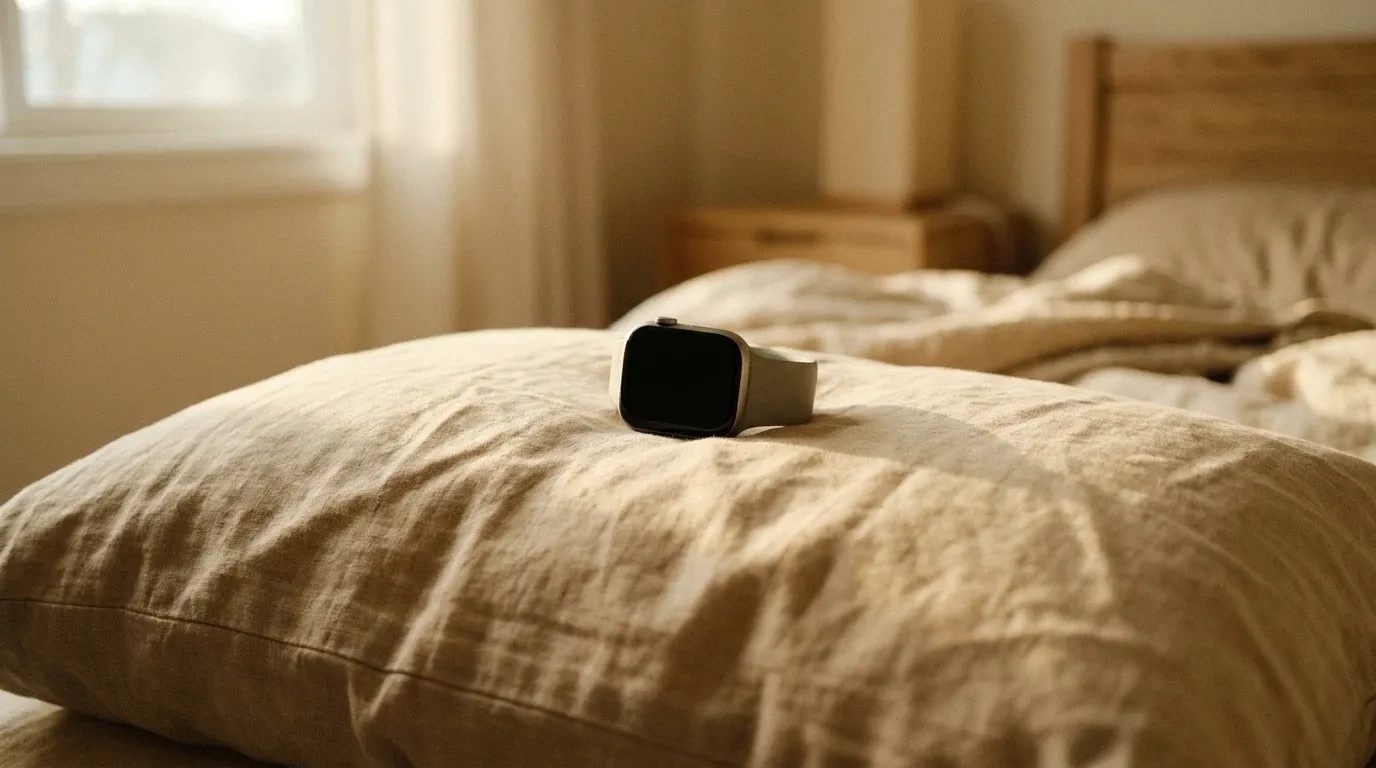
Most people with obstructive sleep apnea have no idea they have it. They wake up tired, chalk it up to stress or a bad mattress, and move on. Meanwhile, their airway is collapsing dozens of times a night. A new study backed by Samsung suggests that the device already on your wrist might be the first thing to flag that something's wrong.
What the Study Actually Found
Researchers compared smartwatch-estimated apnea-hypopnea index (eAHI) readings against polysomnography (PSG), the gold-standard overnight sleep study conducted in a clinical lab. The study enrolled 147 participants and used a Samsung Galaxy Watch to generate continuous sleep data, including breathing irregularities and blood oxygen fluctuations.
The results were meaningful. The wearable demonstrated a credible ability to identify individuals with moderate-to-severe obstructive sleep apnea (OSA) and those in a high-risk category. It won't replace a sleep lab, but it doesn't need to. What it does is put a potential red flag directly on your wrist before you've ever spoken to a doctor about snoring.
The apnea-hypopnea index measures how many times per hour breathing is disrupted during sleep. A score of 5 to 15 indicates mild OSA. Moderate runs from 15 to 30. Severe is anything above 30. If your watch estimates your score is pushing into moderate territory, that's the kind of signal that should get you in front of a sleep specialist.
Why This Matters: The Scale of Undiagnosed Sleep Apnea
OSA affects an estimated one billion people globally. That number is staggering, and the more troubling part is how few of those people know about it. Diagnosis typically requires a referral, an overnight lab study, and in many cases months of waiting. Many people never pursue it at all, either because they don't recognize the symptoms or because the process feels like too much effort for what they assume is just bad sleep.
The consequences of leaving OSA untreated go well beyond daytime fatigue. Chronic sleep-disordered breathing is associated with elevated cardiovascular risk, hypertension, metabolic dysfunction, impaired cognitive performance, and increased risk of depression. The condition quietly degrades your health across multiple systems while you sleep through it.
Poor sleep also undermines everything else you're trying to do for your body. If you're training, optimizing your nutrition, or following structured recovery protocols, untreated OSA creates a ceiling on how much benefit you'll actually absorb. Sleep is the base layer. Without it, everything else is working against resistance.
How the Watch Estimates Apnea Events
Consumer smartwatches have become remarkably capable at passive physiological monitoring. Modern devices track blood oxygen saturation (SpO2), heart rate variability, respiratory rate, and movement throughout the night. When breathing is interrupted repeatedly, those signals shift in characteristic ways. Oxygen saturation dips. Heart rate patterns change. The algorithm is reading those patterns collectively to generate an estimated AHI score.
This is not the same as PSG. A clinical sleep study involves electroencephalography, eye movement tracking, muscle activity sensors, airflow measurement, and chest wall movement monitoring. The data density is incomparably higher. What a smartwatch offers is a population-level screening tool, not a precise diagnostic instrument. The distinction is important.
What the Samsung-backed study adds is validation data: a direct comparison between what the wrist device estimated and what the lab actually measured in the same people at the same time. That kind of head-to-head data is what separates a credible screening claim from marketing. The results suggest the eAHI shows meaningful agreement with PSG, particularly in the moderate-to-severe range where intervention matters most.
Screening Is Not Diagnosis. Here's Why That Still Counts
Wearable health features have a complicated reputation. Blood oxygen readings attracted heavy scrutiny after studies raised questions about accuracy across different skin tones. ECG features vary in clinical utility. The gap between "feature exists on device" and "feature provides clinically meaningful data" is real, and it's worth taking seriously.
But screening and diagnosis serve different purposes. A screening tool doesn't need to be perfect. It needs to be sensitive enough to catch a meaningful proportion of people who actually have the condition, and specific enough that it's not flooding sleep clinics with healthy people convinced they're sick. The study's focus on moderate-to-severe OSA is strategic. Those are the cases where the health stakes are highest and where a wearable estimate, even an imperfect one, could meaningfully accelerate the path to care.
If your watch tells you your sleep looks normal, that's not medical clearance. If it consistently flags elevated estimated AHI over multiple nights, that's a signal worth bringing to your doctor. That's how screening is supposed to work. It lowers the barrier to the conversation, not to the diagnosis.
For people who already struggle with sleep quality and have worked through behavioral approaches like cognitive behavioral therapy for insomnia, a wearable that flags potential OSA adds a genuinely different layer of information. CBT-I addresses sleep behavior and arousal. It won't fix a structural airway problem. Knowing which problem you're actually dealing with matters.
What to Do If Your Watch Raises a Flag
If your device generates sleep apnea risk alerts or consistently shows low blood oxygen readings during sleep, here's a practical path forward:
- Document the data. Most smartwatch apps let you export sleep summaries or view trends over time. Bring a screenshot or summary to your appointment. Your doctor doesn't need to interpret raw wearable data, but a consistent pattern of overnight oxygen dips is useful context.
- Ask specifically about a sleep study. A referral for PSG or a home sleep apnea test (HSAT) is the appropriate next step. Home tests are less comprehensive than lab PSG but are increasingly accepted for diagnosing uncomplicated OSA and are more accessible in terms of cost and scheduling.
- Don't self-diagnose based on the watch alone. An elevated eAHI on a single night could reflect alcohol consumption, an unusually restless night, sleeping position, or sensor placement. Patterns across multiple nights carry more weight than a single data point.
- Consider your full sleep picture. OSA often coexists with other sleep disruptions. If you've struggled with insomnia independently of snoring or daytime fatigue, understanding how sleep restriction therapy works can be a useful part of a broader sleep assessment conversation with a clinician.
The Bigger Picture for Wearable Health Monitoring
Smartwatches screening for OSA fits into a broader shift in how health signals get detected. The traditional model puts detection downstream: you feel bad, you see a doctor, you get tested. Wearable monitoring inverts that sequence. The data exists before the symptoms become impossible to ignore.
This has real implications for conditions that are silent in the early stages. OSA is a good example because its symptoms, fatigue, mood changes, reduced concentration, are easy to attribute to other causes. The watch doesn't get fooled by alternative explanations. It measures oxygen and heart rate while you sleep regardless of what you think is causing your tiredness.
The same logic applies to other lifestyle factors. Research increasingly shows that everyday movement accumulation matters as much as formal exercise for overall health outcomes. Wearables have already shifted how people think about activity by making it visible and trackable. Sleep apnea screening is the same principle applied to a different physiological domain.
There are legitimate questions about data privacy, algorithm transparency, and equitable access across device price points. A Samsung Galaxy Watch capable of generating eAHI data retails at several hundred dollars, which creates obvious access disparities. Those questions don't undermine the science, but they're part of an honest conversation about who benefits from wearable health monitoring in practice.
Where the Technology Is Heading
Regulatory frameworks are starting to catch up with what consumer devices can do. The FDA has cleared sleep apnea detection features on select devices when backed by sufficient clinical validation data. The Samsung-backed study adds to the body of evidence that eAHI estimation can function meaningfully in real-world populations, not just controlled laboratory conditions.
Future iterations will likely improve sensitivity and specificity, refine algorithms for different demographic groups, and potentially integrate with telehealth workflows so that a consistent watch flag could automatically trigger a clinical follow-up. That's not where the technology is today, but it's a credible near-term trajectory.
What's available right now is already useful. If you've never thought about sleep apnea because you didn't think it applied to you, consider that roughly one in seven adults has the condition and most of them are walking around undiagnosed. Your smartwatch isn't going to tell you definitively whether you're one of them. But it might tell you to ask the question. That's a reasonable place to start.