
When your knee hurts, stopping feels logical. Rest it, protect it, wait for it to calm down. That instinct makes sense in the short term, but for the millions of people living with chronic knee pain, it's one of the most damaging things you can do. The science is now clear: in most cases, movement is medicine, and avoiding it makes things worse.
What the SUPER-Knee Trial Actually Found
A major clinical trial called SUPER-Knee looked at young adults who had undergone ACL reconstruction, a population at high risk of developing long-term knee problems and early-onset osteoarthritis. Researchers put participants through a structured, supervised exercise program designed to progressively load the knee joint over time.
The results were significant. Participants showed measurable improvements in both pain levels and muscle strength. Crucially, the supervised loading did not accelerate cartilage damage or increase osteoarthritis risk. That second finding matters enormously, because fear of "wearing out" the joint is precisely what keeps many people stuck on the couch.
This trial adds to a growing body of evidence that graded physical loading, applied correctly and consistently, supports joint health rather than undermining it. The knee is not a structure you protect by keeping still. It's one you maintain by using it.
The Fear-Avoidance Trap
Fear-avoidance is a well-documented psychological pattern in chronic pain management. It works like this: you feel pain, you interpret that pain as a signal of damage, so you reduce activity to avoid making things worse. That reduction leads to muscle weakness and joint stiffness, which then increases pain sensitivity. The cycle reinforces itself.
In knee conditions specifically, fear-avoidance behavior is one of the strongest predictors of long-term disability. People who catastrophize their symptoms, believing that any discomfort means harm, consistently show worse outcomes than those who maintain moderate activity. This isn't about willpower or toughness. It's about how the nervous system responds to inactivity and learned helplessness over time.
The problem is that rest feels like a reasonable response to pain. And it is, acutely. If you've just twisted your knee or had surgery, relative rest is appropriate. But chronic knee pain, defined broadly as pain lasting more than three months, operates under completely different rules. At that stage, the tissue damage that originally caused the pain has usually resolved. What persists is a sensitized nervous system and a weakened supporting structure.
Why Loading Is the Evidence-Backed Answer
Your knee doesn't function in isolation. It depends on the quadriceps, hamstrings, hip abductors, and calf muscles to absorb force and distribute load across the joint. When you stop moving, those muscles atrophy quickly. Within as little as two weeks of significant inactivity, measurable strength losses begin. That means the joint is absorbing more stress with less muscular support, which is the opposite of what you want.
Graded loading reverses this. When you apply progressive mechanical stress to the knee, you stimulate cartilage nutrition (cartilage has no direct blood supply and depends on movement-driven fluid exchange), strengthen the surrounding musculature, and reduce central sensitization over time. Studies consistently show that people with knee osteoarthritis, patellofemoral pain, and post-surgical knees all benefit from structured exercise programs.
This principle connects to a broader point about daily movement. Everyday movement counts as much as your workout, and for people managing joint pain, that truth is especially relevant. It's not just formal exercise sessions that matter. It's the cumulative effect of walking, standing, and low-level activity throughout the day.
Starting at Home: Safe Exercises to Begin Loading
You don't need a clinic referral or a gym membership to begin. The following bodyweight exercises are well-supported by evidence and can be performed safely at home as a starting point. The goal at this stage is not performance. It's tissue tolerance, building your knee's capacity to handle load gradually.
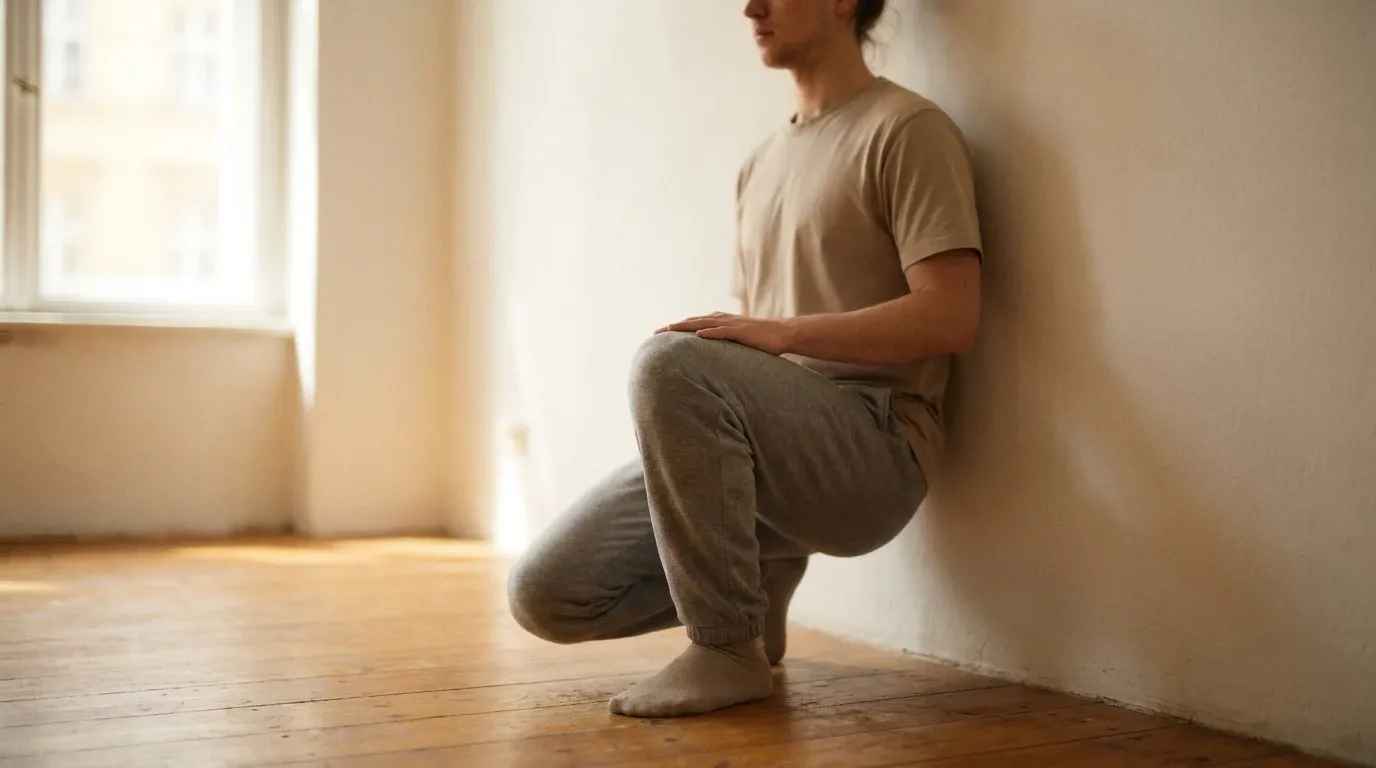
- Wall sits: Stand with your back against a wall and slide down until your thighs are roughly parallel to the floor. Hold for 20 to 30 seconds. This isometric quad exercise is particularly useful for patellofemoral pain because it loads the joint with minimal shear force.
- Step-ups: Use a low step (15 to 20 cm to start). Step up with one foot, bring the other foot up, then step back down with control. Focus on a slow, controlled descent. Single-leg eccentric loading like this is one of the most effective stimuli for tendon and muscle adaptation.
- Terminal knee extensions (TKE): Loop a resistance band around a fixed point and step into it so the band sits behind your knee. Slightly bend the knee, then straighten it against the band's resistance. This isolates the last 30 degrees of quad extension, which is often the weakest range after ACL injury or prolonged disuse.
- Glute bridges: Lie on your back, feet flat on the floor, and push your hips toward the ceiling. This targets the posterior chain, which directly reduces compressive load on the knee by improving hip-driven force absorption.
- Seated calf raises: Sitting in a chair, raise your heels off the ground and lower them slowly. The calf complex plays an underappreciated role in knee biomechanics and is often neglected in home programs.
Start with two to three sets of each exercise, three times per week. Some discomfort during loading is normal and does not mean you're causing damage. Use a simple rule: if pain during exercise is a 4 or below on a 10-point scale and returns to baseline within 24 hours, you're in a safe range.
Progressing Beyond Bodyweight
Once you can complete the basics without significant post-exercise flare, you're ready to add external load. This is where gym access becomes valuable. Leg press, goblet squats, Romanian deadlifts, and split squats all provide higher loading stimuli with good knee-safety profiles when performed with proper form.
Progression should be slow. Many people make the mistake of jumping ahead when they have a few pain-free days, then crashing back to square one. A better approach is to add resistance in small increments, perhaps 5% per week, and treat any multi-day flare-up as a signal to hold the current load for another week rather than retreat entirely.
Recovery support also matters here. Adequate protein intake is essential for muscle repair and tendon health. Collagen synthesis specifically depends on vitamin C and glycine, so a varied, nutrient-dense diet is worth prioritizing. Some athletes explore supplementation during this phase. If you're looking into options like creatine for training support, Creatine, HMB, and Hydration: Does the All-in-One Stack Deliver? offers a balanced breakdown of what the evidence supports and where the marketing outruns the science.
When to Seek Professional Support
Movement-first doesn't mean diagnosis-free. If you have significant swelling, locking, giving way, or pain that's genuinely worsening with low-load activity, those are signals that warrant a clinical assessment before you ramp up your program. A physiotherapist or sports medicine physician can rule out structural issues that need a different approach.
That said, many people delay seeking help because they assume they'll be told to rest. That advice is becoming increasingly rare in evidence-informed practice. Most clinicians working with chronic knee pain now prescribe exercise as the primary intervention. If yours doesn't, it's worth seeking a second opinion.
Mental and emotional factors are also worth taking seriously. Chronic pain has well-documented effects on sleep quality and psychological wellbeing. If you're finding that pain is disrupting your sleep, that disruption will impair your recovery and amplify pain sensitivity. CBT-I Is the Insomnia Fix Most People Have Never Heard Of is one evidence-based approach worth knowing about if sleep has become part of the problem.
The Mindset Shift That Changes Everything
The core reframe here is moving from "pain means damage" to "pain is information." For most people with chronic knee pain, the sensation of discomfort during exercise is not a warning sign that something is breaking. It's a signal from a sensitized nervous system that hasn't yet recalibrated to the demands being placed on it.
That recalibration happens through consistent, graded exposure. Not through heroic workouts or pushing through sharp pain, but through showing up regularly, loading progressively, and trusting that the body adapts when given the right stimulus. The SUPER-Knee trial is one of the clearest demonstrations yet that this approach works even in high-risk populations who've already had serious knee injuries.
Your knee doesn't need more rest. It needs a smarter relationship with load. And that relationship starts with the next step you take, literally.