
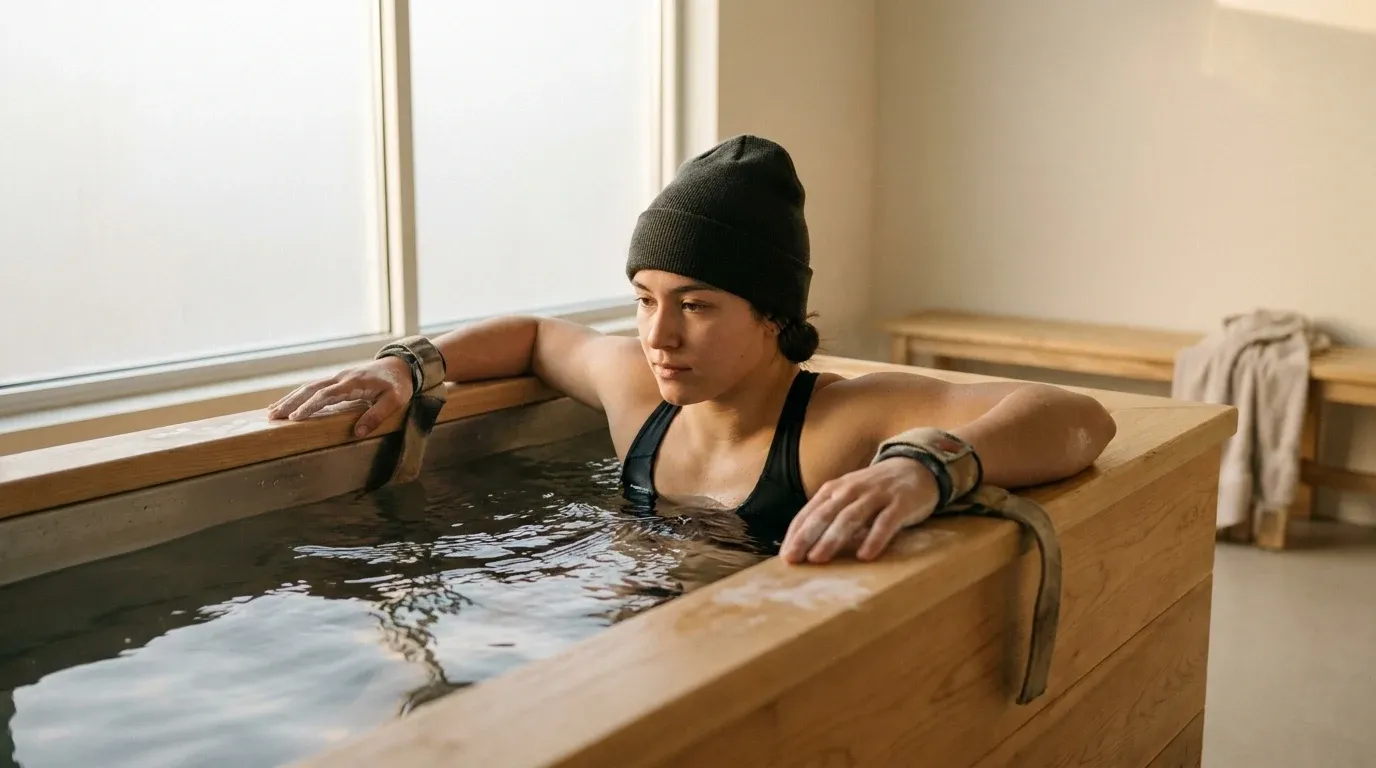
Cold plunges have become one of the most talked-about recovery tools in fitness. Ice baths, cold tubs, and dedicated plunge pools are showing up in commercial gyms, high-end wellness centers, and suburban backyards across the US, UK, and Australia. The pitch is compelling: jump in after a hard session, reduce soreness, recover faster, come back stronger.
The problem is that "recover faster" and "get stronger" are not the same thing. And the timing of your cold exposure may be actively working against your training goals. Here's what the research actually shows.
Cold Water Does Reduce Soreness. But That's Not the Whole Story
To be fair, cold water immersion (CWI) does reduce delayed-onset muscle soreness (DOMS). A widely cited meta-analysis of 17 trials found that CWI was significantly more effective than passive rest at reducing soreness in the 24 to 96 hours following exercise. That's a real benefit, and it's not nothing.
But reducing soreness and accelerating actual muscle repair are two different things. The research does not support the idea that cold plunges speed up tissue regeneration in a meaningful way. What they appear to do is blunt the perception of pain and reduce localized swelling, which feels like recovery but isn't always the same physiologically.
Active recovery methods, such as light movement, walking, or low-intensity cycling, show comparable soreness reduction without the trade-offs discussed below. If your primary goal is to feel better the next day without compromising long-term adaptation, active recovery is hard to argue against.
The Real Cost: Blunted Muscle and Strength Gains Over Time
This is where the cold plunge conversation gets uncomfortable. Multiple studies now show that regular post-workout cold water immersion is associated with smaller gains in both muscle size and strength compared to training without it.
One frequently referenced study followed resistance-trained men over 12 weeks. Those who completed cold water immersion immediately after every session gained significantly less muscle mass and strength than those who used active recovery. Muscle biopsies showed reduced activity in key anabolic pathways, particularly those involving satellite cells, which are the muscle stem cells responsible for growth and repair.
The mechanism is inflammation. When you lift weights, you create controlled muscle damage. The inflammatory response that follows is not a side effect to be eliminated. It's the signal your body uses to initiate adaptation. Cold water immersion blunts that inflammatory cascade, which reduces soreness, but also reduces the stimulus for growth.
Put simply, you're turning down the volume on the signal your muscles need to get bigger and stronger. Over a single session, the effect is small. Over weeks and months of training, it compounds into a measurable difference.
If you're over 40 and focused on preserving or building muscle, this matters even more. The anabolic response to training naturally declines with age, which means every session counts more. The 10-Minute Daily Habit That Protects Muscle After 40 covers related strategies for maintaining that response without undermining your training stimulus.
The Mood Boost Is Real. The Recovery Benefit Is Mostly Perceptual
Cold exposure reliably triggers a surge in norepinephrine and dopamine. Studies measuring the acute neurochemical response to cold water immersion report norepinephrine increases of 200 to 300 percent, which translates directly into improved alertness, focus, and mood. That effect is real and it's not trivial.
What's less clear is whether that neurochemical boost translates into actual physical recovery. When researchers control for perceived soreness and measure objective markers like muscle force output, power production, and strength performance in subsequent sessions, the advantage of cold plunges over active recovery largely disappears.
This creates an important distinction. You may feel more recovered after a cold plunge. Your soreness is lower, your mood is better, and you're more alert. But your muscles, at a cellular level, may not be in a better state for the next training session. In some cases, they may be in a worse one.
The placebo-adjacent nature of the benefit doesn't make it worthless. Perceived recovery influences training effort, motivation, and consistency. But it's worth being honest about what you're actually getting, especially if you're structuring your entire recovery protocol around cold exposure.
Most People Are Getting the Timing Completely Wrong
The most common pattern is the one most likely to cause problems: lifting hard, then immediately getting into a cold plunge. This is exactly the sequence that research links to blunted hypertrophy. You're interrupting the post-workout anabolic window at its most active point.
The good news is that timing appears to matter as much as the practice itself. Research suggests that separating cold exposure from your strength session by at least six hours significantly reduces the interference with muscle protein synthesis. Some researchers suggest that even a three to four hour gap may be sufficient, though the evidence is stronger for longer separations.
Practical strategies that appear to preserve both benefits include:
- Morning lifts with evening cold plunges: Train in the morning, use cold exposure in the evening as a wind-down tool. You get the alertness benefit post-lift and the soreness reduction benefit later without blunting acute adaptation.
- Cold plunges on non-lifting days: Reserve cold water immersion for rest days or active recovery days. You still benefit from soreness reduction and mood elevation without any interference with training signals.
- Saving cold plunges for high-volume training blocks: During phases where recovery demand is extremely high, such as competition prep or high-frequency training blocks, the trade-off may shift. Short-term soreness management may be worth more than marginal long-term adaptation during those periods.
- Using cold for cardio and conditioning days: The interference effect is primarily documented for resistance training. Cold plunges after endurance or conditioning sessions carry fewer documented downsides for strength and hypertrophy goals.
How to Fit This Into a Smarter Recovery Protocol
Cold plunges work best as one tool in a broader recovery system, not as the centerpiece. Sleep remains the single most impactful recovery intervention. Research consistently links poor sleep with reduced muscle protein synthesis, impaired hormonal output, and slower tissue repair. More REM Sleep Is Linked to 83 Fewer Diseases is worth reading if sleep quality is something you haven't fully optimized yet.
Nutrition timing also plays a significant role. Getting adequate protein and carbohydrates into your post-workout window supports the same anabolic processes that cold exposure can interfere with. Cross-Training Nutrition: What You Actually Need to Eat breaks down the specifics of macro timing for people balancing multiple training modalities.
Stress management is another underestimated factor. Chronic psychological stress elevates cortisol, suppresses testosterone and growth hormone, and impairs recovery in ways that no cold plunge can fix. Stress Management: What the Science Actually Supports covers the interventions with the strongest evidence base if this is relevant to your situation.
If you're working with a coach or trainer, this is also worth raising in your programming conversations. The best coaches track recovery as a variable, not an afterthought. 4 Things Great Personal Trainers Do Differently outlines how elite coaches approach program design and recovery integration, which is a useful benchmark for evaluating your own setup.
The Bottom Line on Cold Plunges and Muscle Gains
Cold water immersion is not a bad tool. It reduces soreness, improves mood, and has real neurochemical effects that can support training motivation and consistency. But it's not the recovery accelerator it's often marketed as, and used immediately after strength training on a regular basis, it likely costs you measurable gains over time.
The fix isn't to abandon cold exposure. It's to stop treating it as a post-lift ritual and start using it strategically. Separate it from your strength sessions by several hours. Use it on non-lifting days. Match the tool to the goal rather than applying it reflexively because it's become part of gym culture.
Your soreness is not the best indicator of whether recovery is happening. Your long-term progress is. Build your protocol around what drives adaptation, and fit cold exposure into the gaps where it supports that process rather than interrupts it.