
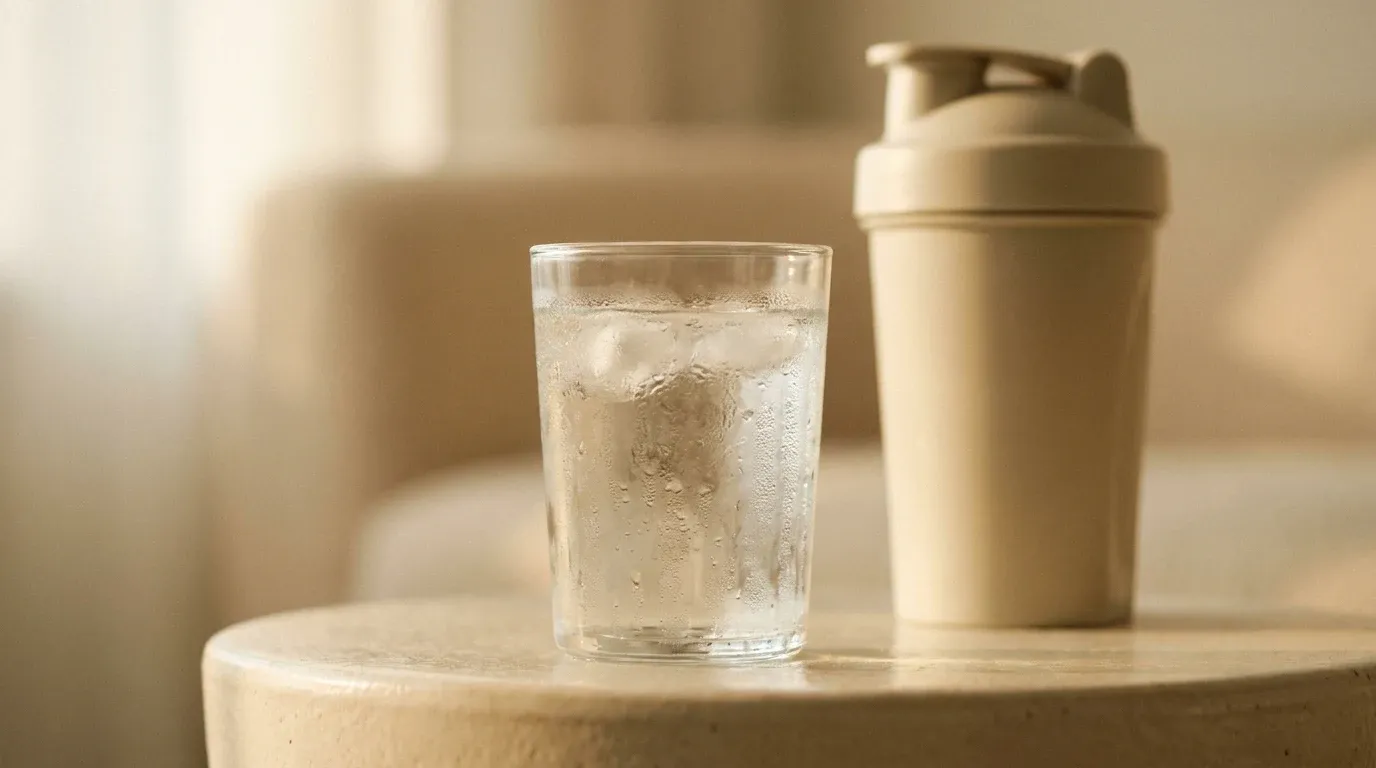
You finish a hard session, mix a scoop of whey into your shaker, and drink it on the way to the locker room. Protein delivered. Recovery started. Except that's not quite what's happening if you haven't replaced the fluids you just lost.
A study published in Nutrients found that exercising to a state of moderate dehydration, roughly 2.2% of body mass, significantly blunted the amino acid response to whey protein consumption. That's not a marginal effect. It's the difference between your protein shake doing its job and your body largely failing to act on it.
What the Research Actually Found
The study had participants exercise until they lost approximately 2.2% of their body mass through sweat, then consumed a standard dose of whey protein under different hydration conditions. Researchers tracked blood concentrations of total amino acids, branched-chain amino acids (BCAAs), leucine, isoleucine, and glutamine over the post-exercise window.
Under the dehydrated condition, circulating levels of all five markers were significantly lower compared to a fully rehydrated state. This matters because amino acid availability in the bloodstream is a key driver of muscle protein synthesis. If leucine and BCAAs aren't showing up in your blood at adequate levels, the anabolic signal your protein shake is supposed to trigger gets dampened before it even starts.
Leucine in particular acts as a molecular trigger for muscle-building pathways. Reduced leucine appearance after whey ingestion means a weaker stimulus to the mechanisms that build and repair muscle tissue. You paid for the protein. Your body just couldn't fully use it.
The 50% Rehydration Finding Changes How You Should Think About This
Here's where the research gets practically useful. The study didn't only compare full dehydration against full rehydration. It also tested a partial rehydration condition, where participants replaced just 50% of the fluid they lost during exercise.
That partial rehydration produced amino acid responses that were statistically comparable to full rehydration. In other words, you don't need to be perfectly topped up on fluids to preserve your protein absorption. But you do need something. The gap between zero rehydration and 50% rehydration was substantial. The gap between 50% and 100% was not.
This is an important nuance. It doesn't give you permission to skip hydration because "partial is close enough to full." It tells you that if you're pressed for time or simply didn't drink as much as you ideally should have, getting some water in before or alongside your protein shake is far better than ignoring fluids entirely.
If your workouts consistently leave you significantly dehydrated before you ever reach the post-exercise window, it's worth reading about pre-workout hydration and why it has to start before you train. How hydrated you arrive at your session determines how much ground you need to make up afterward.
Why Dehydration Blunts Amino Acid Absorption
The mechanism isn't fully resolved, but the leading explanation involves blood volume and gastrointestinal function. Dehydration reduces plasma volume. Reduced plasma volume means slower gastric emptying and compromised gut perfusion, which is the blood flow your intestinal lining needs to absorb nutrients efficiently.
When your gut isn't getting adequate blood flow, the transport proteins responsible for shuttling amino acids across the intestinal wall work at reduced capacity. Amino acids from whey, which is a fast-digesting protein specifically chosen for its rapid absorption profile, end up moving more slowly and incompletely into circulation.
There's also evidence that dehydration affects kidney filtration and amino acid handling, though the gut absorption impairment is likely the primary factor in the post-exercise context.
The practical takeaway is that whey's speed advantage, the reason it's so widely recommended for post-workout use, is contingent on your gut being able to take advantage of it. Dehydration removes that advantage.
Reframing Post-Workout Nutrition
Most post-workout nutrition advice treats protein and hydration as parallel but independent priorities. Eat protein. Drink water. These are usually presented as separate checklist items rather than interacting variables.
This research makes a direct case that they aren't independent. Water is a prerequisite for your protein shake to work the way you expect it to. Skipping fluids doesn't just mean you're mildly dehydrated. It means you may be actively undermining the purpose of the protein you're consuming.
If you're investing time in structured training, whether that's resistance training sessions built around the minimum effective dose for longevity or more intensive programming, you're presumably doing it because results matter. Hydration is one of the cheapest, most accessible levers for protecting those results. Not using it is a significant oversight.
The reframe here isn't complicated. Think of water not as something you drink because you're thirsty after exercise, but as part of the delivery system for your protein. One doesn't work properly without the other.
How Much Fluid Do You Actually Need Post-Workout?
Sweat rates vary considerably between individuals and workout types. A general benchmark used in sports nutrition is to drink approximately 1.5 liters of water for every kilogram of body weight lost during exercise. That's the full rehydration target, accounting for ongoing losses after the session ends.
But given what this study shows about partial rehydration, a more accessible target for most people is to aim for at least half that amount in the immediate post-exercise window. For a typical moderate-intensity session where you lose around 0.5 to 1 kilogram of fluid, that means getting 375 to 750 milliliters of water in alongside or before your protein shake.
Electrolytes also matter, particularly sodium, which helps your body retain and distribute the fluid you consume. If your sessions are long or you sweat heavily, plain water alone may not fully restore plasma volume even if you're drinking adequate amounts. A small amount of sodium alongside your post-workout fluids improves how effectively your body uses what you drink.
This Fits a Broader Pattern in Recovery Science
The hydration-absorption finding isn't an isolated quirk of protein metabolism. It fits a consistent pattern in recovery research: the basics interact with each other in ways that compound when you get them right and undermine each other when you don't.
Sleep is another clear example. Poor sleep impairs muscle protein synthesis, elevates cortisol, and reduces anabolic hormone production. If you're eating and training well but consistently shortchanging your sleep, you're leaving a substantial amount of your training adaptation on the table. The research linking REM sleep to protection against a broad range of diseases reinforces how much that single variable matters across multiple systems.
Stress has a similar relationship with recovery. Chronically elevated cortisol competes with the anabolic environment your training is trying to create. Understanding which stress management interventions are actually supported by evidence is worth your attention if recovery feels like it's stalling despite reasonable training and nutrition habits.
Hydration, sleep, and stress management aren't glamorous. They don't come in a new supplement formulation or require an expensive protocol. But they're the conditions under which everything else, including the protein you're consuming, actually functions.
What to Change Starting Today
You don't need to overhaul your routine. The adjustment here is small and costs nothing.
- Drink before you mix your shake. After your session ends, start with water. Get at least 400 to 500 milliliters in before or alongside your protein, especially if you sweated significantly during training.
- Weigh yourself if precision matters. Pre- and post-workout body weight gives you a direct measure of fluid loss. Multiply the difference in kilograms by 750 to get a practical rehydration target in milliliters.
- Don't wait until you're thirsty. Thirst is a lagging indicator. By the time you feel it, you're already at a level of dehydration that can affect absorption and performance.
- Add sodium if your sessions are long. A small pinch of salt in your water or an electrolyte tablet improves fluid retention and plasma volume restoration.
- Track your pattern, not just individual sessions. Consistent mild dehydration across your training week has cumulative effects on recovery. It's not just about today's shake.
Your protein shake is only as effective as the physiological environment it lands in. Right now, the evidence is clear that a dehydrated gut is a compromised delivery system. Fixing that takes less than two minutes and costs nothing. There's no reasonable argument for not doing it.