
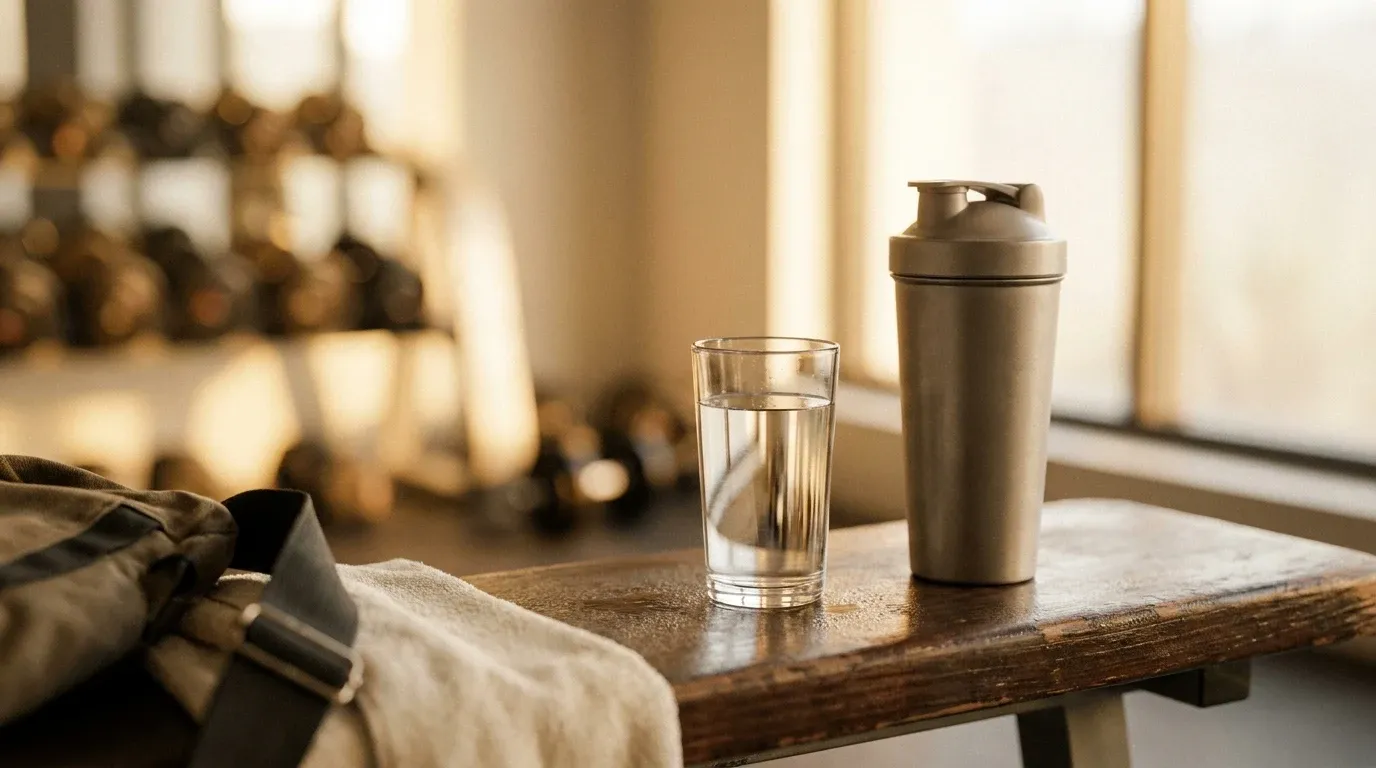
Most people finish a workout, reach straight for their protein shake, and consider recovery handled. It's a reasonable habit. But a study published in Nutrients in October 2026 suggests that sequence is leaving real muscle-building results on the table. If you're even mildly dehydrated when you drink that shake, your body absorbs significantly less of the protein than you think.
Here's what the research found, why it matters for everyday exercisers, and exactly what to do about it without adding cost or complexity to your post-workout routine.
What the Research Actually Shows
The Nutrients study found that a fluid deficit equal to just 2.2% of body mass after exercise was enough to blunt the circulating amino acid response to whey protein. In plain terms: when participants were modestly dehydrated and then consumed a standard whey shake, their blood amino acid levels rose meaningfully less than when they were properly hydrated first.
Amino acids circulating in the bloodstream are what your muscles actually use for repair and growth. If fewer of them reach the bloodstream, less of that expensive protein powder is doing its job. A 2.2% fluid loss sounds trivial, but it's the kind of dehydration that happens routinely during a 45-minute moderate-intensity gym session, especially in a warm environment or if you didn't drink enough beforehand.
For context, a 165-pound (75 kg) person reaches that 2.2% threshold after losing roughly 1.65 liters of sweat. That's achievable in a single workout without ever feeling severely thirsty.
You Don't Need to Drink a Full Liter Before Your Shake
Before you picture yourself forcing down a large bottle of water while your protein shake sits getting warm, here's the important nuance from the same research. Replacing approximately 50% of exercise-induced fluid losses was largely sufficient to restore normal protein absorption. You don't need full rehydration. You need partial rehydration.
For most people finishing a moderate workout, that means drinking somewhere between 300 and 600 ml of water (roughly 10 to 20 oz) before reaching for the shake. That's a manageable target. A standard 500 ml bottle of water covers it in most cases.
This also underscores why your hydration strategy shouldn't start when the workout ends. As detailed in Pre-Workout Hydration: Why It Has to Start Before You Train, arriving at your session already well-hydrated narrows the fluid deficit you'll need to make up afterward. The two halves of the strategy work together.
Why Dehydration Interferes With Protein Absorption
The mechanism isn't complicated once you understand the basics. Digestion and nutrient transport depend heavily on blood volume and plasma concentration. When you're dehydrated, blood becomes more viscous, circulation slows, and gastric emptying (the rate at which your stomach moves food into the small intestine) is impaired. Protein digestion slows. Amino acid transport to the muscles slows with it.
Whey protein is specifically valued for its rapid absorption profile. It's the reason it became the post-workout standard. But that speed advantage is conditional. If your gut environment is compromised by dehydration, the "fast" protein you paid for isn't behaving the way the label implies.
There's also a hormonal angle. Dehydration elevates cortisol, the stress hormone that actively competes with the anabolic signaling your muscles need to rebuild. You're not just slowing amino acid delivery. You're doing it at a moment when the hormonal environment is already working against you.
The Two-Step Post-Workout Protocol
The practical takeaway from this research is simple enough to remember without an app or a detailed plan. It comes down to two steps, done in the right order.
- Step 1: Rehydrate first. Within 10 to 15 minutes of finishing your workout, drink at least 300 to 500 ml of water (roughly 10 to 17 oz). If you trained hard, sweat heavily, or it's warm, aim for the higher end. Plain water works. You don't need an electrolyte drink, though sodium-containing fluids do absorb slightly faster and may help if you're a heavy sweater.
- Step 2: Then consume your protein. Once you've had that initial fluid intake, have your protein shake or whole-food protein source. The window doesn't need to be precise to the minute. Giving your body 10 to 15 minutes between the water and the protein is a reasonable buffer, though even drinking the water immediately before the shake is better than skipping it entirely.
That's the protocol. Two steps, no extra cost, no special products required.
How Much Does Protein Sequencing Actually Matter for Results?
If you're already hitting your daily protein target and training consistently, this change won't transform your physique overnight. Recovery is a system with many variables, and hydration is one input among several.
That said, the compounding effect is real. If you train four days a week and your protein absorption is partially blunted each time because you're skipping the rehydration step, that's potentially hundreds of suboptimal recovery sessions per year. Over months and years, that gap between what you're consuming and what your muscles are actually receiving adds up. The cost of the fix is zero. The cost of ignoring it is slow, invisible, and cumulative.
Recovery optimization goes further than hydration and protein timing, of course. Quality sleep drives a significant portion of muscle repair, and more REM sleep is linked to 83 fewer diseases, with implications that extend well beyond fitness. Managing post-training stress matters too. The physiological stress of exercise compounds with everyday psychological stress, and the stress management interventions that science actually supports are worth understanding if recovery is a priority for you.
Practical Hydration Targets by Workout Type
General guidance is useful, but it's more actionable when mapped to the kind of training you're actually doing. Here are rough benchmarks based on typical fluid losses by session type.
- 30-minute moderate lifting session: Expect 300 to 600 ml of fluid loss. Drink at least 300 ml before your shake.
- 45 to 60-minute mixed cardio and weights: Fluid loss likely 500 to 900 ml. Aim for 400 to 500 ml of water first.
- 60 to 90-minute intense training or outdoor cardio: Loss can exceed one liter. Consider a sodium-containing drink and target 500 to 750 ml before protein.
- Hot environment or high-sweat-rate athletes: Fluid losses are higher than average at any duration. Weigh yourself before and after training if you want a precise measure. Every 1 kg of weight lost equals roughly 1 liter of fluid deficit.
These aren't rigid prescriptions. They're starting points to build awareness of where your hydration stands before you reach for the shaker bottle.
A Note on Electrolytes
Plain water handles most post-workout rehydration needs for recreational exercisers. But if your sessions are long, intense, or you notice salt residue on your skin after training, sodium matters. It's the primary electrolyte lost in sweat, and it plays a role in fluid retention at the cellular level.
You don't need a premium electrolyte product to address this. A small pinch of table salt added to your water, or a light snack with natural sodium content alongside your water, is sufficient for most people. If you do want a purpose-built product, there are solid options available for under $1 per serving in most US markets.
Cold water exposure after training is another variable worth understanding in this context. Cold plunge timing has real implications for muscle gains, and the relationship between temperature, circulation, and recovery is more nuanced than the trend cycle suggests.
Building the Habit Without Overthinking It
The reason most people skip the rehydration step isn't stubbornness. It's habit and convenience. The shake is ready. The blender is out. The gym bag is already packed with powder. Stopping to drink a bottle of water first feels like an interruption in a routine that already feels optimized.
The simplest fix is environmental. Keep a water bottle next to your shaker bottle. Put the protein powder behind it, literally, so reaching for the shaker requires reaching past the water first. Small friction changes like this consistently outperform willpower as behavior-change tools.
If you're newer to structured training and still building the broader framework around your workouts, the guidance in what to tell your trainer in session one covers the kind of foundational conversations that help a coach build a program that actually fits your recovery capacity, not just your fitness goals.
The Bottom Line
A small but consistent oversight is costing many regular exercisers a measurable portion of the protein they're paying for and counting on. The fix requires no new supplements, no extra budget, and no significant change to your schedule. Drink water first. Give your body a few minutes. Then have your shake.
Protein timing debates have filled fitness forums for years. The sequence question has received far less attention, and the Nutrients research makes a compelling case that it deserves more. Your muscles don't just need protein. They need the conditions to actually use it.