
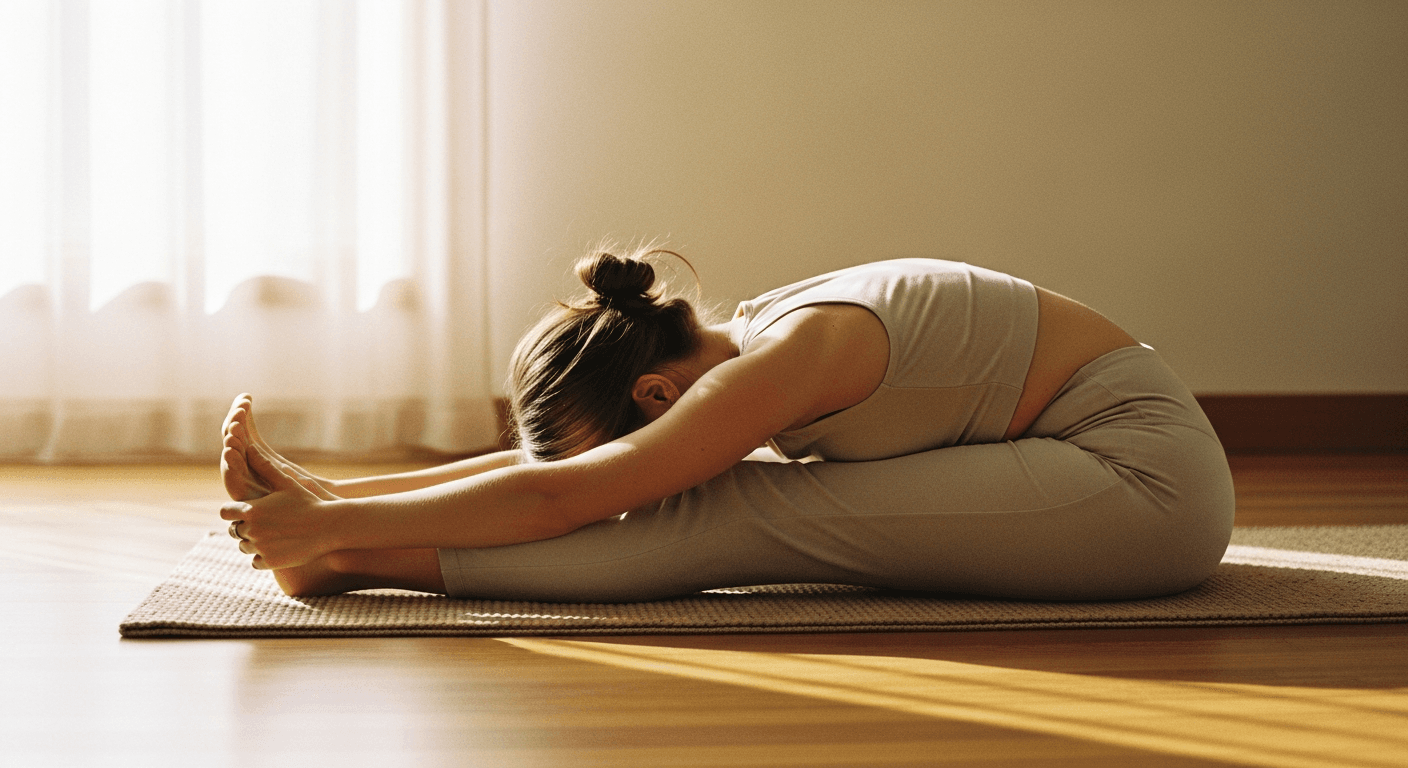
Most people treat yoga as a stretching session with calming music. That framing undersells it considerably. A growing body of research confirms that yoga produces measurable, physiological changes in your nervous system, and those changes directly reduce stress and anxiety through mechanisms that have nothing to do with simply relaxing in a quiet room.
This isn't about replacing therapy or medication. It's about understanding what's actually happening in your body during a yoga session, and why those mechanisms matter for how you structure your practice.
It's Not Just Relaxation. It's Physiology.
Perceived stress and anxiety aren't purely psychological experiences. They're driven by hormonal signals, neural activity, and the balance between two branches of your autonomic nervous system: the sympathetic (fight-or-flight) and the parasympathetic (rest-and-digest). When stress becomes chronic, your sympathetic branch stays dominant far longer than it should.
Yoga interventions consistently show reductions in perceived stress scores across multiple populations. A meta-analysis published in the Journal of Psychiatric Research found that yoga significantly reduced anxiety and stress compared to control groups, and those effects held across different yoga styles, session lengths, and participant demographics. The researchers identified several distinct physiological pathways, not a single vague "relaxation effect."
That distinction matters. If you understand the pathways, you can design your practice to target them. If you think yoga just calms you down, you'll treat it as optional.
For context on how chronic stress silently undermines your physical progress, chronic stress is quietly wrecking your fitness gains in ways that compound over weeks and months.
The Vagus Nerve: Your Internal Brake Pedal
The vagus nerve is the longest cranial nerve in the body. It runs from the brainstem through the neck, chest, and abdomen, connecting your brain to your heart, lungs, and digestive system. Its primary role in stress response is to activate parasympathetic dominance. Think of it as the brake pedal on your fight-or-flight system.
Yoga stimulates the vagus nerve through at least two direct mechanisms: controlled breathwork and specific postural positions. Slow, extended exhalations activate vagal tone, which is the degree to which the vagus nerve is actively dampening sympathetic arousal. When you lengthen your exhale relative to your inhale, as in a 4-count inhale to 8-count exhale pattern, you're directly increasing vagal tone in real time.
Inversions and poses that compress or gently stimulate the abdominal cavity also activate vagal afferent pathways, the nerve fibers running from the body back to the brain. That signal tells your central nervous system the threat has passed. Your heart rate drops. Your blood pressure eases. Your digestion resumes. This is not metaphorical. It's a measurable autonomic shift.
Studies using heart rate variability (HRV) as a proxy for vagal tone consistently show improvements after yoga practice. Higher HRV is associated with better stress resilience, lower all-cause mortality risk, and reduced rates of anxiety disorders. Even a single session can produce transient HRV improvements, though consistent practice builds baseline changes over weeks.
Cortisol Reduction: What the Research Actually Shows
Cortisol is your primary stress hormone. In short bursts, it's useful. It sharpens focus, mobilizes energy, and keeps you alert. Chronically elevated cortisol, however, disrupts sleep, suppresses immune function, impairs memory consolidation, and drives fat storage, particularly around the abdomen.
Multiple randomized controlled trials have measured salivary and serum cortisol before and after yoga programs. A consistent finding is that regular yoga practice, across programs ranging from four to twelve weeks, produces statistically significant reductions in cortisol levels. One review in Frontiers in Human Neuroscience documented cortisol reductions in both healthy adults and clinical populations dealing with anxiety and depression.
What's particularly relevant is the dose. You don't need ninety-minute sessions to see cortisol effects. Studies using sessions as short as twenty to thirty minutes, practiced consistently four to five days per week, have produced meaningful cortisol reductions. That's an important practical point, because one of the most common barriers people cite is time.
If you're already building a movement habit with brief daily sessions, the evidence supports stacking a short yoga or breathwork practice alongside it. The approach mirrors what's documented in five minutes of daily mobility work that actually pays off: frequency and consistency matter more than session length when you're targeting physiological adaptation.
GABA and the Brain Chemistry of Calm
This is where yoga's neurochemical profile becomes genuinely surprising. Gamma-aminobutyric acid (GABA) is the brain's primary inhibitory neurotransmitter. It reduces neural excitability and produces feelings of calm. Low GABA activity is strongly associated with anxiety disorders, and several classes of anti-anxiety medications, including benzodiazepines, work by enhancing GABA receptor activity.
Yoga raises GABA levels. A landmark study using magnetic resonance spectroscopy measured GABA concentrations in the brains of experienced yoga practitioners before and after a session. GABA levels increased by approximately 27% following the yoga session, while a control group that spent the same time reading showed no change.
A follow-up study compared twelve weeks of yoga practice to twelve weeks of walking in terms of GABA production, mood, and anxiety. The yoga group showed significantly greater GABA increases and greater reductions in anxiety. The researchers concluded that yoga may be particularly effective at targeting the neural pathways implicated in anxiety, not simply through behavioral or attentional mechanisms, but through direct neurochemical change.
This doesn't mean yoga replaces psychiatric care for clinical anxiety disorders. It means yoga has a legitimate, documented neurochemical mechanism of action, and practitioners who dismiss it as "just stretching" are working with an incomplete picture.
Which Yoga Styles Produce the Strongest Effects
Not all yoga is identical in its physiological impact. Research has examined several styles with different emphases:
- Hatha yoga (slower, posture-focused) consistently shows strong parasympathetic activation and is well-studied for cortisol reduction in beginners.
- Iyengar yoga (precision alignment, longer holds) has been associated with GABA increases and anxiety reduction in multiple trials.
- Kundalini yoga (breathwork-heavy, includes meditation) shows strong vagal stimulation effects, particularly in studies on trauma and PTSD-adjacent stress responses.
- Restorative yoga (passive, prop-supported) produces the most direct parasympathetic dominance shift, making it particularly useful as a recovery tool after high-intensity training.
- Vinyasa and power yoga offer cardiovascular benefits and mood uplift through endorphin release, but the acute stress-reducing effects on cortisol and vagal tone are less pronounced during the session itself.
For stress and anxiety management specifically, slower, breath-centered practices appear to produce the most reliable neurochemical benefits. That doesn't mean vinyasa has no value. It means matching your style to your goal.
Building a Practice That Actually Works
The research points toward a few practical principles for anyone who wants stress reduction as a primary outcome from their yoga practice.
First, prioritize breathwork. The vagal and cortisol effects are strongly tied to controlled, elongated exhalations. Even five minutes of structured breathwork, such as box breathing or 4-7-8 breathing, practiced independently of posture work, produces measurable autonomic effects. You don't need a full class to access this mechanism.
Second, consistency beats intensity. Four twenty-minute sessions per week outperform one ninety-minute session in terms of cortisol adaptation. The nervous system responds to repeated, low-dose stimuli when building parasympathetic tone.
Third, treat rest and recovery as part of the stress management protocol. The physiological gains from yoga practice, including GABA production and HRV improvement, consolidate during recovery periods. Understanding what to actually do on a rest day makes the stress-reduction effects of your active practice more durable.
Fourth, sleep amplifies everything. Cortisol dysregulation and poor sleep form a feedback loop that yoga can help interrupt, but the relationship runs both directions. poor sleep disrupts your gut and may worsen cancer risk, and it also blunts the hormonal benefits of practices like yoga by keeping your stress response elevated overnight.
The Bigger Picture
Yoga's reputation as a soft or supplementary activity has historically kept it at the edges of serious wellness programming. The physiology doesn't support that position. Vagus nerve stimulation, cortisol reduction, and GABA elevation are not minor or anecdotal effects. They're documented, reproducible, and clinically relevant.
If you're managing chronic stress, dealing with low-grade anxiety, or simply trying to perform and recover better, yoga offers a direct intervention on the physiological systems driving those problems. The access barrier is low. The time requirement is modest. The evidence is solid.
The question isn't whether yoga works on your nervous system. It clearly does. The question is whether you're using it deliberately enough to get the full benefit.