
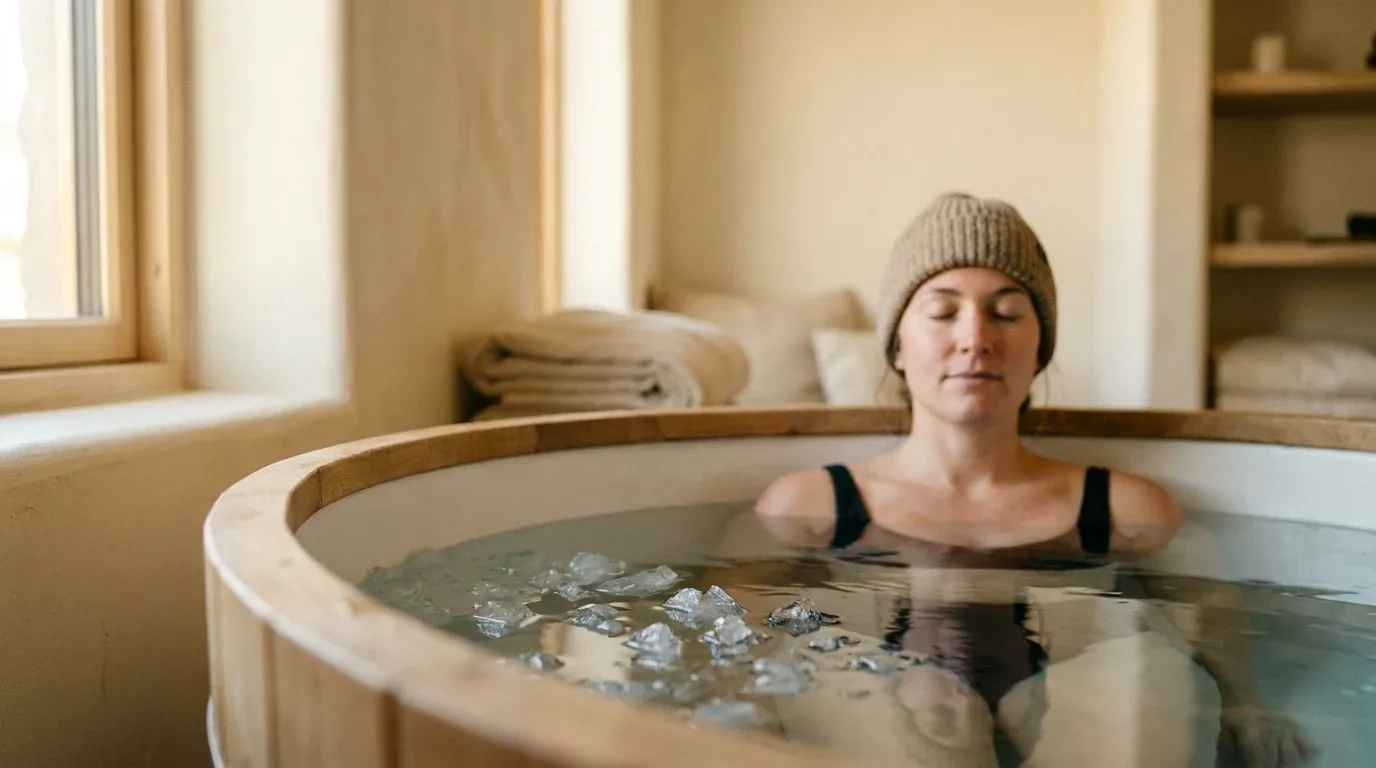
Cold water immersion has become one of the most visible recovery rituals in fitness. Athletes post videos stepping into ice-filled tubs, wellness brands sell dedicated cold plunge units, and gym culture has largely accepted the ice bath as a smart post-workout habit. But if your primary goal is building muscle, the evidence suggests you might be working against yourself.
Recent research has complicated the picture considerably. What feels like aggressive recovery may, in certain circumstances, be suppressing the very biological signals your body needs to grow stronger. Here's what the science actually says.
What Happens to Your Muscles After a Hard Lift
Resistance training creates controlled damage to muscle fibers. That damage triggers an inflammatory response, and while "inflammation" often sounds like something to eliminate, this acute version is essential. It activates satellite cells, stimulates protein synthesis, and initiates the structural remodeling that makes your muscles larger and more resilient over time.
The key signaling pathway involved is the mTOR pathway, which acts as a master switch for muscle protein synthesis. Alongside it, inflammatory markers like prostaglandins and cytokines play a direct role in coordinating repair. These are not side effects of training. They are the mechanism.
When you immerse yourself in cold water immediately after lifting, you blunt that inflammatory response. Blood vessels constrict, cellular signaling slows, and the cascade that would have driven adaptation is partially interrupted. A 2021 review published in Sports Medicine found that repeated post-resistance-training cold water immersion significantly attenuated gains in muscle hypertrophy and strength compared to passive recovery. The effect wasn't marginal. Across multiple studies, subjects who avoided cold immersion after lifting showed meaningfully greater increases in lean mass over weeks and months.
Soreness Relief Is Real. But It's Not the Same as Recovery
This is where a critical distinction gets lost in popular fitness advice. Cold water immersion does reduce delayed onset muscle soreness (DOMS). Multiple controlled trials confirm this. You will feel less sore the day after an ice bath than you would after passive rest. That's a real physiological effect, driven by reduced nerve conduction velocity and decreased local inflammation in the short term.
The problem is that soreness reduction and structural muscle recovery are not the same thing. Soreness is a symptom. Muscle adaptation is a process. You can suppress the former without accelerating the latter, and that's exactly what cold immersion appears to do. The muscles feel better, but the signals that would drive long-term growth are quieter than they should be.
This distinction matters enormously if you're tracking your progress by how recovered you feel rather than by actual performance data. Feeling fresh the next day is not evidence that your muscles have rebuilt more effectively. It may simply mean the repair signals were turned down.
When Ice Baths Do Make Sense
None of this means cold water immersion is useless. The context determines everything, and there are legitimate scenarios where it's the right call.
Endurance athletes operate under different physiological priorities. The inflammatory adaptations that matter for hypertrophy are less central to aerobic performance improvements, and the acute fatigue management benefits of cold immersion are more relevant when you're training twice a day or competing across consecutive days. A cyclist in a multi-stage race or a soccer player in a congested fixture schedule is not optimizing for muscle growth. They're managing cumulative fatigue, and cold water immersion serves that goal well.
High-frequency competition blocks are another valid use case. When you're competing multiple times in a short window and soreness would directly impair your next performance, short-term symptom management takes priority over long-term adaptation. You accept the tradeoff consciously because the competitive schedule demands it.
It's also worth noting that a meta-analysis of popular recovery modalities found that passive rest performs surprisingly well compared to active interventions for most training contexts, which puts expensive recovery tools in perspective regardless of training type.
The Highest-Evidence Recovery Interventions You Might Be Skipping
Before debating ice baths versus cold plunges, it's worth asking whether you've optimized the recovery factors that have the strongest evidence base. Two stand above everything else: sleep and nutrition.
Sleep is where the majority of anabolic hormone secretion occurs, including growth hormone release that peaks during slow-wave sleep. Disrupted or insufficient sleep impairs muscle protein synthesis directly, raises cortisol, and reduces the hormonal environment needed for muscle repair. Understanding the distinct roles of deep sleep and REM sleep can help you prioritize sleep quality rather than just total hours, which is where most people leave gains on the table.
Post-workout nutrition, particularly leucine-rich protein intake within a reasonable window after training, has a stronger and more consistent evidence base for supporting muscle growth than any recovery modality. Leucine is the amino acid most directly responsible for activating mTOR signaling. Getting enough of it from high-quality food sources is one of the highest-leverage decisions you can make. A breakdown of the best leucine foods for muscle and energy gives you a practical starting point if you're not already prioritizing this.
Adequate total protein intake, caloric sufficiency, and sleep hygiene will produce measurably better long-term outcomes than any combination of cold plunges, compression boots, or infrared saunas. These tools are refinements at best. They're not foundations.
How Often Should You Use Cold Water Immersion if You're Lifting for Muscle?
Researchers and sports scientists who have reviewed the available evidence generally converge on a practical guideline: if hypertrophy is your primary training goal, limit cold water immersion to one or two sessions per week at most. This allows you to use it strategically, for example after a particularly brutal session where soreness management matters for the days ahead, without systematically suppressing the adaptive signaling that drives muscle growth across your full training week.
Timing also matters. Some researchers suggest that waiting at least six hours after a resistance training session before using cold immersion may reduce interference with early-phase signaling, though the evidence here is less definitive than the frequency recommendations.
Temperature and duration are worth calibrating too. Most studies showing the blunting effect on hypertrophy use protocols of 10 to 15 minutes at 10 to 15 degrees Celsius (50 to 59 degrees Fahrenheit). Brief, less intense exposures may carry a smaller interference effect, though the research hasn't fully resolved this.
The Bigger Picture for Strength-Focused Training
The ice bath conversation fits into a broader pattern in fitness culture: the overconsumption of recovery modalities that feel productive but lack strong evidence for the specific goals most people are chasing. There's a real psychological appeal to doing something after a hard workout. Cold exposure, compression, stretching, foam rolling. They signal effort and discipline. But they can also become a distraction from the variables that move the needle most.
If you're training for muscle growth, your adaptation happens in the sessions and in the recovery between them. Protecting that recovery environment means not inadvertently suppressing the biology that makes lifting pay off. Resistance training already delivers an extraordinary range of benefits beyond muscle size, and getting the recovery strategy right means you're fully capitalizing on the work you're already putting in.
The ice bath isn't the enemy. Uninformed frequency is. Used at the right times, for the right training contexts, cold water immersion has a place. Used reflexively after every resistance session because it feels like the right thing to do, it may be quietly undermining the results you're training for.
What to Do Instead After Most Lifting Sessions
- Eat a protein-rich meal or shake within one to two hours. Prioritize leucine-dense sources like chicken, eggs, Greek yogurt, or whey protein to support mTOR activation.
- Prioritize sleep over every other recovery tool. Seven to nine hours of quality sleep does more for muscle repair than any modality you can buy or schedule.
- Use passive rest as your default. Your body's repair systems are sophisticated. Letting them run without interference is often the most effective strategy.
- Reserve cold immersion for endurance sessions or competition weeks, where soreness management takes priority over maximizing hypertrophic adaptation.
- Track performance, not just how you feel. If your strength and volume are progressing week over week, your recovery strategy is working. If they're stalling, audit the fundamentals before adding recovery tools.
The goal of recovery is to show up to your next session better than you were at your last one. Sometimes that means doing less, not more.