
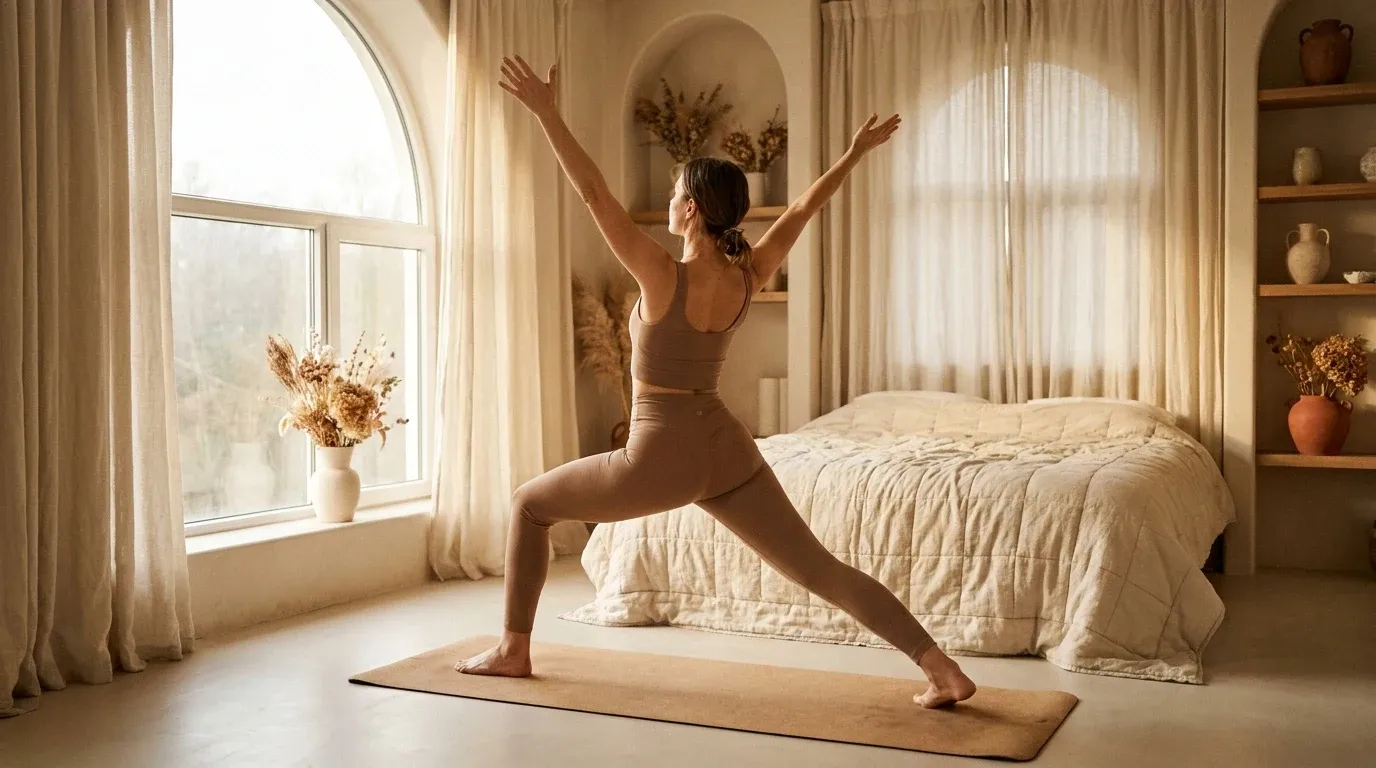
If you've been rolling out your mat at night to wind down before bed, a new study suggests you might be working against your own sleep. Researchers at the National Institute of Mental Health and Neurosciences (NIMHANS) compared the effects of morning versus evening yoga on sleep quality in young adults, and the results are worth paying attention to.
The popular advice to use evening yoga as a relaxation ritual has some truth to it. But when researchers measured what was actually happening to sleep quality overnight, the picture shifted considerably.
What the Study Actually Found
The NIMHANS-led study tracked young adult participants practicing yoga at two different times of day over a structured period. Researchers assessed sleep using validated objective metrics, not just self-reported feelings of rest.
Morning yoga practitioners showed measurably better overall sleep quality and fewer nighttime disturbances compared to the evening group. These weren't marginal differences. The morning group consistently scored better on the metrics that matter most for genuine restorative sleep.
The evening group wasn't without benefits. Participants who practiced at night reported reduced feelings of sadness and experienced a sense of immediate calm after their sessions. That's real and it matters, particularly for emotional regulation. But it didn't translate into improved objective sleep quality. Feeling relaxed before bed and actually sleeping better are, it turns out, two different things.
Why Timing Changes Everything
The explanation likely comes down to circadian biology. Your body runs on a roughly 24-hour internal clock that governs alertness, temperature, hormone release, and sleep pressure. Movement in the morning sends a clear wake signal to that system, reinforcing the natural rise in cortisol and core body temperature that your biology already expects at that time of day.
When you strengthen those morning wake signals consistently, you also strengthen the contrast between wakefulness and sleep later in the day. This consolidates what researchers call sleep drive, the biological pressure to sleep that builds throughout the day and releases when you finally lie down.
Evening exercise, including yoga, can interfere with that process. Even gentle movement elevates heart rate, increases body temperature, and activates the nervous system to some degree. For some people, that's enough to delay the natural wind-down that precedes quality sleep, even if it feels relaxing in the moment.
This isn't entirely new territory. Research on exercise timing and sleep has been building for years, and the NIMHANS findings align with a broader body of evidence suggesting morning movement produces stronger circadian benefits than evening sessions when sleep quality is the primary outcome.
The Evening Yoga Defense
Before you abandon your 8 PM practice entirely, it's worth being precise about what evening yoga does and doesn't do.
The emotional benefits are real. Reduced sadness, lower perceived stress, and a sense of calm are meaningful outcomes, especially if you're managing a demanding schedule or high daily stress load. For mental health maintenance, an evening session may be exactly what you need.
Evening yoga also remains far better than no yoga. If your schedule genuinely doesn't allow for morning practice, you're not doing yourself harm by practicing at night. The NIMHANS study compared two yoga groups to each other, not a yoga group to a sedentary control group.
The nuance here matters. It's not that evening yoga is bad. It's that if improving your sleep quality is your primary reason for practicing yoga, the evidence now suggests morning is the more effective window.
Who Should Be Cautious About Applying These Findings
The NIMHANS study focused on young adults, and that population caveat is significant. Sleep architecture changes substantially with age. Older adults spend less time in deep slow-wave sleep, wake more frequently during the night, and are more sensitive to circadian disruptions. Whether the morning yoga advantage holds as strongly in that demographic hasn't been established by this research.
People with clinical sleep disorders, including chronic insomnia, sleep apnea, or restless leg syndrome, operate in a different physiological context entirely. Yoga timing may still matter for them, but any intervention should be considered alongside medical guidance rather than as a standalone fix.
For women navigating perimenopause or menopause, sleep disruption is often driven by vasomotor symptoms and hormonal fluctuations that yoga timing alone is unlikely to fully resolve. That said, exercise remains one of the more evidence-backed behavioral tools in that context. You can read more about the broader research on perimenopause and sleep, and what exercise actually does.
What This Means for Your Practice
If you're practicing yoga specifically to sleep better and you haven't been seeing results, timing may be the variable you haven't adjusted yet. The research gives you a concrete, low-friction thing to test.
Here's a practical approach. Shift your yoga sessions to the morning for two weeks. Keep everything else consistent: your sleep schedule, caffeine intake, screen time habits, and overall practice duration. At the end of two weeks, assess whether your sleep feels more consolidated, whether you're waking less at night, and whether you feel more rested in the morning.
Two weeks is long enough for circadian patterns to begin shifting. It's also short enough that if morning yoga doesn't suit your schedule or preferences, you haven't committed to a permanent overhaul.
You don't need an intense session to get the benefit either. A 20 to 30 minute morning practice, even a moderate one, appears sufficient to send those circadian wake signals. The key is consistency and timing, not duration or intensity.
Building a Routine That Actually Supports Sleep
Yoga timing is one lever among several. Sleep quality is downstream of a lot of daily habits, and the basics still matter more than any single intervention. Post-workout recovery fundamentals consistently outperform high-tech approaches, and the same logic applies to sleep. Consistent sleep and wake times, a cool room, and limiting bright light in the evening will likely do more than any timing optimization on its own.
That said, morning movement has benefits that extend well beyond sleep. Strength training in particular has been shown to carry significant longevity benefits, and understanding the surprising longevity benefit of lifting weights helps make the case for building any kind of structured morning movement habit, whether it's yoga, resistance training, or a combination of both.
If yoga is your primary modality and you're curious about structuring your practice for different goals beyond sleep, the best time to do yoga depends on what you're actually trying to achieve, and sleep is just one of several outcomes worth considering.
The Bottom Line
The NIMHANS study adds meaningful evidence to a question that previously relied too heavily on intuition and anecdote. Evening yoga feels good, and that's not nothing. But feeling calm before bed isn't the same as sleeping better, and the data now points clearly toward morning practice as the more effective choice for improving objective sleep quality.
If your evenings are the only time you can practice, keep going. Yoga at any time beats no yoga. But if you have flexibility and sleep is what you're chasing, setting your alarm 30 minutes earlier and moving before the day starts is a genuinely evidence-backed strategy worth trying.
- Morning yoga produced better objective sleep quality and fewer nighttime disturbances in young adults.
- Evening yoga improved mood and reduced sadness but didn't improve sleep metrics.
- Circadian alignment is the likely mechanism: morning movement reinforces wake signals that consolidate sleep pressure later.
- The study population was young adults, so findings may not apply directly to older adults or those with clinical sleep disorders.
- Try a two-week morning shift if better sleep is your primary goal, keeping all other variables consistent.