
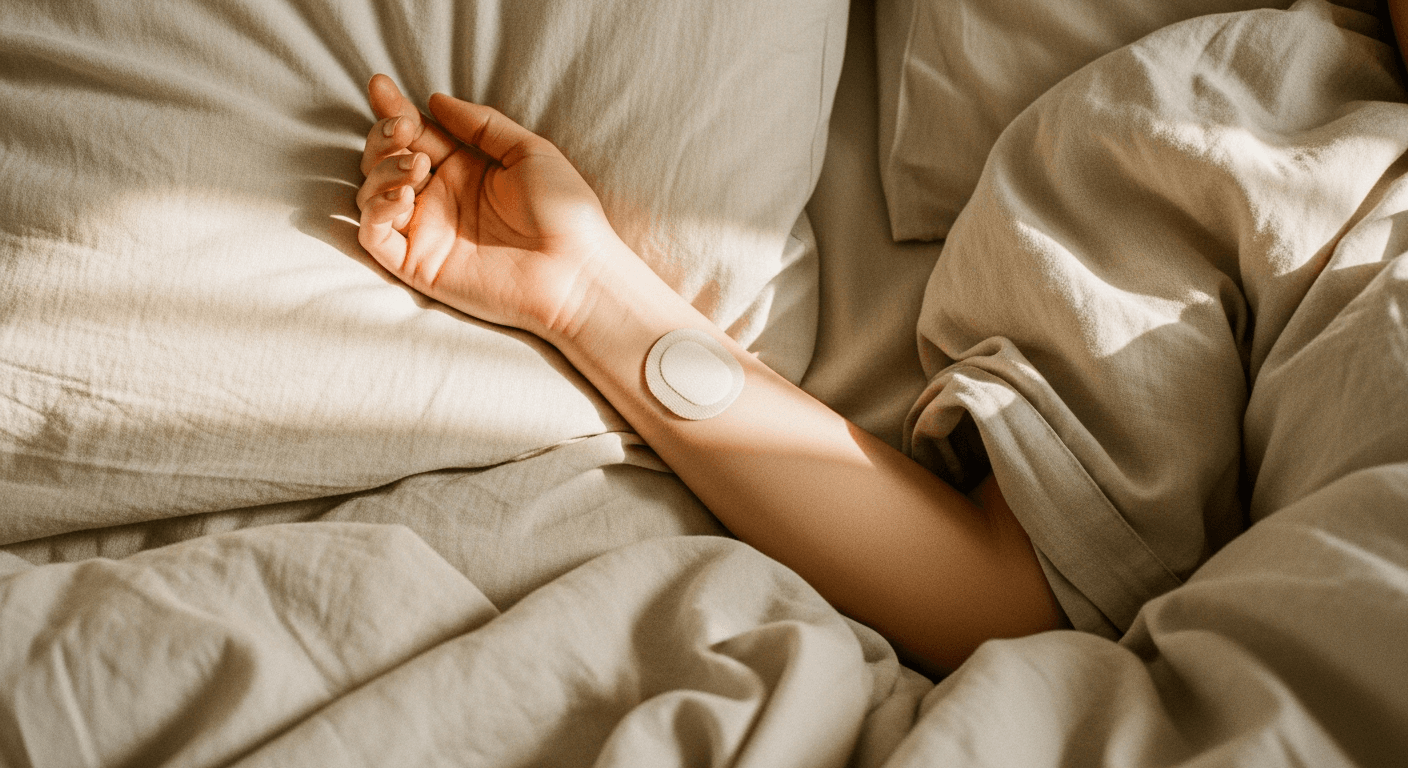
Sleep tech has spent years giving you data. Trackers, rings, headbands. Scores every morning telling you how badly you slept. What most of it hasn't done is actually change the quality of your sleep in real time. That's starting to shift.
Researchers at the University of Texas at Austin have developed a wearable patch called NEUSLeeP that uses bioelectronic ultrasound stimulation to improve sleep architecture while you're wearing it. In early trials, participants reached REM sleep 43 minutes faster than their baseline and extended total REM duration by roughly 16 minutes per night. Those aren't marginal numbers.
What NEUSLeeP Actually Does
The patch applies low-intensity ultrasound waves directly through the skin in a completely non-invasive way. No needles, no implants, no medication. It's worn during sleep and targets the peripheral nervous system to modulate brain activity associated with sleep stages.
The underlying principle is bioelectronic medicine, a field that uses electrical or acoustic signals to influence biological processes without pharmaceutical intervention. In this case, the ultrasound stimulation is timed and calibrated to nudge the body toward deeper sleep cycles, particularly the REM phase that most sleep trackers show you're not getting enough of.
What makes this different from, say, white noise machines or weighted blankets is that it's not creating a passive environment. It's actively interacting with your nervous system during sleep. That's a meaningful distinction when you're evaluating what the technology can and can't promise.
The Trial Results in Plain Numbers
The trial data is specific enough to take seriously. Participants using NEUSLeeP during sleep reached REM onset 43 minutes faster on average compared to nights without the device. They also logged approximately 16 additional minutes of REM sleep per night.
For context, most adults average between 90 and 120 minutes of REM sleep across a full night. Adding 16 minutes represents a meaningful percentage increase, particularly for people who are REM-deficient to begin with, which includes a significant portion of adults with chronic stress, irregular schedules, or mild sleep disorders.
Reaching REM faster also matters for sleep efficiency. REM doesn't happen uniformly across the night. It concentrates in the later sleep cycles, so if disruptions cut your sleep short, REM is what you lose first. Getting there sooner creates a buffer.
Why REM Specifically Matters
REM sleep is the stage most directly linked to emotional processing and memory consolidation. During REM, the brain replays and integrates emotional experiences from the day, essentially sorting what to retain and what to release. Chronic REM deprivation is associated with heightened emotional reactivity, reduced stress tolerance, and impaired decision-making.
The researchers behind NEUSLeeP specifically cited emotional well-being as one of the key outcomes they're targeting. That framing connects the technology to a broader clinical conversation about sleep disorders, anxiety, and mood regulation. Sleep and mental health have a two-way relationship, and the APA has documented how disrupting one consistently undermines the other. A device that reliably extends REM could have real therapeutic implications beyond lifestyle optimization.
This is also why the technology sits at the intersection of consumer wearables and clinical sleep therapy. It's not quite a medical device in its current form, but the outcomes it's targeting are clinical in nature.
Where This Fits in the Sleep Tech Landscape
The consumer sleep tech market has expanded rapidly, but most of it falls into one of two categories: passive monitoring or environmental conditioning. Rings and wristbands track your sleep. Weighted blankets, cooling mattresses, and grounding sheets try to create better conditions for it. Neither category directly influences sleep architecture during the night.
NEUSLeeP represents a third category. Active physiological intervention. It's closer in principle to transcranial stimulation devices used in clinical research than to anything currently sold at retail. That's what makes it interesting and what makes it worth watching carefully.
The challenge for any technology in this space is the gap between lab conditions and real-world use. Trial participants in a controlled setting behave differently from someone wearing a patch after a stressful workday and three glasses of wine. Reproducibility outside of research conditions is the real test, and that data doesn't exist yet at scale.
It's also worth applying a consistent evidence framework here. Knowing how to tell hype from real evidence matters more as consumer health products make increasingly specific physiological claims. A 43-minute improvement in REM onset is a precise number. Precise numbers from small trials don't always survive larger, more diverse populations.
The Broader Recovery Picture
Sleep doesn't operate in isolation. REM quality is influenced by everything from your cortisol levels to your nutrition habits to how much you moved during the day. A patch that accelerates REM onset is a meaningful tool, but it's working within a system.
Research consistently shows that most people are falling short on both sleep and exercise, and those deficits compound each other. Poor sleep reduces motivation for physical activity. Insufficient movement reduces sleep quality. A device like NEUSLeeP could help break that cycle at the sleep end, but the behavioral factors don't disappear.
Nutrition also plays a more direct role in sleep architecture than most people realize. Amino acid availability, particularly tryptophan and its conversion pathway to serotonin and melatonin, affects REM regulation. If you're consistently under-eating protein or eating it in patterns that don't support overnight recovery, the biochemical substrate for quality REM sleep is compromised regardless of what's on your wrist or chest.
The recovery strategies that hold up in 2026 are the ones that address sleep, movement, and nutrition as an integrated system, not separate levers. NEUSLeeP is designed to optimize one variable within that system. That's valuable. It's not the whole equation.
What to Watch For as This Develops
The technology is currently in research and development. There's no commercial release date, no confirmed pricing, and no regulatory pathway announced yet. That's normal for a device at this stage, but it means the practical implications for most consumers are still 12 to 36 months away at minimum.
Here's what will determine whether NEUSLeeP transitions from a promising research finding to a legitimate consumer product:
- Replication at scale. The trial results need to hold across larger, more diverse populations before any clinical or commercial claims can be substantiated.
- Regulatory classification. A device that actively modulates nervous system activity during sleep is likely to require FDA review in the US and equivalent approvals in the UK, Canada, and Australia. That process takes time and shapes what claims the manufacturer can legally make.
- Comfort and wearability. Sleep tech lives or dies on whether people actually wear it consistently. The patch format is promising for compliance, but long-term wearability data matters.
- Side effect profile. Non-invasive doesn't automatically mean side-effect-free. Headache, skin irritation, or disrupted sleep in edge cases are all worth understanding before widespread use.
- Pricing and access. If it reaches market as a premium clinical device, it may sit at a price point that limits access to users who need it most. That's a recurring problem in health tech.
The Signal in the Noise
Consumer sleep tech has produced a lot of data over the past decade and relatively little transformation. The average person wearing a sleep tracker today knows more about their sleep than they did five years ago. Whether they're sleeping better is a different question.
NEUSLeeP's proposition is different in kind, not just degree. It's not telling you what your REM score was. It's attempting to change your REM in real time. That shift from measurement to intervention is where the real potential lies, and where the real scrutiny should follow.
The research coming out of the University of Texas at Austin is credible and specific. The results are worth taking seriously. But the honest position right now is that this is a technology with genuine promise that hasn't yet been tested at the scale or under the conditions that would justify broad confidence in it.
Watch it. Don't wait for it to replace your existing sleep habits. And when it does reach market, evaluate it the same way you'd evaluate any health product making precise physiological claims: look at the full trial data, not just the headline number.