
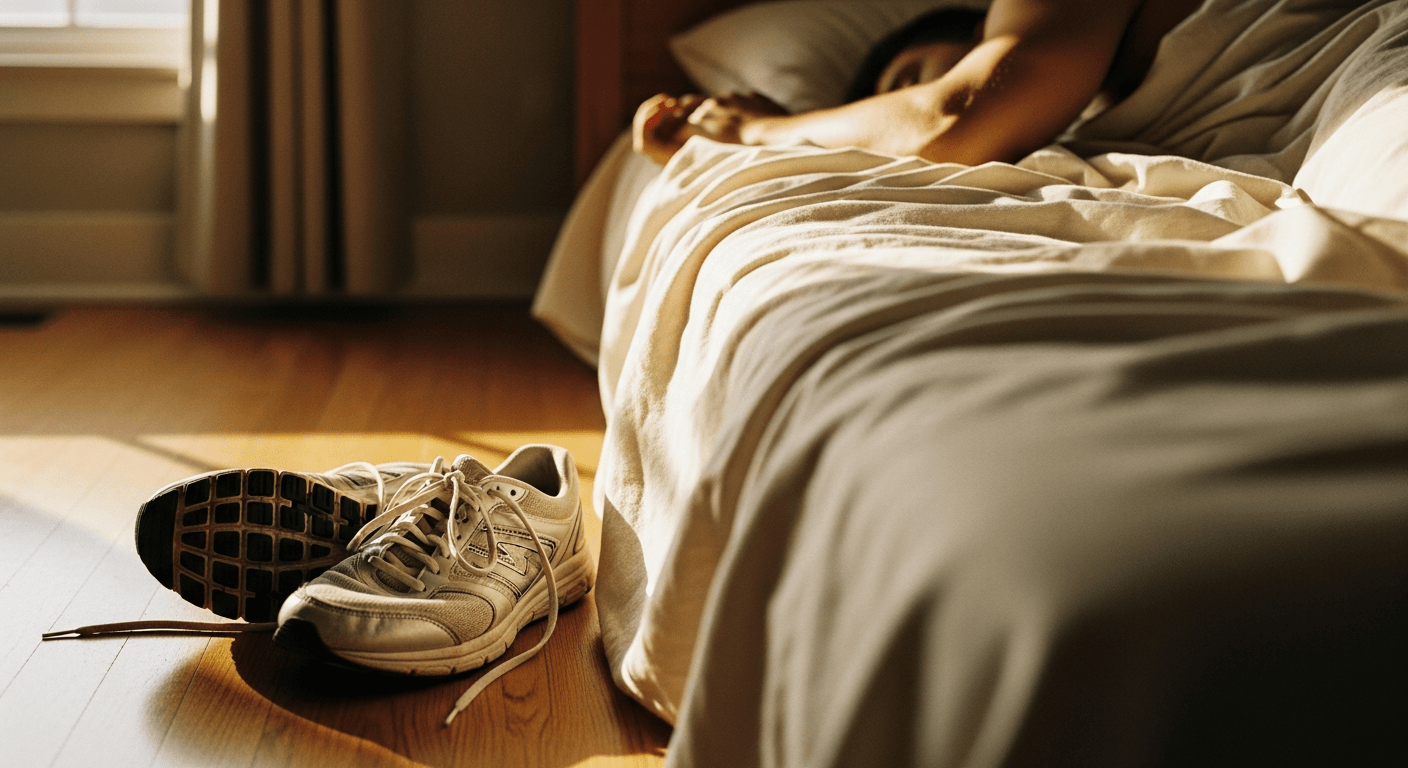
Most athletes and active people obsess over training volume, protein intake, and recovery tools. Sleep gets treated as the thing that happens when everything else is done. That's a costly mistake. New research from UC Berkeley is making the case more clearly than ever: the quality of your deep sleep, not just the number of hours you log, directly determines how much muscle repair and fat metabolism happen overnight.
If you're putting serious effort into your training and your results have plateaued, your nights deserve the same attention as your workouts.
What the UC Berkeley Research Actually Found
Researchers at UC Berkeley identified a feedback loop between deep sleep, specifically slow-wave sleep (SWS), and growth hormone secretion. The finding matters because it reframes how fitness enthusiasts should think about sleep. It's not enough to be in bed for eight hours. What counts is how much time your brain spends in the slow, high-amplitude electrical activity that defines deep sleep stages.
During slow-wave sleep, the pituitary gland releases the majority of your daily growth hormone. That hormone drives muscle protein synthesis, mobilizes fat stores for fuel, and repairs connective tissue stressed during training. The UC Berkeley circuit research suggests that disruptions to deep sleep, even subtle ones you wouldn't notice on a basic sleep tracker, can suppress this hormonal cascade significantly.
This has direct implications if you're strength training, doing high-intensity intervals, or preparing for an endurance event. Poor deep sleep doesn't just leave you tired. It actively limits the physiological adaptations you're trying to build.
Habits That Protect Your Deep Sleep
The good news is that slow-wave sleep responds well to behavioral changes. You don't need a prescription or an expensive protocol. Here's what the evidence consistently supports.
Lock in a consistent wake time
Your circadian rhythm is anchored primarily to your wake time, not your bedtime. When you wake at the same time every day, including weekends, your body learns to time deep sleep efficiently in the first half of the night, which is when SWS naturally peaks. Irregular schedules fragment this architecture and reduce the proportion of restorative sleep stages.
Cool your bedroom down
Core body temperature needs to drop by roughly 1 to 2 degrees Celsius for sleep to initiate and deepen. Research consistently points to a bedroom temperature of around 18 to 19 degrees Celsius (65 to 66°F) as the sweet spot for maximizing slow-wave sleep. If your room is warmer, your body struggles to make that thermal shift, and deep sleep suffers.
Cut alcohol at least three hours before bed
Alcohol is widely misunderstood as a sleep aid. It does help you fall asleep faster, but it fragments sleep architecture in the second half of the night and specifically suppresses REM and slow-wave stages. Consuming alcohol within three hours of bedtime measurably reduces deep sleep, regardless of how "well" you feel you slept. For athletes, this is particularly damaging since that's exactly when growth hormone secretion would otherwise peak.
Limit blue light in the evening
Light in the blue spectrum (roughly 460 to 480 nm) suppresses melatonin production by signaling to your brain that it's still daytime. Screens, LED lighting, and overhead lighting in the two hours before bed all contribute. Endless Scrolling Hurts Your Memory. Exercise Fights Back. covers the cognitive side of this problem in depth, but the sleep architecture angle is equally important: delayed melatonin onset shortens your total slow-wave sleep window.
Practical fixes include switching to warm-spectrum lighting after 9 p.m., using blue-light filtering glasses if screen use is unavoidable, and keeping your phone outside the bedroom.
When Behavioral Changes Aren't Enough: The Case for CBT-I
Insights from the SLEEP 2026 conference reinforced what sleep medicine specialists have argued for years: cognitive behavioral therapy for insomnia (CBT-I) is the gold-standard non-pharmacological treatment for chronic sleep disruption. Multiple studies presented at the conference showed CBT-I outperforming sleep supplements, including melatonin, magnesium, and ashwagandha, on both objective and subjective sleep quality measures.
CBT-I works by addressing the thought patterns and behaviors that perpetuate insomnia rather than masking symptoms. It typically involves sleep restriction therapy, stimulus control, cognitive restructuring, and relaxation techniques delivered over six to eight sessions. It's not a quick fix, but its effects are durable in a way that supplements aren't.
Before you spend money on sleep stacks, it's worth knowing that 5 Simple Recovery Habits That Actually Work covers the behavioral foundations that support CBT-I principles without requiring formal therapy. And if you're skeptical about whether supplements are even delivering what their labels promise, Can You Actually Trust What's on Your Supplement Label? is worth your time.
CBT-I is increasingly available through digital platforms and apps, some of which charge between $80 and $150 for a full program. That's a fraction of what most people spend on sleep supplements in a year, with significantly better outcomes.
Using Wearables to Monitor Deep Sleep Quality
The consumer wearable market has matured to the point where devices can give you meaningful data on sleep stages, heart rate variability (HRV), and overnight resting heart rate. For fitness enthusiasts, these metrics are genuinely useful, but only if you know how to interpret them.
Heart rate variability is particularly informative. High overnight HRV generally indicates strong parasympathetic nervous system activity, which correlates with effective recovery. If your HRV trends downward across consecutive training days without a clear cause, disrupted deep sleep is a common culprit worth investigating.
Sleep stage estimates from wearables are less precise than polysomnography, the gold-standard clinical test, but they're improving. Devices that combine accelerometry with photoplethysmography (PPG) can now give you reasonably reliable slow-wave sleep estimates. What Your Sleep Tracker Can Actually Tell You About Apnea explains the technical limits and how to use this data responsibly.
One important caveat: a single night of data tells you very little. Patterns across two to four weeks are what actually reveal whether your deep sleep is adequate for recovery. This is also relevant if your tracker flags anything that looks like disordered breathing. As One Night Sleep Test Isn't Enough, Study Finds outlines, single-night assessments frequently misclassify sleep apnea, which means both false positives and missed diagnoses are common.
Use your wearable as a trend tool, not a diagnostic device. If your data consistently shows less than 15 to 20 percent of total sleep in slow-wave stages, or HRV that doesn't recover even on rest days, those are signals worth discussing with a healthcare provider.
The Mental Performance Dimension
Deep sleep isn't just about muscle repair. Slow-wave sleep is when your brain consolidates procedural memory, including the motor patterns you're reinforcing through training. Reaction time, decision-making, and the ability to execute complex movements under fatigue all depend on adequate SWS.
Research consistently shows that even one or two nights of poor deep sleep impairs cognitive performance in ways that athletes often attribute to overtraining or low motivation. If you're feeling mentally flat during workouts, struggling with focus, or losing technical precision at the end of sessions, your sleep architecture deserves a closer look before you change your program.
This is also where coaching quality intersects with recovery. If you're working with a trainer who doesn't ask about your sleep, that's a gap worth addressing. Whether you're weighing your options between formats, AI vs Human Trainer: What to Choose in 2026 walks through which approach best accounts for recovery-based programming adjustments.
A Practical Framework for Better Sleep Quality
- Set a fixed wake time seven days a week and protect it even after a late night.
- Lower your thermostat to 18 to 19 degrees Celsius before bed. A cool shower can accelerate the process.
- Stop drinking alcohol at least three hours before your target sleep time on training days.
- Dim your lights and stop screen use 90 minutes before bed. If that's not realistic, use blue-light filtering glasses.
- Track HRV trends over weeks, not nights, to assess whether your recovery is keeping pace with your training load.
- Consider CBT-I if you've had persistent trouble falling or staying asleep for more than four weeks. Skip the supplements until you've addressed behavioral patterns first.
- Talk to a doctor if your wearable consistently flags low SpO2 or highly fragmented sleep. Don't self-diagnose based on a single night of data.
Sleep optimization isn't a passive process. It's a trainable skill with measurable outputs, and the science is now precise enough to tell you exactly where to focus your effort. Your training earns you the adaptation. Your deep sleep is where that adaptation actually happens.