
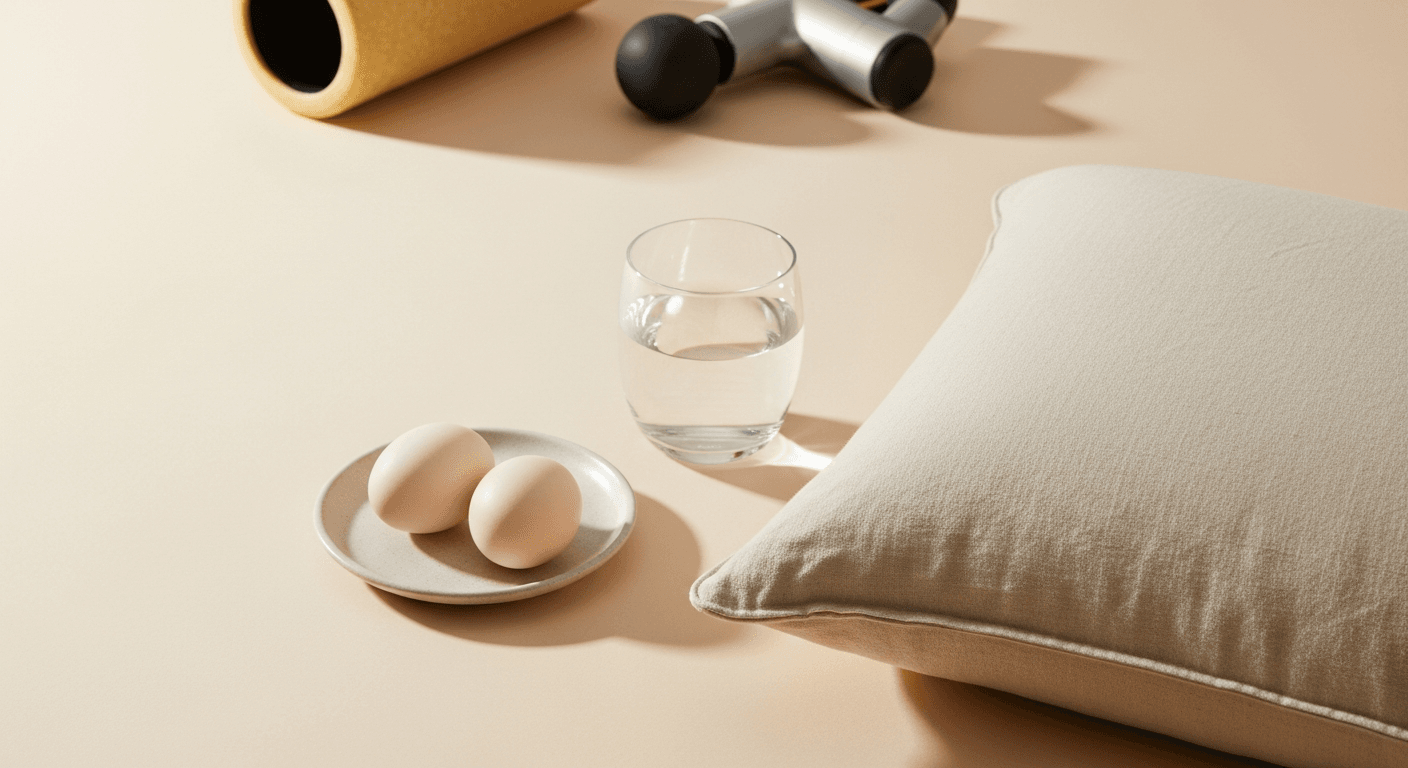
The recovery technology market is worth billions and growing fast. Percussion guns, infrared saunas, hyperbaric chambers, cold plunge tubs, and wearable biosensors compete for your attention. And your wallet. A May 2026 evidence review published across multiple sports science journals reconfirms what researchers have been saying for years: the fundamentals of sleep, hydration, and protein timing consistently outperform every high-tech protocol tested. The gap is not even close.
That's not an argument against technology. Some tools have real utility. But when the basics aren't in place, no device or protocol bridges the gap. Here's what the current evidence actually supports.
Progress Is Built During Recovery, Not During the Workout
Training creates the stimulus. Recovery creates the adaptation. This distinction matters more than most people realize, especially in a fitness culture that rewards volume and intensity above everything else.
The May 2026 review analyzed over 140 studies across endurance, strength, and mixed-sport populations. Its central finding: athletes and recreational exercisers who prioritized recovery consistency showed greater strength and performance gains over 12-week periods than those who increased training volume without recovering adequately. More work without adequate recovery doesn't produce more results. It produces fatigue, stagnation, and injury risk.
If you're serious about building strength as a long-term health priority, recovery quality is the variable you should be optimizing first. Not training frequency.
Sleep Is the Highest-Leverage Tool You Already Have
The evidence here is consistent across decades of research and reconfirmed by the 2026 review. Adults who sleep between seven and nine hours per night show significantly better hormonal profiles for muscle repair, lower markers of systemic inflammation, faster reaction times, and improved mood regulation compared to those sleeping six hours or fewer.
During deep sleep stages, the body releases the majority of its daily growth hormone. This is the primary driver of tissue repair and muscular adaptation after training. Cut sleep short and you interrupt that process regardless of how well you eat or how many supplements you take.
The review found that sleep deprivation of even 90 minutes per night over five consecutive days was enough to meaningfully impair next-day performance and elevate cortisol to levels that actively interfere with recovery. No recovery gadget tested in the literature has demonstrated the ability to compensate for that deficit.
Sleep tracking wearables have become increasingly popular, and some data suggests they can motivate better sleep habits. But there's a meaningful difference between tracking sleep and improving it. Understanding why sleep became the top wellness priority in 2026 helps put the technology conversation in the right context. The wearable doesn't do the work. Getting to bed earlier does.
Protein Timing: Simple Math That Outperforms Most Supplements
Post-workout protein shakes, branched-chain amino acids, and recovery blends generate enormous revenue every year. The evidence supporting most of these products is weak at best. What the evidence does consistently support is straightforward: consuming 20 to 40 grams of high-quality protein per meal, distributed across three to four meals per day, maximizes muscle protein synthesis more reliably than any supplement stack tested in the 2026 review.
The mechanism is well understood. Muscle protein synthesis is triggered by the presence of essential amino acids, particularly leucine. A threshold of roughly 2 to 3 grams of leucine per meal is needed to fully activate this response. That threshold is met by a standard serving of chicken, eggs, Greek yogurt, cottage cheese, or a quality whey protein. It does not require a $90-per-month product with eight proprietary ingredients.
Timing also matters, though the research has refined the window considerably. The old "anabolic window" of 30 minutes post-workout has been revised. Current evidence supports a broader two-to-three-hour window, which means your post-training meal is more important than rushing a shake in the parking lot. What matters most is total daily protein intake (roughly 1.6 to 2.2 grams per kilogram of body weight for active individuals) and consistent meal-by-meal distribution.
Nutritional detail matters here. If you're already optimizing your smoothies and recovery meals, be aware that ingredient combinations can work against you. For example, research has shown that adding a banana to your smoothie can destroy up to 84% of its antioxidant content, a detail that matters if you're relying on those compounds for their anti-inflammatory recovery support.
Hydration: The Overlooked Basic That Costs Almost Nothing
Dehydration of just two percent of body weight measurably impairs both physical performance and cognitive function. That's a well-established finding replicated dozens of times in controlled settings. Yet hydration remains one of the most consistently under-addressed aspects of recovery.
The 2026 review flagged this as particularly relevant for individuals who train in the morning and rely on coffee as their primary pre-workout fluid. Caffeine is not a hydration substitute. Starting a session already slightly dehydrated compounds fatigue, reduces power output, and slows recovery in the hours after training.
The practical target for most active adults is 35 to 45 milliliters of fluid per kilogram of body weight daily, adjusted upward for heat, sweat rate, and training intensity. Electrolytes matter when sessions exceed 60 to 90 minutes or when training in high heat. For most people most of the time, water and food-based electrolytes are sufficient. There's no evidence that expensive alkaline waters or complex hydration formulas offer a meaningful advantage over plain water consumed consistently.
Active Recovery Is Underrated and Free
Complete rest on recovery days is intuitive but not always optimal. Light movement, specifically walking, easy cycling, or gentle swimming, promotes blood circulation, reduces delayed onset muscle soreness, and accelerates the clearance of metabolic byproducts without adding physiological stress to the system.
The evidence consistently shows that 20 to 40 minutes of low-intensity movement the day after an intense session reduces perceived soreness by 20 to 30 percent and can accelerate return-to-performance timelines compared to passive rest. The intensity must stay genuinely low. Heart rate below 60 percent of maximum is the working guideline. This isn't a workout. It's circulation.
Cold water immersion and contrast therapy have both been studied extensively. The honest summary: they reduce acute soreness perception but show limited evidence of actually accelerating strength adaptation. Some data suggests that regular cold immersion post-training may blunt hypertrophic signaling. The effect size is debated, but it's a reason to be cautious about making cold plunges a daily habit if muscle growth is your primary goal.
What About the Expensive Gear?
Percussion massagers, wearable recovery trackers, and infrared devices aren't worthless. Some of them offer real but modest benefits for specific applications. Smart recovery trackers from brands like Whoop, Oura, and Garmin can provide useful data on heart rate variability and sleep staging, which may help you make better training decisions on the margin.
The problem is sequencing. A $30-per-month wearable subscription sitting on top of a six-hour sleep schedule and inconsistent meals isn't going to move the needle. It's optimizing the margin while ignoring the foundation. The 2026 review found that individuals who scored highest on basic recovery habit adherence, sleep, protein, hydration, and light activity, showed performance outcomes that were simply not matched by those relying on technology without the fundamentals in place.
Gadgets earn their place only after the basics are locked in. At that point, yes, some of them can help you fine-tune. But the return on a consistent bedtime dwarfs the return on a $500 recovery device used while sleep-deprived.
The Action Plan: Low-Cost, Evidence-Based Recovery
Here's what the science actually supports as your weekly recovery framework:
- Sleep 7 to 9 hours every night. Treat your bedtime as a non-negotiable training variable. Dim lights 60 to 90 minutes before bed. Keep your room cool and dark.
- Hit 20 to 40 grams of protein per meal. Prioritize a protein-rich meal within two to three hours post-training. Distribute intake across the full day rather than backloading it at dinner.
- Drink water consistently throughout the day. Don't rely on thirst alone, especially during training blocks. Start the morning with 400 to 500 milliliters before coffee.
- Add one or two active recovery sessions per week. A 30-minute walk or easy bike ride on your off days reduces soreness and keeps your aerobic system ticking without adding stress.
- Be consistent before being perfect. Seven nights of adequate sleep beats one perfect recovery weekend. The compounding effect of consistent basics over weeks and months is where real adaptation happens.
You don't need to spend $350 a month on recovery gadgets to make progress. You need to sleep, eat enough protein, stay hydrated, and move gently between hard sessions. The May 2026 evidence review didn't uncover anything revolutionary. It confirmed what the data has shown for years. The fundamentals work. They work better than the alternatives. And they're available to anyone.
If you want to explore how coaching can help you build these habits more systematically, understanding your coaching options in 2026 is a useful starting point for finding the right structure and accountability.