
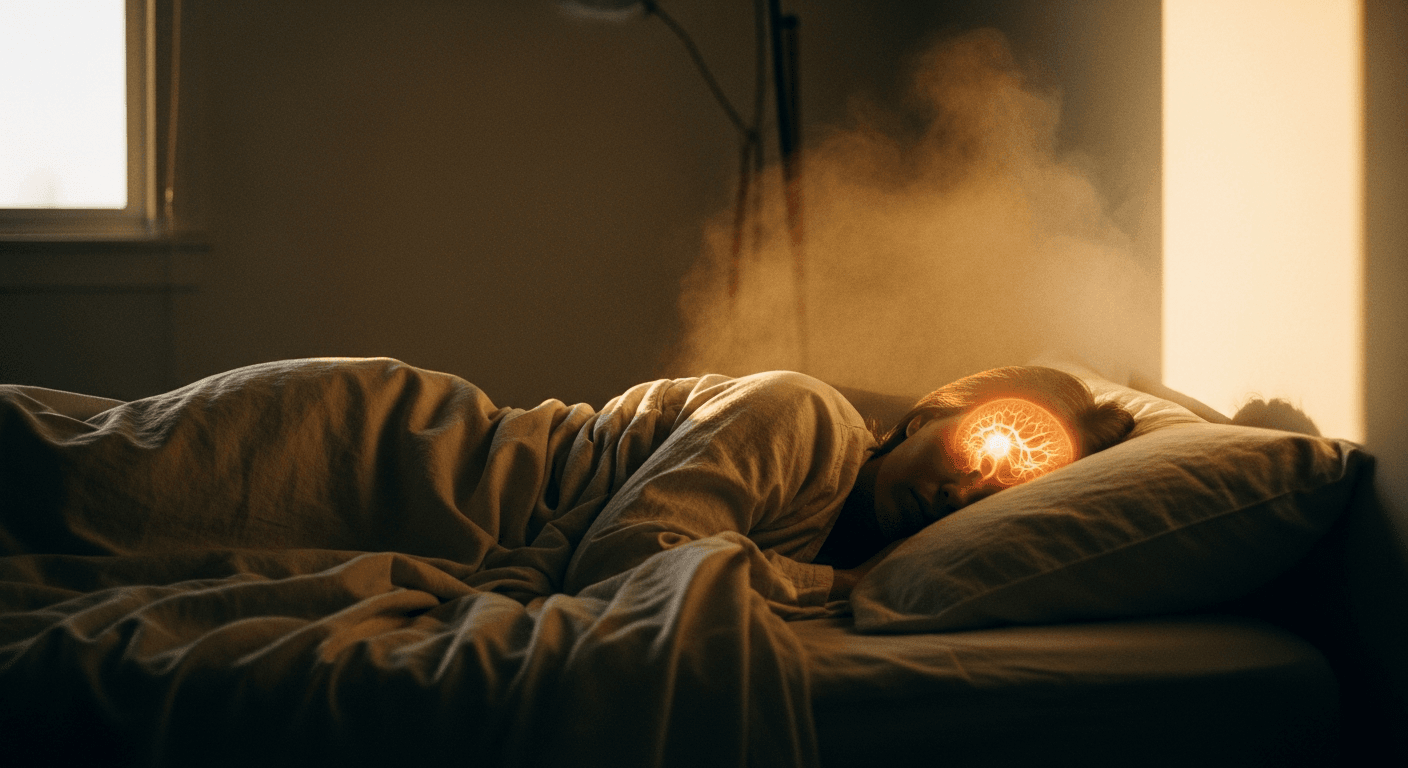
Most people treat sleep as the body's off switch. You're tired, you rest, you wake up. But that framing misses almost everything interesting about what happens when your eyes close. Sleep isn't passive recovery. It's an active, highly organized biological process that primes your brain for the next day's learning, scrubs out toxic waste, and stitches new experiences into long-term memory.
New research backed by the American Psychological Association makes this clearer than ever. Sleep isn't just something you need more of. It's something your brain depends on to function at a level you'd actually recognize as sharp.
Your Brain Doesn't Rest During Sleep. It Resets.
There's a persistent idea that sleep is simply the brain powering down. The evidence says otherwise. During sleep, your brain cycles through distinct stages. Non-REM slow-wave sleep consolidates procedural and declarative memories. REM sleep processes emotional content and strengthens associative connections between ideas you encountered during the day.
The net effect is a neural reset. Synaptic connections that fired repeatedly during waking hours are selectively strengthened or pruned, a process researchers call synaptic homeostasis. Without that pruning, your neural pathways become saturated. You literally lose the capacity to absorb new information efficiently.
Studies using memory consolidation tasks consistently show that people who sleep after learning retain significantly more than those who stay awake for the same interval. It's not rest that drives the improvement. It's the sleep itself.
This has real consequences for anyone managing a demanding cognitive workload, whether that's studying, building skills at work, or trying to stay sharp as you age. Sleep and moderate exercise together protect mental health and cognitive performance well into midlife, according to a large Finnish cohort study, reinforcing that sleep isn't an isolated variable.
The Glymphatic System: Your Brain's Overnight Cleaning Crew
One of the most significant neuroscience discoveries of the past decade involves a system most people have never heard of. The glymphatic system is a network of fluid channels that runs alongside blood vessels in the brain. Its job is to clear out metabolic waste, including beta-amyloid and tau proteins, the same compounds that accumulate in Alzheimer's disease.
Here's the critical part: the glymphatic system is significantly more active during sleep than during waking hours. Brain cells actually shrink during sleep, expanding the spaces between them and allowing cerebrospinal fluid to flow more freely through the tissue. The result is a thorough flush of waste products that accumulate throughout the day.
When sleep is disrupted or cut short, that clearance is incomplete. Beta-amyloid levels measurably rise after even a single night of poor sleep. Over years and decades, chronic sleep deprivation creates conditions that may meaningfully accelerate neurodegeneration.
This connects directly to ongoing research into dementia prevention. The CABA trial found that creatine supplementation slowed Alzheimer's-related cognitive decline by 30%, but researchers in that space consistently note that no supplement compensates for structural sleep deficits. Glymphatic clearance requires actual sleep, not pharmacological shortcuts.
Sleep Debt Is Real and It Compounds
Losing one hour of sleep a night for a week is not the same as losing seven hours on a single night. The effects of partial sleep deprivation accumulate in ways that aren't immediately obvious because your subjective sense of sleepiness adapts. You stop feeling as tired. But your cognitive performance keeps declining.
Research from the University of Pennsylvania's sleep lab showed that subjects restricted to six hours of sleep per night for two weeks performed as poorly on cognitive tasks as subjects who had been kept awake for 24 hours straight. Critically, the six-hour group didn't perceive themselves as significantly impaired. They had adapted to the deficit. Their performance hadn't.
The domains hit hardest by sleep debt are exactly the ones you rely on most: sustained attention, working memory, emotional regulation, and decision-making under uncertainty. Irritability isn't a personality flaw if you're chronically under-slept. It's a neurological consequence of prefrontal cortex underfunction.
The compounding effect also has long-term implications. Consistent sleep restriction over years is associated with elevated inflammatory markers, insulin resistance, and increased cortisol reactivity. These aren't separate health problems. They're downstream effects of a brain that never gets enough time to reset and clean itself.
What Disrupts Sleep More Than You Think
Blue light from screens is the most discussed culprit, and the concern is legitimate. Exposure to short-wavelength light in the evening suppresses melatonin production and delays your circadian clock. But blue light isn't the whole story.
Room temperature has a significant and often underestimated effect on sleep quality. Your core body temperature naturally drops as you approach sleep, and that drop is part of the signal that initiates deeper sleep stages. A room that's too warm interferes with that process. Research consistently points to a sleep environment between 60 and 67 degrees Fahrenheit as optimal for most adults.
Alcohol is another factor that's frequently misunderstood. It may help you fall asleep faster, but it suppresses REM sleep and fragments sleep architecture in the second half of the night. You wake up having logged the hours but missed the restorative stages that matter most for memory and emotional processing.
Irregular sleep timing compounds all of these factors. Your circadian system is not just a timer. It's a full-body coordination mechanism that governs hormone release, immune function, and cellular repair. Shifting your sleep window dramatically on weekends, a pattern sometimes called social jetlag, creates a misalignment between your internal clock and your behavior that has measurable health consequences.
Practical Habits That Support Glymphatic Clearance
The good news is that supporting healthy sleep doesn't require expensive technology or a complex protocol. The interventions with the most consistent evidence are straightforward.
- Consistent bedtime and wake time: Going to bed and waking at the same time every day, including weekends, stabilizes your circadian rhythm more effectively than any other single intervention. Consistency matters more than the specific time.
- Cool room temperature: Aim for 60 to 67 degrees Fahrenheit. If you run warm, a fan or light bedding can be more effective than air conditioning alone because airflow aids heat dissipation from the skin.
- No screens 30 minutes before bed: This isn't just about blue light. The cognitive stimulation from social media, news, and email activates arousal pathways that take time to quiet. A phone in another room removes the temptation entirely.
- Limit alcohol after 6 p.m.: If you drink, doing so earlier in the evening gives your body more time to metabolize it before your primary sleep window begins.
- Moderate evening light: Dimming overhead lights in the hour before bed accelerates the natural melatonin rise and makes falling asleep easier without any supplementation.
Exercise timing is also worth considering. Morning workouts completed before 8 a.m. are associated with reduced heart disease risk, and there's evidence that early exercise also supports deeper sleep architecture compared to intense late-evening training, which can elevate core temperature and delay sleep onset.
Sleep Is Part of a Larger Recovery System
It's worth zooming out. Sleep doesn't operate in isolation from the rest of your health behaviors. What you eat, how much you move, and how you manage stress all influence sleep quality, and sleep in turn influences all of those domains. The relationship is bidirectional and cumulative.
Emerging wellness research frames sleep not as a passive default but as an active, non-negotiable component of physical and cognitive performance. Rest and recovery are increasingly recognized as foundational to any serious wellness strategy in 2026, not as the absence of effort but as a distinct form of it.
If you're investing in nutrition, training, and supplementation but routinely cutting sleep to six hours or less, you're leaving a significant share of those gains on the table. The glymphatic system doesn't negotiate. It either gets the time it needs or it doesn't complete its work.
Protecting your sleep isn't a soft wellness habit. It's one of the highest-leverage things you can do for brain health, learning capacity, and long-term cognitive resilience. The research is settled enough on this that the question isn't whether sleep matters. It's whether you're treating it with the same seriousness as the rest of your health stack.
Start with the basics. Pick a consistent bedtime. Cool the room. Put the phone down. That's not a simplified message. That's what the evidence actually supports.