
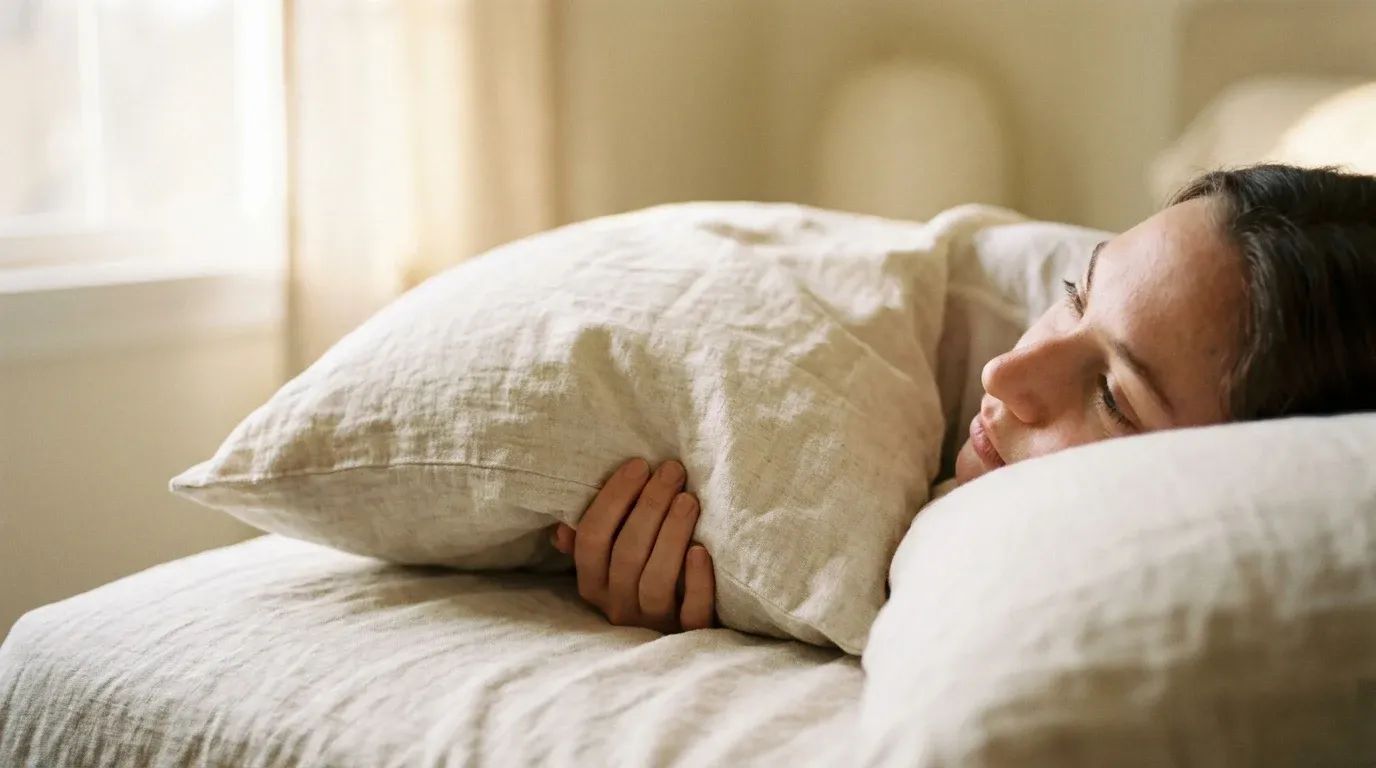
For decades, the advice was simple: get eight hours. It was printed on wellness posters, repeated by doctors, and cited in every productivity article ever written. But long-term sleep research published through 2026 is telling a more complicated story. Eight hours of fragmented, architecture-poor sleep doesn't protect you the way six and a half hours of well-structured sleep can. The number on your tracker isn't the point. What's happening inside those hours is.
Why Duration Alone Is the Wrong Target
Large cohort studies tracking hundreds of thousands of adults over ten to twenty years have consistently found that the relationship between sleep duration and health outcomes isn't linear. Both short sleepers (under six hours) and long sleepers (over nine hours) show elevated risk for cardiovascular disease, metabolic dysfunction, and all-cause mortality. But when researchers control for sleep quality and continuity, much of the duration signal weakens significantly.
In other words, duration is a proxy. It's measuring something real, but it's not the thing itself. When sleep is genuinely restorative, you tend to get enough of it naturally. When it's fragmented or structurally poor, no amount of extra time in bed makes up the difference.
This matters practically because millions of people are trying to optimize the wrong variable. They go to bed earlier, track their total hours, and feel frustrated when their health or energy doesn't improve. The question isn't how long you slept. It's what your sleep actually did.
Sleep Architecture: The Framework You're Probably Ignoring
Sleep isn't a single state. It cycles through distinct stages across the night, each serving different biological functions. A typical 90-minute cycle moves through light NREM sleep, deep slow-wave sleep (SWS), and REM sleep. Most adults complete four to six of these cycles per night, and the proportion of time spent in each stage matters enormously.
Slow-wave sleep is highest in the first half of the night and is critical for physical repair, immune function, and memory consolidation. REM sleep, which dominates the second half, is essential for emotional regulation, cognitive flexibility, and synaptic pruning. Disrupting either, even without shortening total sleep time, produces measurable deficits.
Chronic sleep fragmentation, where you're technically in bed for eight hours but waking repeatedly, compresses REM and SWS disproportionately. You lose the most valuable portions of the night first.
The REM Sleep Signal Is Getting Harder to Ignore
REM sleep has become one of the most studied targets in sleep medicine, and the findings are striking. Reduced REM proportion has been associated with elevated risk across a wide range of conditions, including Alzheimer's disease, depression, anxiety disorders, cardiovascular disease, and metabolic syndrome. A 2023 analysis drawing on polysomnography data from tens of thousands of participants found that every 5% reduction in REM proportion was associated with a 13% increase in all-cause mortality risk.
REM sleep appears to be particularly vulnerable to disruption. Alcohol suppresses it strongly, even in moderate amounts consumed hours before bed. Certain antidepressants and sleep medications reduce it substantially. Irregular sleep timing fragments it. And chronic stress, which elevates cortisol and norepinephrine throughout the night, consistently degrades REM architecture even when total sleep duration appears adequate.
If you're dealing with persistent low mood, brain fog, or poor stress resilience despite sleeping what looks like a full night, REM disruption is a plausible mechanism worth examining. What chronic stress actually does to your body extends well into the night, and the sleep consequences are often underappreciated.
Sleep Continuity: The Underrated Metric
Beyond REM proportion, sleep continuity is emerging as a powerful predictor of health outcomes in its own right. Continuity refers to how uninterrupted your sleep is across the night, measured by metrics like wake after sleep onset (WASO) and arousal index.
Research shows that people with high sleep fragmentation show worse cognitive performance, higher inflammatory markers, and greater cardiometabolic risk than people with shorter but more continuous sleep. The immune system, in particular, appears sensitive to fragmentation. Studies using experimental sleep disruption protocols find that fragmenting sleep without reducing duration can impair natural killer cell activity and antibody response comparably to outright sleep deprivation.
Sleep apnea is one of the most common drivers of fragmentation, and it's significantly underdiagnosed. If you snore heavily, wake with headaches, or feel unrefreshed despite adequate time in bed, an evaluation is worth prioritizing. The cardiovascular risks associated with untreated apnea are substantial, and whether CPAP therapy alone is enough to protect you from those risks is a question the evidence is still working through.
What Actually Moves the Needle on Sleep Quality
Here's where the research becomes actionable. A large body of evidence points to a relatively small set of behavioral and environmental factors that have genuine, measurable effects on sleep architecture. Most of them are free. Most of them are also consistently underused.
Sleep timing consistency is probably the single most powerful intervention available. Keeping your wake time fixed seven days a week, including weekends, anchors your circadian rhythm and dramatically improves both REM proportion and slow-wave sleep over time. Even a 60 to 90-minute variation between weekday and weekend wake times, sometimes called social jet lag, measurably degrades sleep architecture across the week.
Temperature regulation has strong mechanistic and clinical support. Core body temperature needs to drop by approximately 1 to 1.5 degrees Celsius to initiate and maintain sleep. Keeping your bedroom cool, around 65 to 68°F (18 to 20°C) for most adults, removes a common barrier to both sleep onset and deep sleep maintenance. Warm baths or showers taken 60 to 90 minutes before bed paradoxically accelerate this cooling process by drawing heat to the periphery.
Alcohol timing and quantity deserve more attention than they typically receive. Even one to two drinks consumed within three hours of sleep onset significantly suppresses REM sleep in the first half of the night, disrupts sleep continuity in the second half, and increases next-day cortisol reactivity. The "sleep-promoting" effect of alcohol is real but superficial. It sedates rather than genuinely facilitates sleep architecture. Cannabis presents a similar tradeoff, with THC suppressing REM sleep in a pattern that looks beneficial on short-term sleep onset metrics but erodes architecture over time.
Morning light exposure is one of the most reliable circadian anchors available. Ten to thirty minutes of outdoor light within an hour of waking suppresses residual melatonin, sets your cortisol awakening response, and advances the timing of evening melatonin release by up to two hours. This effectively makes it easier to fall asleep and stay asleep the following night without any pharmaceutical support.
Where Supplements and Devices Actually Stand
The sleep supplement market is enormous and growing. Melatonin, magnesium glycinate, L-theanine, ashwagandha, and dozens of other compounds are marketed aggressively with claims that often outpace the evidence considerably. The reality is that most supplements show modest effects at best, primarily on sleep onset latency, and relatively limited effects on sleep architecture itself.
Melatonin is genuinely useful for circadian phase shifting, particularly for jet lag and shift work. It's not a sedative and it doesn't meaningfully improve sleep quality in people whose circadian timing is already well-anchored. Magnesium has some evidence in populations with documented deficiency, but supplementation in replete individuals shows limited benefit. If you're evaluating any supplement category carefully, the same scrutiny applies here as elsewhere. The reliability of supplement labeling in 2026 remains a genuine concern worth understanding before you spend money.
Consumer sleep trackers have improved substantially. Devices using advanced accelerometry and heart rate variability data can now estimate sleep stages with reasonable accuracy for population-level trend monitoring. But they remain prone to misclassification at the individual level, and the anxiety some people develop around their sleep data, sometimes called orthosomnia, can itself impair sleep. Use trackers as directional tools, not as definitive diagnostics.
Special Populations: Where This Gets More Complex
Sleep architecture changes significantly across the lifespan and is altered by many health conditions. Older adults naturally produce less slow-wave sleep. People recovering from illness, injury, or major hormonal shifts often show disrupted architecture that requires targeted attention rather than generic advice.
Postpartum individuals, for example, face fragmentation that's structurally different from most sleep disruption scenarios, with unpredictable interruptions that are almost impossible to schedule around. Understanding how to support recovery in that context, including sleep, is part of what working effectively with postpartum clients actually requires.
Emerging pharmacological research is also relevant here. GLP-1 receptor agonists and newer weight-loss compounds are showing significant effects on sleep apnea severity through mechanisms beyond simple weight reduction. If apnea is a driver of your fragmentation, the treatment landscape is evolving quickly.
The Practical Reframe
Stop asking how many hours you slept. Start asking whether your sleep was continuous, whether you're waking feeling genuinely restored, and whether your timing is consistent enough to support a stable circadian rhythm.
The habits with the strongest evidence aren't expensive or complicated. Fix your wake time. Keep your room cool. Cut alcohol off at least three hours before bed. Get outside within an hour of waking. These interventions work because they address the actual mechanisms of sleep architecture, not just the duration metric that's easiest to count.
If you've done all of that and still feel like your sleep isn't working, that's the signal to look deeper, whether at potential apnea, circadian phase disorders, or the chronic stress load that may be quietly dismantling your REM sleep from the inside out. The eight-hour target wasn't wrong. It just wasn't the full picture.