
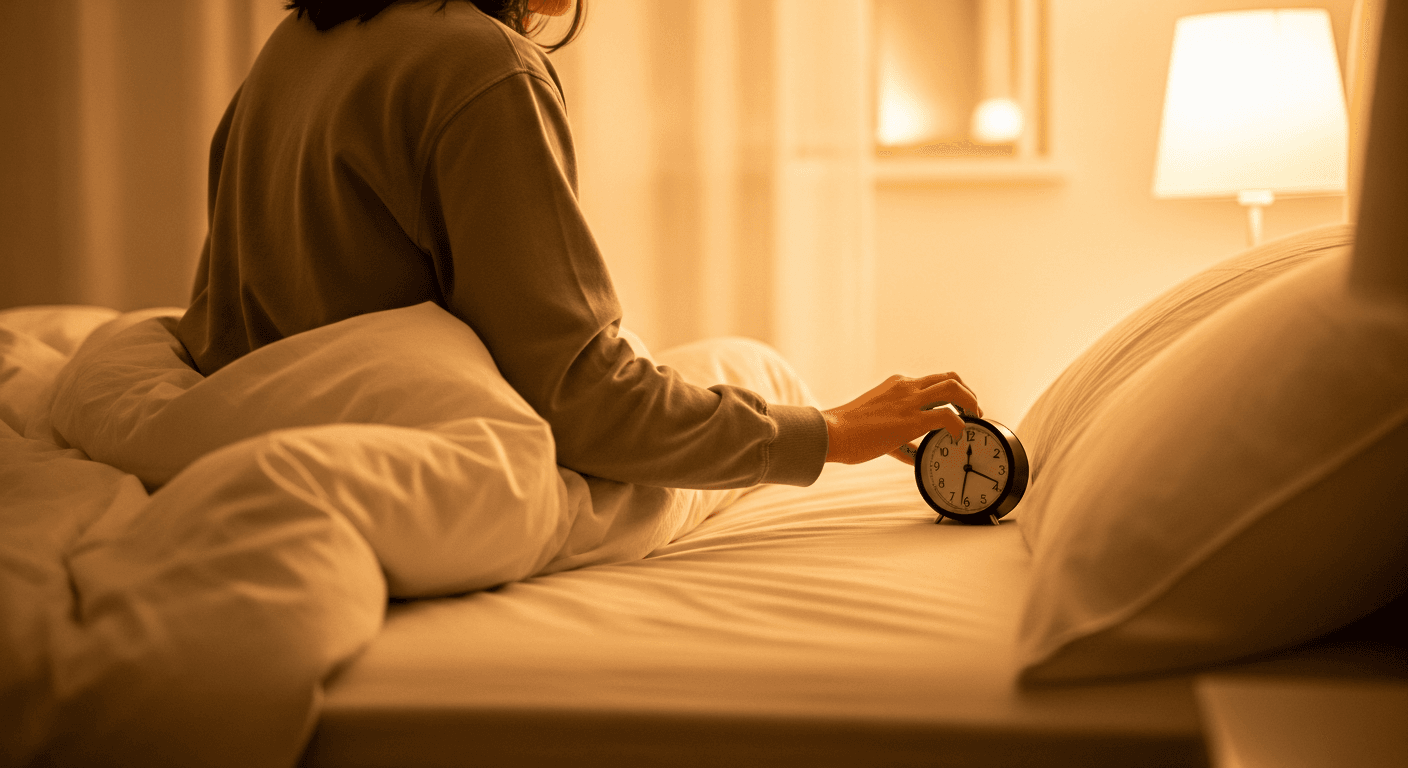
If you're between 18 and 34 and you keep dragging yourself through the workday, new research suggests the problem probably starts the night before. A study from Flinders University and the Sleep Health Foundation found that more than one in three young adults in this age group say poor sleep is actively hurting their daily productivity. That's not a minor inconvenience. That's a third of an entire generation underperforming at work, in the gym, and in their relationships because they can't get quality rest.
The same research identified four core disruptors keeping young adults awake: late-night technology use, worry, stress, and an overactive mind at bedtime. The good news is that each one has a practical, evidence-backed fix. Here's what the science actually supports, and how to build it into your evenings starting tonight.
Why Sleep Matters More Than You Think Right Now
Sleep isn't passive recovery. During deep sleep stages, your brain consolidates memory, clears metabolic waste, and resets the neural circuits responsible for focus and emotional regulation. When those processes get cut short, the cognitive cost shows up fast: slower reaction times, reduced working memory, lower mood, and impaired decision-making.
Even modest improvements matter. Research consistently shows that gaining just 30 to 60 minutes of additional sleep per night, when maintained consistently, produces measurable gains in focus, mood stability, and work performance within one to two weeks. You don't need a perfect eight hours immediately. You need a better system. If you're unsure what your actual target should be, how much sleep you actually need in 2026 is a useful starting point before you redesign your routine.
Disruptor 1: Late-Night Technology Use
Screens are the most widespread sleep disruptor for young adults, and the mechanism is well understood. Blue-spectrum light emitted by phones, tablets, and laptops suppresses melatonin production, the hormone that signals to your body that it's time to sleep. Beyond the light itself, the content you consume, social feeds, news, competitive games, and short-form video, keeps your nervous system in a low-grade state of arousal that's incompatible with the transition toward sleep.
The practical fix here is a hard device curfew. Set a specific time, ideally 60 to 90 minutes before your target sleep time, after which screens go dark or at minimum switch to aggressive warm-light modes. Most phones have built-in settings for this. Use them.
- Set a phone curfew at the same time every night. Consistency trains the expectation. Within a few days, your body starts associating that time with winding down.
- Charge your phone outside the bedroom. If it's in the room, you'll check it. Remove the friction entirely.
- Use blue-light filtering glasses or screen modes from early evening, not just the final hour. Melatonin suppression can begin hours before you feel sleepy.
- Replace the scroll with something low-stimulus. Reading physical books, light stretching, or listening to podcasts at low volume are all viable replacements that don't spike cortisol or dopamine.
Disruptor 2: Worry and Anxious Thoughts
Lying in bed while your brain rehearses tomorrow's difficult conversation or replays today's mistakes is one of the most common complaints among young adults who struggle to fall asleep. This isn't a character flaw. It's a timing problem. Your mind finally gets quiet enough to process unresolved concerns the moment your head hits the pillow, and without a structured outlet, those thoughts loop.
Two strategies have solid backing here. The first is scheduled worry time. Set aside 15 minutes in the early evening, not right before bed, to write down everything that's bothering you. Once it's on paper, your brain doesn't need to keep rehearsing it. The second is a brief gratitude or closure journal: three things that went well today and one thing you're going to let go of tonight. It sounds simple because it is. The mechanism is genuine. Writing externalizes rumination and reduces the cognitive load you carry into sleep.
If anxiety is a consistent pattern rather than situational stress, it's worth understanding the broader framework. The 4 A's of stress management offers a structured way to categorize what you can control, change, adapt to, or accept, which takes a lot of the mental churn out of your pre-sleep hours.
Disruptor 3: Stress
Stress and worry overlap but they're not identical. Worry is usually thought-based and future-focused. Stress tends to be physiological: elevated cortisol, a racing heart, muscle tension. When your nervous system is running hot, sleep architecture suffers even if you do manage to fall asleep. You spend less time in restorative deep sleep and wake more frequently through the night.
The most effective interventions target the body as much as the mind. Slow, diaphragmatic breathing, specifically extended exhales, activates the parasympathetic nervous system and lowers heart rate within minutes. A simple protocol: inhale for four counts, hold for four, exhale for six to eight. Do this for five minutes before bed and you'll notice a tangible shift.
Physical activity earlier in the day also significantly reduces pre-sleep cortisol levels. The relationship between exercise and sleep quality is bidirectional: better sleep supports performance, and consistent training supports sleep. Free recovery strategies that actually work covers several techniques, including breathwork and contrast methods, that reduce physiological stress without adding cost or complexity to your routine.
One important note: intense exercise within two to three hours of bedtime can temporarily raise cortisol and core body temperature, making it harder to fall asleep. If evenings are your only available training window, keep it moderate and finish well before your wind-down begins.
Disruptor 4: An Overactive Mind at Bedtime
This one is slightly different from worry. An overactive mind isn't always anxious. It might be creative, problem-solving, or simply still running at the pace your day demanded. Young adults with cognitively demanding jobs or studies often report that their mind simply won't downshift, even when they're physically tired.
The solution is a deliberate wind-down ritual that signals a change of state. Your nervous system responds to cues. When you perform the same sequence of low-arousal activities each evening, your brain begins to associate that sequence with sleep onset. Over time, the ritual itself starts to make you drowsy.
An effective wind-down ritual doesn't need to be elaborate. It needs to be consistent. A workable template:
- 90 minutes before bed: Screens off or in low-light mode. Dim the overhead lighting in your space.
- 60 minutes before bed: Journaling, light reading, or a short stretching sequence. Nothing that requires active problem-solving.
- 30 minutes before bed: Breathing exercises or meditation. Even five to ten minutes of focused breathwork measurably reduces sleep latency, the time it takes to fall asleep.
- Consistent bedtime: Get into bed at the same time every night, even on weekends. Varying your sleep timing by more than an hour across the week creates social jet lag, a state of chronic circadian misalignment that undermines sleep quality regardless of total hours.
The Most Underrated Lever: Consistent Sleep and Wake Times
Among all sleep hygiene interventions studied, consistent sleep and wake timing has among the strongest evidence behind it. Your circadian rhythm is a biological clock, and like any clock, it works best when it runs at a regular cadence. Irregular schedules, late nights on weekends followed by early alarms on Monday, fragment sleep architecture and reset the clock in ways that take days to recover from.
Pick a wake time you can maintain seven days a week. Work backward from that to identify your target bedtime. Protect both. The alarm matters, but the consistency matters more. Within two to three weeks of maintaining a fixed schedule, most people report falling asleep faster, waking less often, and feeling more alert in the morning without any other changes.
This consistency also compounds with other health behaviors. When sleep quality improves, appetite regulation normalizes, training performance improves, and mood stabilizes. Research on workout variety and longevity points to the same principle: regular, varied physical activity interacts with sleep in ways that extend healthspan. The two systems reinforce each other when both are given structure.
Putting It Together: A Realistic Evening Routine
You don't need to overhaul your life. You need a consistent sequence that addresses each of the four disruptors without adding more obligations to an already full schedule.
Here's a condensed version you can start tonight:
- 9:00 PM (or 90 min before target bedtime): Phones on charger outside the bedroom. Lights dimmed.
- 9:15 PM: 10-minute worry dump. Write everything on your mind into a notebook. Close the notebook.
- 9:30 PM: Light activity: gentle stretching, a short walk, or low-stimulus reading.
- 10:00 PM: Five minutes of slow breathing. Lights off.
- 10:30 PM (or your fixed bedtime): In bed. Same time every night.
That's it. No supplements required. No special equipment. No perfectly optimized sleep environment, though a cool, dark room certainly helps. Just a repeatable system that gives your nervous system the cues it needs to downshift.
The research is clear: poor sleep at 18 to 34 isn't an inevitable feature of being young and busy. It's a fixable problem with identifiable causes. And fixing it, even partially, pays back across every area of your life faster than almost any other single change you can make.