
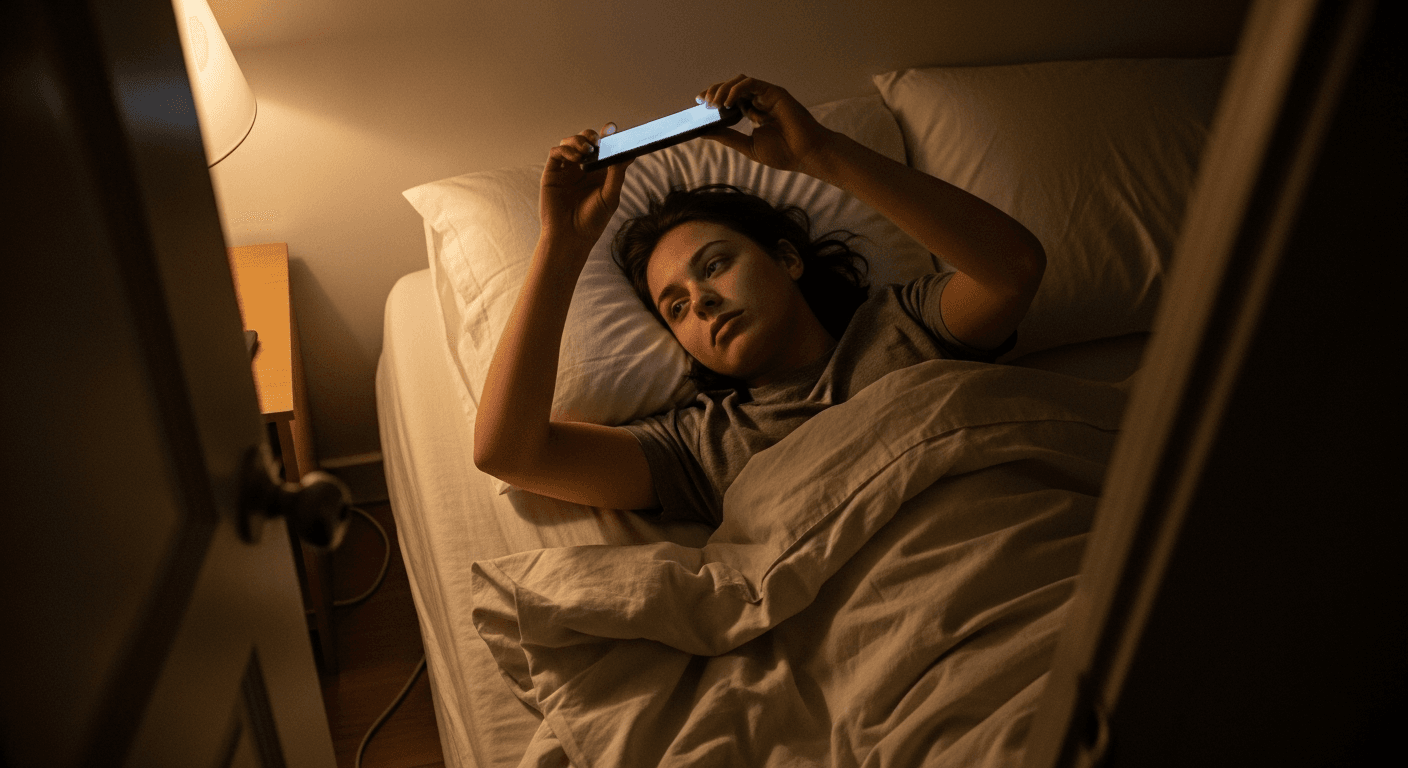
Sleep advice tends to follow a familiar script. Wind down earlier. Cut the caffeine. Try a warm bath. The problem is that generic guidance skips the part where anyone actually explains what's keeping you awake in the first place. New research from Flinders University and the Sleep Health Foundation does exactly that, and the findings are pointed enough to be genuinely useful.
The study identifies the specific behaviors and mental states driving sleep loss among 18 to 34 year olds, a group that turns out to be the most sleep-deprived demographic in Australia. Understanding the precise culprits is the first step toward doing something about them.
The Scale of the Problem
Nearly one in three Australian adults regularly get less than the recommended seven hours of sleep per night. That figure alone is significant, but it becomes more striking when you break it down by age. Adults aged 18 to 34 report the worst sleep outcomes of any group, consistently falling short of that minimum threshold more often than older cohorts.
Over half of young and middle-aged adults say they experience several nights of inadequate sleep per week. This isn't the occasional bad night before a big presentation. It's a persistent, recurring pattern affecting the majority of people in their prime working and studying years.
The downstream effects are measurable. More than a third of young adults report that poor sleep directly hurts their performance at work or school. Concentration drops. Decision-making suffers. Reaction times slow. If you've ever sat through a morning meeting wondering why the simplest tasks feel like heavy lifting, there's a good chance the night before is the answer.
For context on how much sleep your body actually requires, how much sleep do you actually need in 2026 breaks down the science behind individual sleep needs and why the standard eight-hour rule isn't the whole story.
What's Actually Keeping You Awake
The research identifies four primary disruptors responsible for poor sleep among young adults. None of them are surprising in isolation. What's valuable is seeing them ranked and named clearly, because that gives you a concrete target list rather than a vague instruction to "relax more."
Late-Night Technology Use
Screens before bed consistently emerge as one of the strongest predictors of delayed sleep onset. The mechanisms are well established: blue light suppresses melatonin production, and the content itself, whether social media feeds, news, or streaming, keeps your nervous system in a state of alertness that's the opposite of what you need to fall asleep.
What makes this particularly difficult for young adults is that evening screen time is also tied to connection and entertainment. Scrolling is how many people decompress after a long day, which means the behavior that feels like relaxation is actively working against sleep quality. The habit is also self-reinforcing. The more sleep-deprived you are, the harder it becomes to exercise the willpower to put the phone down.
Worry
Worry is distinct from general stress. It's the specific mental habit of running through potential problems, rehearsing conversations, or cycling through worst-case scenarios. The research identifies it as a top sleep disruptor, and the timing matters: lying down in a quiet, dark room removes the distractions that normally keep anxious thoughts at bay during the day.
Financial pressure, relationship uncertainty, and career anxiety are all common worry triggers for 18 to 34 year olds. There's rarely an easy fix, but structured approaches to managing anxious thinking can reduce the amount of mental real estate worry occupies at bedtime. The 4 A's of stress management offers a practical framework for categorizing stressors and deciding which ones are actually worth mental energy.
Stress
Stress and worry overlap but aren't identical. Stress tends to be more physiological: elevated cortisol, muscle tension, a heightened state of arousal. Chronic stress keeps your body's threat-response system partially switched on, which makes the transition into sleep harder and degrades sleep quality even when you do manage to fall asleep.
The relationship between stress and sleep is bidirectional. Poor sleep raises cortisol levels, which increases stress, which makes sleep harder. Breaking that cycle usually requires addressing both sides at once rather than waiting for life to calm down on its own.
Physical activity is one of the most reliable ways to reduce baseline stress levels, and it doesn't require hours at the gym. free recovery strategies that support both training and stress reduction outlines approaches that cost nothing and can be built into routines you already have.
An Overactive Mind at Bedtime
Separate from worry, many young adults describe a more general cognitive hyperactivity at night. Their minds simply won't slow down. Mental to-do lists, replaying events from the day, planning ahead, problem-solving. The brain stays in productivity mode long after the body has run out of energy.
This pattern is often linked to how young adults structure their evenings. When the day ends abruptly, with no real buffer between activity and bed, the brain doesn't get a signal that it's time to shift gears. A racing mind at bedtime is frequently less about psychological distress and more about the absence of a genuine wind-down period.
Why Young Adults Specifically
It's worth asking why this age group bears the heaviest sleep debt. The answer is partly structural and partly behavioral.
Adults aged 18 to 34 are navigating a life phase defined by competing demands. Education, early career development, new relationships, financial independence, and social pressure all converge during these years. Sleep often becomes the variable that gets compressed when everything else needs to fit.
There's also a cultural component. Sleep deprivation in young adulthood is frequently normalized or even worn as a badge of effort. Staying up late to finish work, pulling all-nighters, grinding through exhaustion. These behaviors are treated as evidence of commitment rather than as a health concern, even though the evidence consistently shows that lifestyle habits in this life stage have long-term consequences that extend well beyond the immediate impact on productivity.
Chronobiology plays a role too. Research on circadian rhythms shows that natural sleep timing shifts later in adolescence and early adulthood, meaning young adults are biologically inclined toward later sleep onset. When early-morning obligations like classes or work shifts don't accommodate that shift, the result is chronic sleep restriction accumulated across the week.
What You Can Actually Do
Generic sleep hygiene tips tend to feel unhelpful because they're rarely connected to the specific behaviors causing the problem. Given what this research identifies, here's a more targeted approach:
- Set a hard stop for screens. Thirty to sixty minutes before bed, put the phone in another room. Not face-down on the nightstand. Another room. Physical distance reduces the temptation to check it reflexively.
- Schedule a worry window. Instead of letting anxious thoughts arrive at bedtime, set aside fifteen minutes earlier in the evening to write down what's on your mind. Getting it onto paper gives your brain permission to stop holding it in active memory.
- Build a genuine transition period. Your wind-down routine doesn't need to be elaborate, but it needs to exist. Even twenty minutes of low-stimulation activity before bed, reading a physical book, stretching, slow breathing, signals a shift in mental state that screens actively prevent.
- Protect your sleep schedule on weekends. Sleeping in significantly on Saturday and Sunday disrupts your circadian rhythm enough to make Monday morning harder, a phenomenon sometimes called social jet lag. Keeping wake times within an hour of your weekday schedule limits the damage.
- Address stress during the day, not at bedtime. Stress management isn't a bedtime activity. Regular physical exercise, social connection, and structured stress-reduction practices work because they lower baseline cortisol levels over time, not because they provide immediate relief when you're already lying awake.
It's also worth being realistic about the stress piece. Emerging research on how the body manages chronic stress signals suggests that long-term stress exposure has biological consequences that go beyond feeling tired or anxious. Sleep is one of the primary mechanisms your body uses to regulate that response, which makes protecting it a higher-order health priority than it often gets treated as.
The Bigger Picture
What makes this research useful is its specificity. Late-night tech use, worry, stress, and an overactive mind. Those aren't vague lifestyle categories. They're identifiable behaviors and mental states that you can observe in yourself and respond to directly.
If you're one of the roughly one in three young adults consistently falling short of seven hours, the path forward starts with an honest audit of which of these four culprits is most relevant to your situation. For many people, it's more than one. That's also fine. Knowing the list means you're no longer working blind.
Sleep isn't a passive experience that either happens or doesn't. It's shaped by what you do in the hours before bed, how you manage your stress during the day, and how much you've normalized the kind of chronic shortfall that quietly undermines almost everything else.