
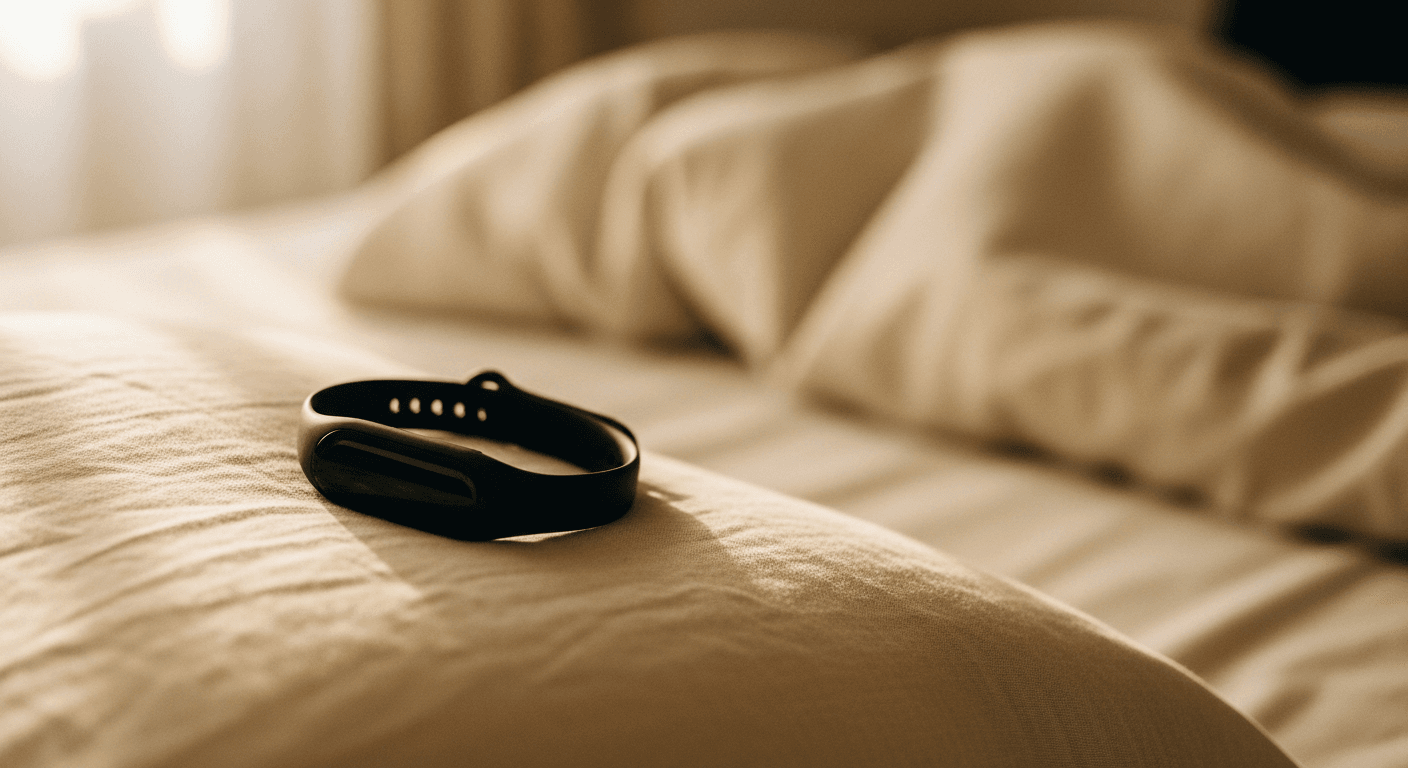
Sleep tracking is the #1 wellness tech habit of 2026. Oura Ring, Apple Watch, Whoop — nocturnal wearable sales are growing fast. But a question is starting to surface in the research community: does checking your sleep score every morning actually improve your sleep — or does it create a new problem?
Key Takeaways
- Sleep tracking is the dominant wellness tech habit of 2026 per Business Upturn research
- Consumer wearables measure sleep via movement + heart rate — not EEG (the clinical reference method)
- Orthosomnia: the anxiety generated by reading your own sleep score can degrade the following night's sleep
- Best use: identify patterns over multiple weeks, not optimize each individual night
What wearables actually measure
Most consumer wearables (Oura Ring, Apple Watch, Whoop, Garmin) use two main sensors to infer sleep stages: an accelerometer (detecting movement) and a heart rate sensor (PPG). This data is then processed by proprietary algorithms to estimate light, deep, and REM sleep phases.
Polysomnography — simultaneous recording of EEG (brain activity), EMG (muscle tone) and EOG (eye movements) in a sleep lab — remains the reference method. Comparisons between polysomnography and wearables show significant discrepancies in stage detection, especially for deep sleep and REM. Wearables are generally reasonably accurate on total sleep duration — less reliable on stage composition. At-home EEG devices are beginning to close this gap, offering a middle ground between lab-grade accuracy and everyday convenience.
The orthosomnia problem
In 2017, researchers Kelly Glazer Baron and Sabra Abbott introduced the term "orthosomnia" to describe an emerging pattern: patients whose anxiety around improving their objective sleep score (measured by wearable) began degrading their subjective and actual sleep quality. In 2026, this phenomenon is better-documented and more common — as sleep wearables become mainstream.
The mechanism is counterintuitive: seeing a bad sleep score in the morning generates stress. That stress raises cortisol. Elevated daytime cortisol interferes with the following night's sleep. The wearable designed to improve sleep produces the opposite effect in anxious or perfectionist users — a dynamic that's especially relevant given how poor sleep can sabotage physical performance well before most people recognize it.
How to use sleep wearables intelligently
This doesn't mean sleep wearables are useless. There's a valid use case: identifying patterns over several weeks, not optimizing night by night. Genuinely useful insights at the 2-to-4 week scale:
- Correlation between alcohol the night before and measured recovery quality
- Correlation between training end time and time to fall asleep
- Impact of evening screens on overnight heart rate
- Resting heart rate variability as a general recovery indicator
What doesn't work: comparing your score of 78 to 82 one night, then spiraling over 68 on a hard night. That night-by-night use generates anxiety without producing actionable information. If you feel generally good and your score fluctuates nightly, that's normal — not a problem to solve. For a deeper look at what your HRV and recovery metrics actually mean, the data is more nuanced than most apps suggest.