
For decades, the gold standard for understanding sleep has been polysomnography. You check into a sleep lab, technicians attach electrodes to your scalp, and you spend a night hooked up to equipment while a specialist monitors your brain waves. The data is detailed. It's also, almost inevitably, compromised.
Sleeping in an unfamiliar room, under observation, with sensors taped to your body is not how most people sleep. That tension between clinical precision and real-world conditions has been quietly undermining sleep research for years. At-home EEG is starting to resolve it.
The First-Night Effect Is a Research Problem Nobody Talks About Enough
Sleep scientists have long acknowledged what they call the "first-night effect." When people sleep in a lab environment for the first time, one hemisphere of the brain stays more alert than the other. It's a vigilance response. The result is fragmented sleep, suppressed deep sleep stages, and REM patterns that don't reflect what happens at home.
A single-night lab study captures a snapshot of disrupted sleep and calls it a baseline. That's not a minor methodological footnote. It means decades of clinical data may be describing how people sleep when they're stressed and uncomfortable, not how they actually sleep.
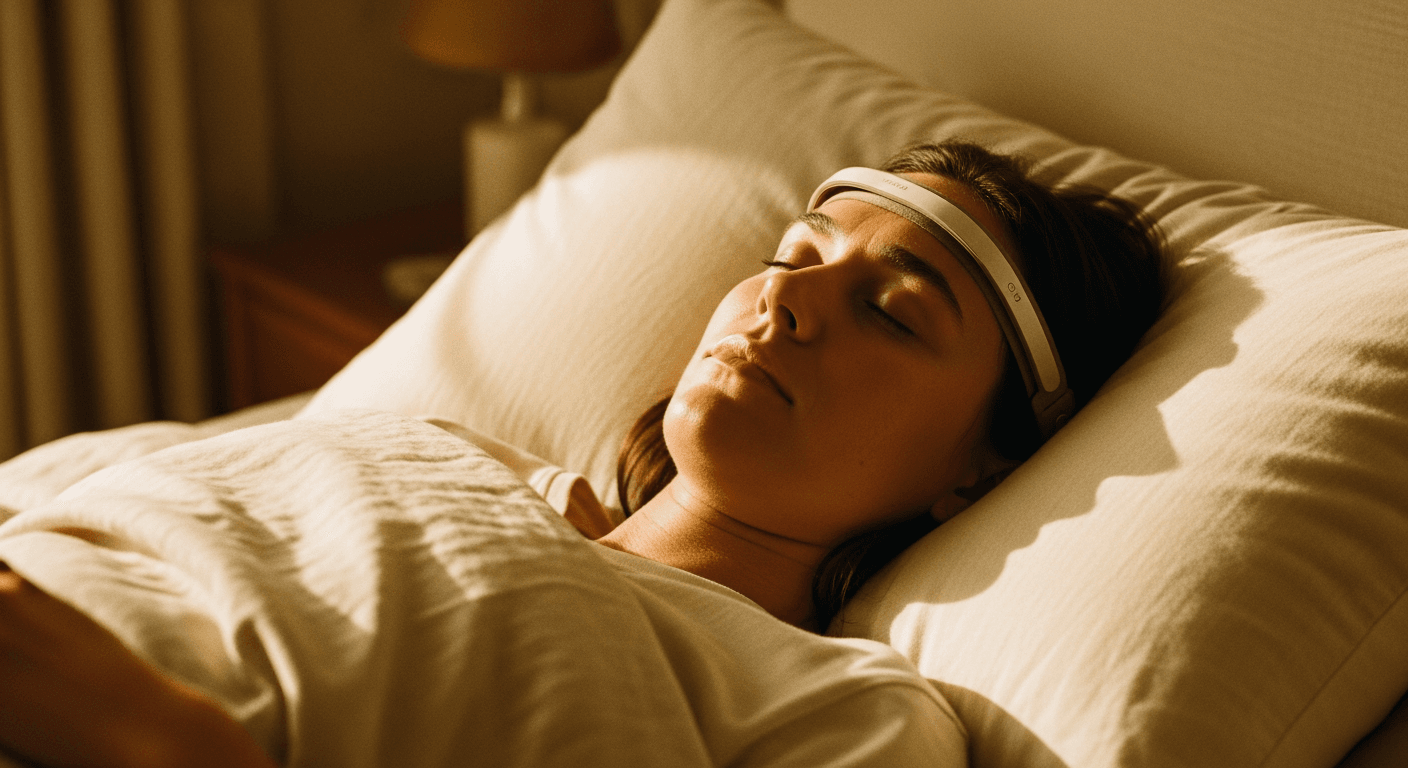
At-home EEG eliminates most of that distortion. When you're sleeping in your own bed, with a lightweight headband rather than a full electrode cap, the neurological data you generate looks fundamentally different. And when researchers can collect that data across weeks or months rather than a single night, the picture becomes richer and more accurate than anything a lab has historically been able to produce.
If you've ever wondered whether your results from a home sleep apnea test vs. a lab study were telling the same story, the answer is nuanced. For apnea detection, home tests have become quite reliable. For full sleep architecture analysis, the lab has traditionally had the edge. That edge is narrowing fast.
What Wrist-Based Wearables Can't Actually Tell You
Most consumer sleep tracking runs on accelerometers and photoplethysmography. Your device measures movement and heart rate variability, then uses an algorithm to infer whether you're in light sleep, deep sleep, or REM. It's an educated estimate. The brain data isn't there.
Sleep architecture, the cycling pattern between NREM light sleep (N1 and N2), slow-wave deep sleep (N3), and REM sleep across a night, is where the most clinically meaningful information lives. Staging sleep accurately requires measuring electrical activity in the brain. That's what EEG does. Everything else is a proxy.
Research comparing consumer wearables to polysomnography has consistently shown that wrist devices overestimate total sleep time and struggle most with identifying N3 slow-wave sleep accurately. This matters because slow-wave sleep is where physical recovery, memory consolidation, and metabolic restoration are most active. If your tracker is miscategorizing that stage, the sleep score it's giving you is built on a shaky foundation.
This connects to a broader conversation about how we interpret wellness data. Tools like MIT's biomarker models, covered in MIT's PhenoMol research on recovery and fitness biomarkers, are pushing toward more granular physiological measurement. Sleep EEG fits that same direction. Precision matters when you're trying to optimize something as complex as recovery.
How Machine Learning Is Extracting More From Brain Wave Data
Companies like Beacon Biosignals are doing something that goes beyond basic sleep staging. They're applying machine learning to large-scale EEG datasets to identify neurological signatures that manual scoring can't reliably detect.
Standard polysomnography produces sleep stage classifications that depend on a technician reviewing recordings and applying fixed scoring criteria. It's time-consuming, somewhat subjective, and limited to what trained human eyes can identify in a waveform. Machine learning models trained on thousands of hours of EEG data can detect subtler patterns. Early neurological markers for conditions like Alzheimer's, Parkinson's, and depression have distinct EEG signatures that appear during sleep before symptoms become clinically obvious.
At-home EEG combined with this kind of analysis creates a continuous monitoring capability that doesn't exist in any other form. You're not getting a single lab snapshot every five years. You're building a longitudinal record of how your brain functions across different conditions, life stages, stress levels, and interventions.
That longitudinal dimension is exactly what's missing from most health monitoring. Orthosomnia research has shown that obsessive tracking can create anxiety, but the problem there is usually low-quality data generating noise rather than signal. When the data is actually measuring brain activity rather than estimating it, the quality of insight changes.
Drug Development Is Being Reshaped by Real-World Sleep Data
Pharmaceutical trials for sleep disorders, neurological conditions, and psychiatric treatments have always faced a practical problem. You need to measure how a drug affects sleep architecture, but running lab polysomnography on hundreds of participants across months is expensive, logistically complex, and produces data contaminated by the first-night effect.
At-home EEG is changing this. Clinical trials using consumer-grade EEG devices can now collect continuous sleep data from participants sleeping in their own homes across the full trial duration. The data is more representative, the sample sizes are larger, and the cost per data point drops significantly.
This is already accelerating development timelines for drugs targeting conditions like insomnia, epilepsy, and treatment-resistant depression. Regulators are taking note. The FDA has shown increasing openness to real-world evidence in drug approval processes, and longitudinal at-home EEG data fits that category well.
For researchers studying populations like young adults who are already sleep-deprived at alarming rates, as detailed in data on why 1 in 3 young adults aren't sleeping enough, the ability to gather brain-level data in natural settings rather than labs opens entirely new lines of inquiry.
What "Healthy Sleep" Might Actually Look Like
Here's where things get genuinely interesting. As at-home EEG data accumulates across diverse populations sleeping in real conditions, it's challenging some foundational assumptions.
The standard model describes healthy adult sleep as cycling through roughly four to six complete sleep cycles per night, each lasting 90 minutes, with REM periods getting longer toward morning. That model was built primarily on lab data from relatively homogenous study populations. It was always meant to be a generalization. At-home data is revealing just how much individual variation exists.
Age, sex, genetics, metabolic health, training load, and stress all interact to produce sleep architecture that looks quite different from person to person. Research on sleep differences between men and women, explored in 2026 data on the sleep gender gap, shows meaningful divergence not just in duration but in the distribution of sleep stages. That's exactly the kind of nuance lab-based population averages tend to flatten out.
The practical implication is that what your sleep "should" look like is more individual than the generic advice suggests. A normal REM percentage for one person may indicate something different in another. Personalizing sleep recommendations requires brain-level data. You can't get there with a wrist accelerometer.
What's Coming for Everyday Users
Consumer EEG headbands already exist. Devices from companies like Dreem, Muse, and Neurosity offer varying levels of EEG capability, with prices ranging from roughly $200 to $500 for consumer models. Clinical-grade wearable EEG currently sits closer to $1,000 to $3,000, depending on the electrode count and software platform.
The trajectory is familiar. Costs are falling, algorithms are improving, and the hardware is getting lighter and more comfortable. Within the next few years, you'll likely see EEG capability integrated into sleep devices that are genuinely comfortable to wear all night, with software that translates raw brain wave data into actionable, personalized insights rather than generic sleep scores.
What that unlocks for the average person is meaningful. You'll be able to see not just that you slept seven hours, but how much restorative slow-wave sleep your brain actually generated. You'll be able to track how training load, nutrition choices, or alcohol intake shifted your sleep architecture over time. You'll have data that can genuinely inform conversations with a doctor about neurological health.
Sleep is not just rest. It's the period when your brain clears metabolic waste, consolidates learning, regulates emotional processing, and runs what amounts to a full-system maintenance cycle. Understanding what's actually happening during those hours, at the neural level, is one of the more consequential things you can do for long-term health. The tools to do that are almost here.