
Most sleep tech tells you what happened after the fact. A ring or wristband logs your REM cycles overnight, then hands you a score in the morning. Useful, maybe. Actionable, rarely. A new wave of research is trying to do something fundamentally different: not measure sleep, but actively reshape it.
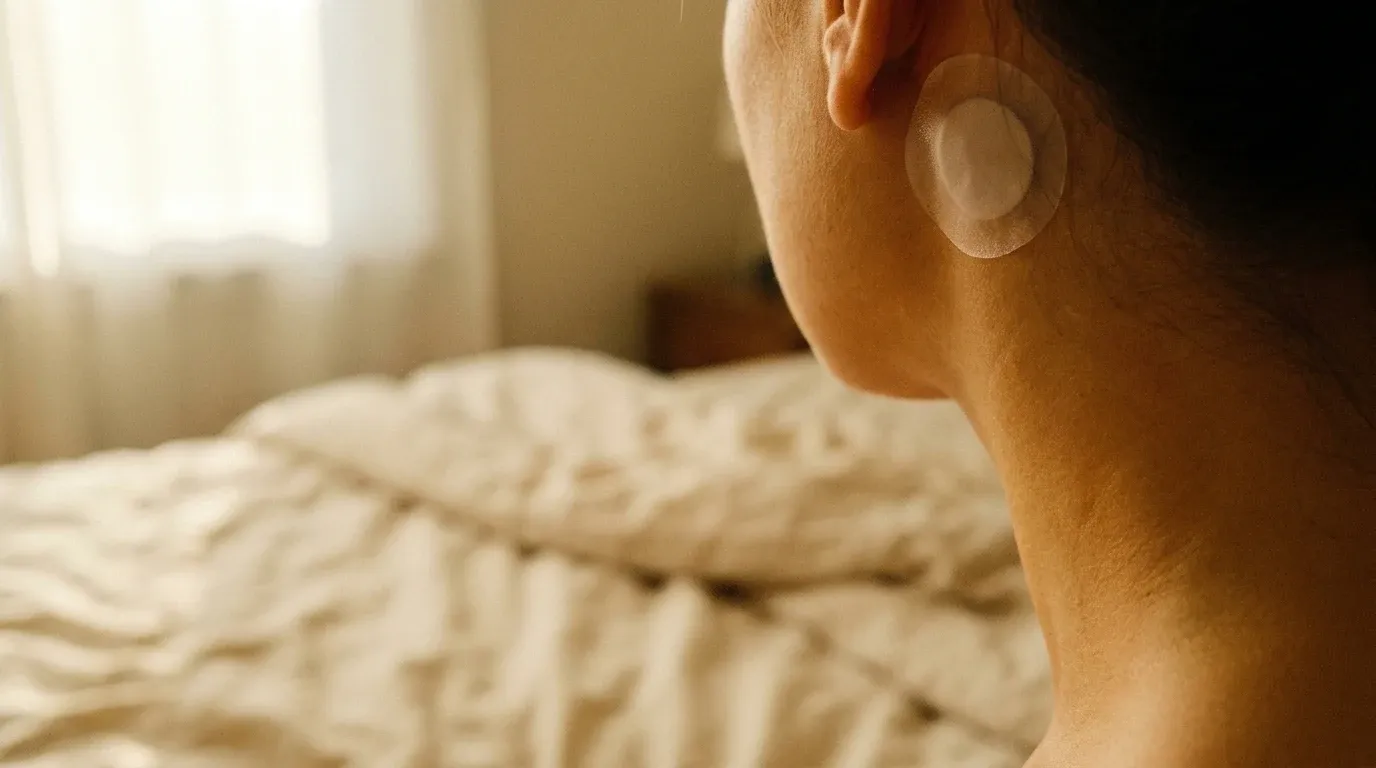
The latest example is a stick-on neurostimulation patch that researchers used to shift REM sleep onset 43 minutes earlier in study participants. No drugs. No disruption to total sleep time. Just a targeted electrical signal applied to the scalp that nudged the brain's internal timing earlier in the night.
That's a meaningful number. And it raises real questions about where consumer sleep technology is heading.
What the Research Actually Found
The study used transcranial alternating current stimulation delivered through a lightweight adhesive patch worn on the head. The device targeted specific oscillatory patterns in the brain, particularly the neural signals associated with sleep stage transitions. By entraining these rhythms during the early part of the sleep window, researchers were able to pull REM onset significantly forward without fragmenting sleep or reducing overall sleep duration.
Participants saw REM begin, on average, 43 minutes earlier than their baseline. That shift matters because REM sleep is not evenly distributed across the night. It tends to concentrate in the later sleep cycles, meaning you get more of it in the final hours before waking. If you're sleeping six hours instead of eight, you're disproportionately cutting REM. Pulling that phase forward could, in theory, protect more of it.
The patch was non-invasive, required no clinical setting, and produced no reported adverse effects. Those are the conditions that make a research finding relevant to the broader public rather than just the lab.
Why REM Timing Matters More Than Most People Think
REM sleep is where a lot of the high-value recovery work happens. Memory consolidation, emotional regulation, and cognitive processing all depend heavily on it. Athletes and active adults tend to focus on deep slow-wave sleep as the physical repair phase, which it is. But dismissing REM undersells what it contributes to performance, decision-making, and mental resilience.
Short sleep is an obvious problem. But poor sleep architecture, meaning the right stages in the wrong proportions or sequence, is a subtler and more widespread issue. Someone sleeping seven hours but hitting almost no REM until the last 45 minutes is running a deficit that a fitness tracker score might not fully capture.
This is part of why researchers have been pushing into non-pharmacological sleep architecture tools. Medication can induce sleep, but it often distorts REM. Cognitive behavioral therapy for insomnia works, but it takes weeks and targets sleep efficiency broadly. Neurostimulation research is trying to target specific stages with more surgical precision.
If you're already paying attention to how alcohol affects your overnight recovery, this research sits in the same conceptual space. As covered in Does Alcohol Really Wreck Your Recovery Night?, even moderate drinking suppresses REM in ways that compound across a training week. A tool that could counteract some of that disruption would have obvious appeal.
The Neurostimulation Landscape Is Moving Fast
This study doesn't exist in isolation. Research into non-invasive brain stimulation for sleep has accelerated over the past several years, and a parallel track using ultrasound has already produced consumer-adjacent results. A wearable ultrasound patch that targets REM-promoting brain regions has already moved into early commercial development, as explored in A Wearable Ultrasound Patch Can Boost Your REM Sleep. The underlying principle is similar: apply a precise physical signal to the brain during sleep to shift what happens inside it.
What makes the stick-on electrical stimulation patch notable is its simplicity. Ultrasound devices require more complex hardware to focus the signal. A transcranial alternating current patch is closer to existing consumer EEG and tDCS devices that have already found niche audiences in the focus and meditation space. The hardware barrier to entry is lower, which typically accelerates the path from lab to product.
The sleep wearable market is already enormous and still growing. Devices tracking heart rate variability, skin temperature, and blood oxygen have normalized the idea of wearing something to bed. The jump from passive monitoring to active intervention is the next logical step, and consumer appetite is clearly there.
The Gap Between Research and Your Nightstand
None of this means you'll be ordering a REM-shifting patch from an online retailer next month. Research findings require replication, larger sample sizes, and long-term safety data before anything reaches a consumer shelf responsibly. The 43-minute shift is striking, but a single study result needs context and confirmation before it drives purchasing decisions.
There's also a real risk of overclaiming in this space. The wellness tech industry has a track record of commercializing preliminary neuroscience faster than the evidence justifies. Devices marketed as improving focus, reducing stress, or enhancing sleep have frequently launched on the back of small studies with weak controls. Healthy skepticism is warranted.
That said, the trajectory is clear. Research groups are producing increasingly clean results using non-pharmacological tools. Regulatory agencies in the US and elsewhere are developing clearer frameworks for neurostimulation devices. And a consumer base that already buys smart rings, sleep trackers, and recovery wearables is primed for the next category.
It's also worth noting that the fundamentals haven't changed. As the evidence in Cheap Recovery Often Beats Expensive Tech consistently shows, consistent sleep timing, reduced screen exposure before bed, and stable wake times outperform most devices in head-to-head comparisons. Technology works better on a solid behavioral foundation. A patch that shifts REM onset by 43 minutes won't compensate for a chronically irregular schedule.
What This Means for Sleep Regularity
One of the most robust findings in recent sleep science is that regularity, meaning going to bed and waking at consistent times, predicts mental and physical health outcomes more reliably than total sleep duration alone. Research analyzing data from tens of thousands of participants has shown that irregular sleep patterns are associated with significantly higher rates of depression, anxiety, and loneliness, as detailed in 23,000 People's Sleep Data Reveals a Mental Health Pattern.
Neurostimulation tools that shift sleep stage timing could interact with circadian regularity in complex ways. Pulling REM earlier is beneficial if it increases the proportion of REM you capture within your actual sleep window. But if it creates inconsistency in how the sleep cycle sequences night to night, that could introduce its own costs. This is exactly the kind of question that follow-up research needs to answer before widespread adoption.
The same applies to how this technology might interact with training schedules. If you're managing recovery across a structured training block, the timing and quality of REM sleep has downstream effects on adaptation, as the relationship between sleep, training frequency, and muscle maintenance becomes clearer. That context is worth keeping in mind, particularly for anyone already optimizing around performance. The principles outlined in How Often Do You Actually Need to Train to Keep Muscle? highlight just how sensitive the recovery equation is to disruption.
Where This Technology Is Likely to Land
The realistic near-term scenario is not a mass-market consumer patch but a clinical and high-performance niche. Sleep clinics treating chronic insomnia, sports medicine programs managing athlete recovery, and elite training facilities with resources to adopt early-stage technology are the most likely first movers.
From there, the trajectory typically follows the same arc as any health tech: clinical use drives refinement, refinement drives cost reduction, cost reduction drives consumer availability. The timeline from compelling research result to drugstore shelf varies widely, but the direction of travel here seems reasonably clear.
What's worth watching is how this technology stacks up against behavioral and nutritional levers that already work. Non-REM and REM sleep quality respond meaningfully to diet, stress management, and training load. The neurostimulation space adds a new tool to that stack, but it doesn't replace the foundation.
A stick-on patch that reliably shifts REM onset by 43 minutes without side effects is a genuinely interesting result. Whether it survives replication, scales to a product, and delivers real-world benefit consistently remains to be seen. But it's the kind of finding that marks a direction, and the direction is toward sleep tech that actively intervenes rather than passively observes.