
You exercise consistently. You hit the gym, maybe roll out a yoga mat on Sunday mornings, and you still feel wound up by Tuesday. The problem might not be how much you're moving. It might be how you're moving.
A growing body of research is making a clear case that dance, specifically rhythm-synchronized movement to music, produces a cortisol reduction that neither yoga nor conventional gym training reliably matches. The gap isn't small, and the mechanism behind it tells you something genuinely useful about how stress and the body interact.
What the Research Actually Shows
Studies measuring salivary cortisol before and after different forms of exercise consistently find that dance produces steeper post-session drops than aerobic gym workouts or yoga sessions of comparable duration. One widely cited analysis found cortisol levels after a structured dance session fell significantly more than after equivalent-intensity treadmill work, with participants also reporting higher positive affect scores.
Yoga does lower cortisol over time, particularly through breathwork and parasympathetic activation, but its mechanism is different and slower-acting. The gym, depending on intensity, can temporarily spike cortisol before it falls. Dance appears to compress that arc: it engages the stress response system and then resolves it within the same session, repeatedly, in a way that mirrors natural emotional processing.
If you want the broader overview of how dance compares across wellness metrics, the science behind why dance outperforms yoga and the gym for stress relief covers the headline findings. This piece goes deeper into why the physiology works the way it does.
The Rhythm Effect: Why Synchronization Changes Everything
The key variable separating dance from other exercise isn't effort or duration. It's entrainment, the process by which your nervous system synchronizes to an external rhythmic signal, in this case, music.
When your movement locks onto a beat, your brain engages motor, auditory, and limbic circuits simultaneously. This multi-system activation is unusual. Most exercise primarily drives motor and cardiovascular circuits. Dance pulls in the emotional processing centers of the brain at the same time, which is why it produces a distinctly different neurochemical output.
Research on rhythmic auditory stimulation shows that synchronizing movement to music increases endorphin release beyond what the physical exertion alone would generate. The mechanism is thought to involve the brain's reward pathways responding to both the music and the successful execution of synchronized movement, a kind of double trigger that structured gym work doesn't activate in the same way.
This also explains why dancing to music you love intensifies the effect. Emotional engagement with the music adds a third layer of limbic activation. Your cortisol response is being addressed on multiple levels at once: physiological, rhythmic, and emotional.
Social Connection as a Cortisol Buffer
Dance, even when done alone, carries an implicit social architecture. The music was made by someone. The movement styles reference shared cultural forms. When dance is done with others, the cortisol-lowering effect appears to amplify further through a well-documented mechanism: interpersonal synchrony.
When people move in coordination with each other, oxytocin release increases and cortisol output decreases. This has been measured in group fitness settings, but the effect is stronger in dance specifically because the synchrony is more precise and emotionally loaded. Mirroring another person's movement while both of you follow the same beat triggers a social bonding response that generic group exercise doesn't fully replicate.
For people who exercise regularly but still feel chronically stressed, this is worth sitting with. The gym is often a solitary or parallel-play environment. Even group fitness classes tend to involve people working alongside each other rather than with each other. Dance changes that structure at a neurochemical level.
Why Exercise Type Matters as Much as Exercise Volume
The conventional advice on stress and exercise focuses almost entirely on volume and intensity: get 150 minutes of moderate activity per week, keep your heart rate up, stay consistent. That framework isn't wrong, but it's incomplete.
If cortisol reduction were purely a function of cardiovascular effort, every gym session would leave you equally de-stressed. The evidence doesn't support that. High-intensity training, in particular, can sustain or elevate cortisol for hours post-workout if recovery is inadequate, a tradeoff worth understanding if you're already carrying a significant stress load. The relationship between intense physical effort and hormonal recovery is explored in detail in the piece on cold immersion after lifting and the recovery tradeoffs involved.
What the dance research suggests is that the type of movement, its rhythmic structure, its emotional content, and its social context, contributes independently to mental health outcomes. Two people exercising the same number of hours per week can have meaningfully different cortisol profiles based solely on what kind of movement they're doing.
This matters practically. If you're someone who exercises hard and still feels stressed, adding more of the same type of training is unlikely to fix the problem. Swapping one or two sessions per week for dance-based movement may produce better stress outcomes than increasing your current workout volume.
The Endorphin Picture
Endorphins are often credited to exercise generally, but the relationship is more specific than that. Endorphin release scales with rhythmic, repetitive motor activity, which is why running produces a runner's high in a way that weight training typically doesn't. Dance sits at the peak of this spectrum because it combines rhythmic movement with music synchronization and emotional engagement, all of which independently stimulate endorphin pathways.
Research using proxy measures of endorphin activity (since direct measurement requires invasive methods) finds that group dancing produces pain tolerance increases, a standard marker of endorphin release, roughly comparable to those seen in distance running, and greater than those seen in non-rhythmic resistance training. This is a significant finding. It positions dance not as a softer alternative to real exercise, but as a neurochemically distinct and potent category of physical activity.
For women navigating hormonal transitions, where cortisol dysregulation and mood variability are common, the combination of endorphin release and cortisol reduction makes dance a particularly relevant option. Related context on how physical activity intersects with hormonal health is covered in what women between 50 and 75 actually need from nutrition to stay strong.
You Don't Need a Class or a Studio
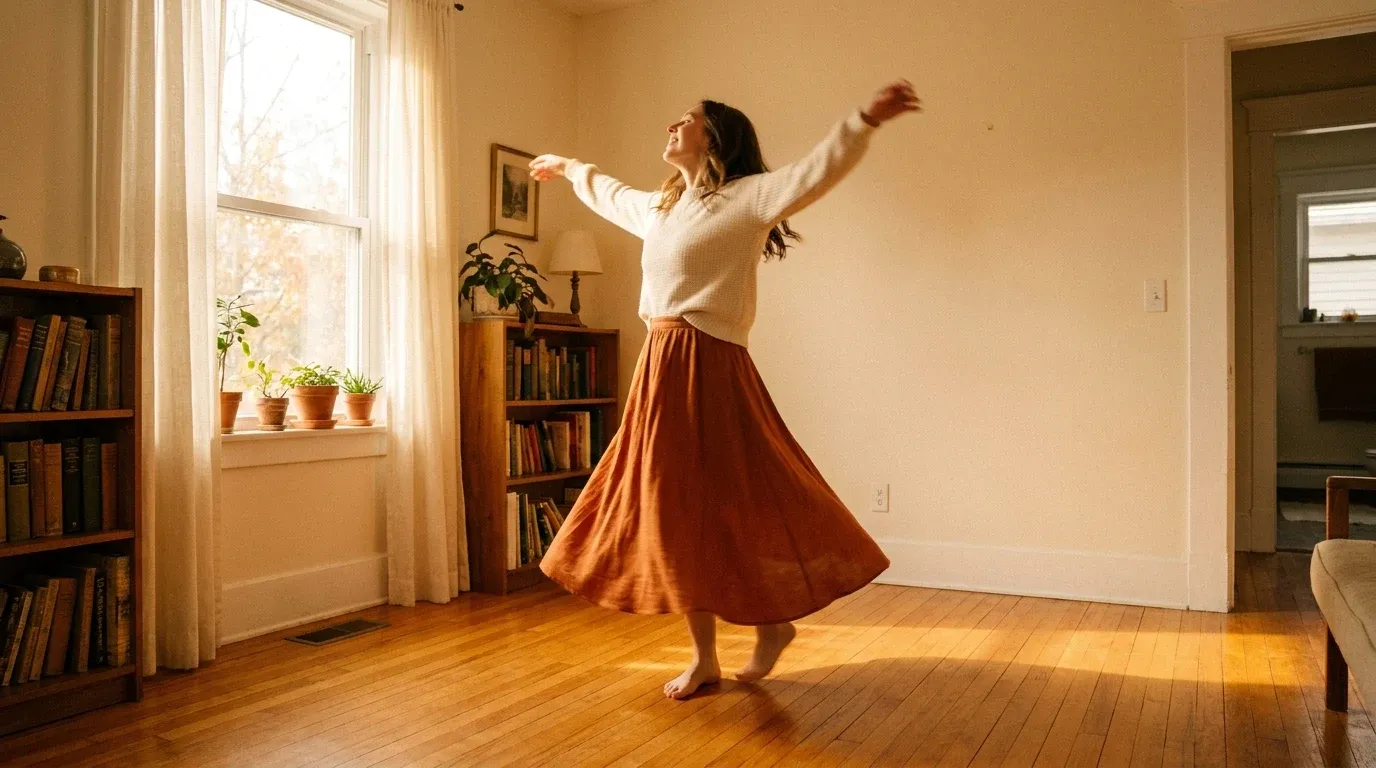
One of the most practically useful findings in recent dance research is that the stress-reduction benefits don't require formal instruction, a studio, or even a lot of time. Studies on free-form movement, participants simply moving to music however they felt like moving, show measurable cortisol reductions after sessions as short as 10 to 15 minutes.
This is not a trivial point. It removes the main barriers most people cite: cost, coordination, self-consciousness, and scheduling. A $0 playlist and some floor space at home is genuinely sufficient to access the physiological benefits being discussed here.
What appears to matter most is that the movement is self-directed and emotionally engaged, not that it follows any particular form. Improvised dancing to music you enjoy activates the same multi-system neurological response as trained dancing. The brain doesn't require technical skill to initiate the rhythmic entrainment, endorphin release, and cortisol reduction cascade. It just requires you to move and feel the music.
- 10 to 15 minutes of free movement to music shows measurable cortisol reduction in current studies.
- Music you emotionally connect with intensifies the endorphin and cortisol response beyond neutral-tempo playlists.
- Moving with others, even informally, adds an oxytocin layer that amplifies the social cortisol-buffering effect.
- No specific style required. Free movement outperforms choreography-focused sessions in some stress measures, possibly because it removes performance pressure.
Building Dance Into a Stress Management Routine
If you're building or refining a stress management approach, the evidence supports treating dance as a primary tool rather than an afterthought. That doesn't mean abandoning strength training or structured cardio. Those carry their own benefits that dance doesn't fully replicate. It means recognizing that your stress regulation needs a different input than your cardiovascular fitness needs.
A practical structure might look like this: keep your existing training for fitness outcomes, add two to three 10-to-15-minute free movement sessions per week specifically targeting cortisol, and treat them as seriously as you treat recovery protocols. Sleep quality, which significantly affects cortisol regulation independent of exercise, is another variable worth monitoring alongside movement type. What a sleep study reveals about heart and lung function in recovery provides useful context on how closely these systems are connected.
The larger takeaway is that stress management through movement is not a one-size-fits-all equation. You can be exercising regularly, eating well, and sleeping adequately and still have cortisol dysregulation if your movement practice doesn't include the rhythmic, emotionally engaged, socially resonant elements that dance uniquely provides.
Your nervous system responds to more than effort. It responds to rhythm, connection, and expression. Dance delivers all three at once, and the cortisol data reflects exactly that.