
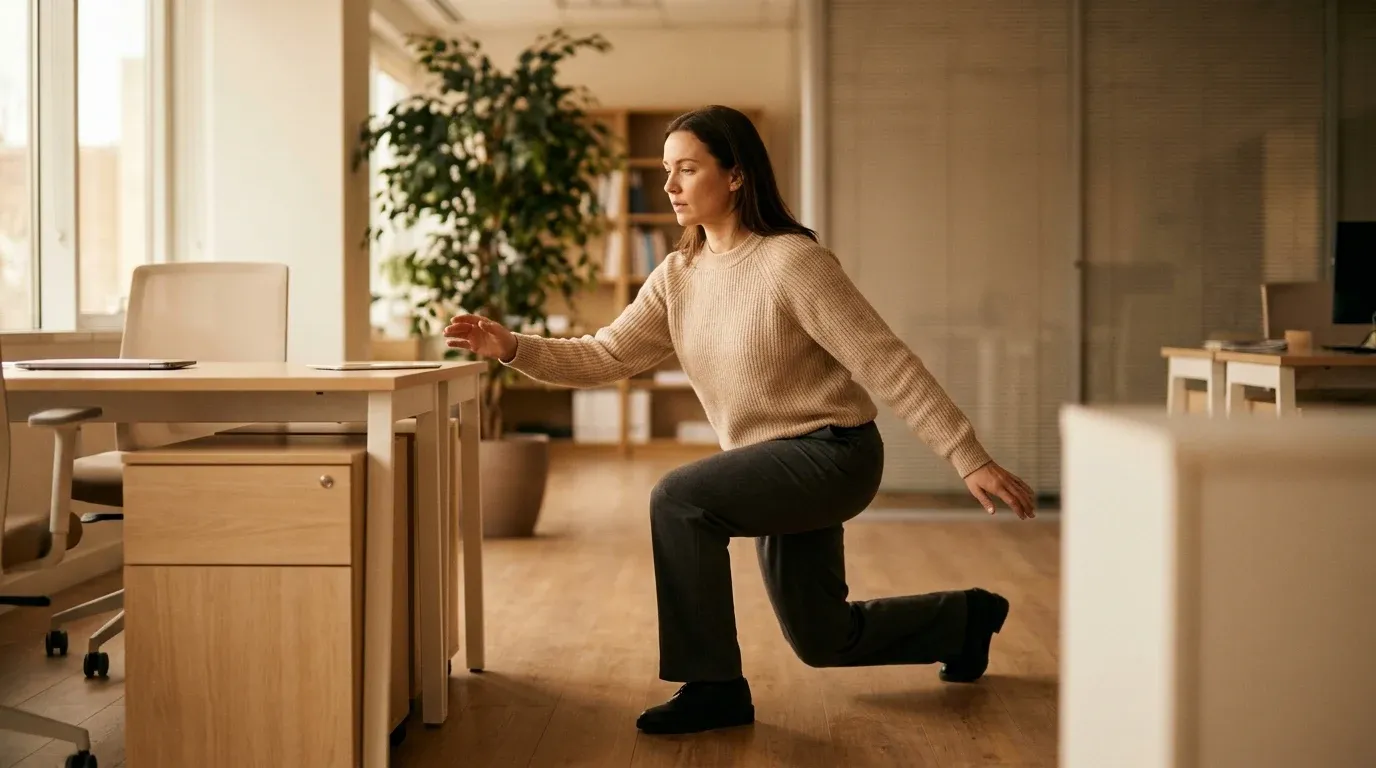
You probably already know that sitting all day isn't good for you. But the solution your employer offers, a subsidized gym membership you never quite use, isn't working either. Converging research published this week reframes the entire conversation: brief, distributed bouts of movement scattered across your workday deliver measurable improvements in both cardiovascular fitness and blood sugar control, even in people who are otherwise entirely sedentary.
That's not a workaround. That's an evidence-backed model that corporate wellness programs have been slow to adopt, and the cost of that delay is becoming harder to ignore.
What the New Research Actually Shows
Studies published in the current news cycle confirm what exercise physiologists have been building toward for years. Short movement sessions, ranging from two to ten minutes in duration, improve aerobic capacity and glucose regulation when distributed across the day. The effect is particularly significant in sedentary adults, meaning the population that most corporate wellness programs are theoretically designed to help.
Blood sugar control matters here for a specific reason. Prolonged sitting causes glucose to accumulate in the bloodstream between meals, a pattern that over time contributes to insulin resistance. Breaking up sitting with even brief activity, a two-minute walk, a set of bodyweight squats, a short stairwell loop, resets this cycle more effectively than a single longer session at the gym after work.
On the cardiovascular side, the research supports the idea that frequency of movement, not just total weekly volume, is a meaningful variable. Your heart and vascular system respond to repeated low-intensity stimulation throughout the day, not only to structured aerobic workouts. This doesn't replace those workouts. It complements them, and for the segment of the workforce that currently does nothing, it's a credible starting point.
Breaking Down the 20-to-30-Minute Daily Target
Physicians and exercise researchers have generally converged on 20 to 30 minutes of moderate movement per day as a meaningful minimum for sedentary adults. The problem has always been compliance. Asking someone in back-to-back video calls from 9 a.m. to 6 p.m. to find a continuous 30-minute window is asking them to solve a scheduling problem that doesn't have an obvious solution.
The micro-break model dissolves that problem. Three 10-minute sessions, or six 5-minute sessions, can reach the same daily target while fitting into the natural seams of a work schedule. A movement break before a meeting starts. A brisk walk during a lunch that's technically on the calendar but rarely protected. Two minutes of mobility work when a call ends early.
The compliance advantage here isn't psychological. It's structural. You're not asking employees to reorganize their lives around a wellness goal. You're asking them to use time that already exists between tasks. That's a fundamentally different ask, and the research on habit formation supports why it sticks more reliably.
For remote workers especially, this framing changes the calculus. Remote work offers wellbeing benefits that in-office environments often undercut, and one of those benefits is schedule flexibility. Micro-break protocols are easier to implement at home than in an open-plan office, which means distributed work arrangements and distributed movement can be designed to reinforce each other.
The Dual Business Case: Disease Risk and Lost Productivity
Two data points from the first week of October 2026 sharpen the business case considerably. Research published on October 7 linked prolonged sedentary behavior to elevated cancer risk, adding to an already substantial body of evidence connecting sitting time to cardiovascular disease, metabolic disorders, and early mortality. This is the long-term liability case: a workforce that sits for eight to ten hours a day is accumulating health risk that will eventually express itself in insurance costs, disability claims, and turnover.
The Vitality productivity report published on October 8 addresses the near-term version of the same problem. Presenteeism, the condition of being physically present at work but cognitively disengaged due to poor health or low energy, is estimated to cost employers significantly more than absenteeism. Workers who move regularly report better focus, lower fatigue, and higher sustained cognitive performance. Movement breaks don't just reduce long-term disease risk. They produce measurable returns in the current quarter.
HR teams that frame movement break policies through both lenses, chronic disease prevention and productivity recovery, are making an argument that finance teams can actually engage with. It's not a wellness pitch. It's a risk management pitch with a short feedback loop.
This argument becomes even stronger when you layer in the evidence on stress. Ranked interventions for stress management consistently place physical movement among the top performers, above many pharmacological and cognitive interventions for mild-to-moderate stress in working adults. A micro-break program, designed well, addresses fitness, metabolic health, and stress simultaneously.
Why Embedded Movement Outperforms Discretionary Programs
The traditional corporate wellness model operates on an assumption that doesn't hold: that employees have discretionary time outside work hours that they're willing and able to dedicate to fitness. The data on gym membership utilization challenges this consistently. Employer-subsidized memberships show high initial enrollment and steep drop-off within 90 days, particularly among lower-income employees, caregivers, and workers with long commutes.
The problem isn't motivation. It's opportunity cost. When gym time competes with sleep, family obligations, and commuting, it loses. That's not a character flaw. It's arithmetic.
Embedded movement, by contrast, doesn't compete with life outside work. Standing desks, walking meeting policies, scheduled break reminders, and short movement protocols embedded into team routines happen during work time. They don't require employees to make a separate decision every day about whether to go to the gym. The decision is already made for them by the structure of the workday.
Walking meetings represent one of the most frictionless implementations of this model, requiring no equipment, no training, and no dedicated space. A 30-minute one-on-one that happens while walking delivers the movement benefit, often improves the quality of the conversation, and costs nothing to implement.
It's also worth noting that embedded movement programs tend to reduce the equity gap in wellness participation. Gym-based programs disproportionately benefit employees who already exercise. Movement break programs reach the sedentary population more effectively, which is precisely where the health and productivity ROI is highest.
What HR Can Build Without a Budget
The zero-cost case for micro-break protocols is genuinely strong, and it's worth being specific about what that looks like in practice.
- Calendar blocking: Add a standing two-minute movement reminder at the top of each hour in shared team calendars. Normalize the pause before meetings start rather than running them back-to-back.
- Walking meeting policy: Designate one-on-ones and small-group calls of 30 minutes or fewer as default walking meetings, with opt-out available. No equipment required.
- Desk mobility prompts: Share a rotating library of two-to-five-minute movement sequences (mobility, walking, light resistance) through existing Slack or Teams channels. No external platform needed.
- Manager modeling: Brief team leads on starting meetings with 60 seconds of movement. Behavioral norms shift faster when they're modeled from the top of a team rather than mandated from HR.
- Lunch protection: Formalize a policy that lunch blocks are non-meeting time. A 20-minute walk during lunch costs the company nothing and delivers a meaningful daily movement dose.
None of these interventions require capital expenditure. None require a vendor relationship. They require policy intent and manager buy-in, which is a different resource: organizational will rather than organizational budget.
Once a movement break culture is established, it also becomes a more credible foundation for higher-cost investments. A team that already moves during the day is more likely to use a wearable benefit, engage with a fitness stipend, or benefit from access to a personal trainer than a team that has never normalized movement at work. You're building the behavior first, then layering the tools on top.
The Bigger Picture: Movement as Infrastructure, Not Perk
The framing shift that this research supports is a significant one. Movement at work has historically been positioned as a perk, a nice-to-have that signals a progressive culture. The accumulating evidence repositions it as infrastructure, a structural requirement for sustained cognitive performance, metabolic health, and long-term workforce viability.
Sleep research is making a parallel argument. REM sleep has now been linked to protection against 83 different diseases, and the workplace conditions that destroy sleep quality, late meetings, chronic stress, sedentary exhaustion, are the same conditions that movement break programs begin to counteract. These interventions aren't isolated. They compound.
If your organization is still evaluating whether to invest in wellness, the micro-break model removes the evaluation barrier. You don't need a budget to start. You need a policy decision and a manager briefing. The research published this week gives you the evidence to make that case internally. The business case is there. The implementation path is clear. What's left is execution.