
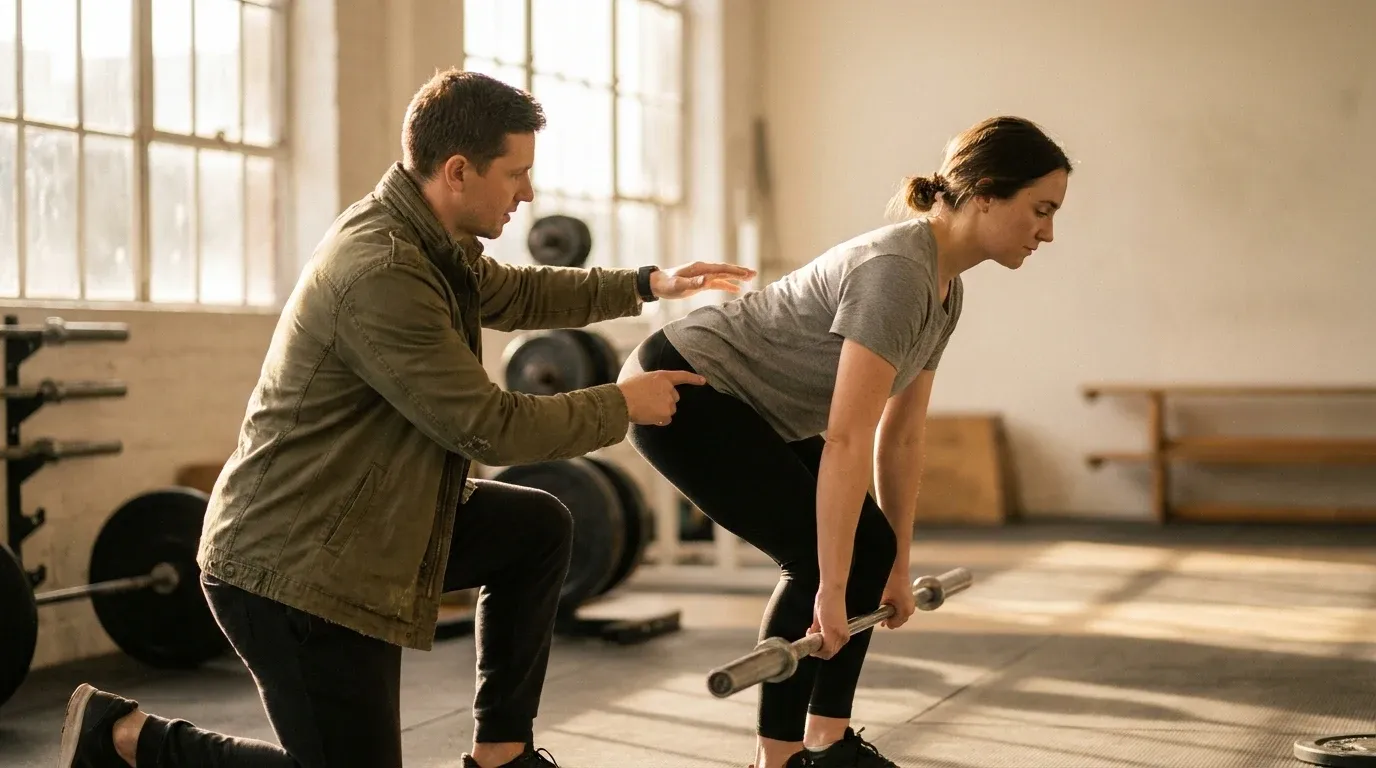
Ask ten coaches to demonstrate a hip hinge and you'll get ten different answers. Ask them to teach it to a new client under load and the gap between knowing and coaching becomes painfully obvious. The hip hinge is not a deadlift warm-up. It's not a cue you drop in after the bar is already moving. It's the foundational movement pattern that determines whether your client builds a strong posterior chain or spends three weeks on the physio table.
Getting it right from day one changes everything. Getting it wrong is one of the most common and preventable causes of training injury in coached strength work.
Why the Hip Hinge Is a Safety Issue, Not a Technique Detail
The majority of deadlift-related back injuries don't come from lifting too much weight. They come from lifting with lumbar flexion under load. When the lower spine rounds at the base of a pull, the compressive and shear forces on the lumbar discs increase sharply. Research on spinal loading consistently shows that even moderate loads become dangerous when the lumbar curve collapses, particularly at the point of initial lift-off.
This distinction matters enormously for how you frame the hip hinge to your clients. It's not about aesthetics or looking competent in the gym. It's about keeping the spine in a mechanically safe position while force is transferred through the posterior chain. The hip hinge. done correctly. is what allows that transfer to happen through the glutes and hamstrings rather than through spinal structures that aren't designed for that kind of stress.
When clients understand this, they stop treating your cues as optional. The hip hinge becomes something they want to master, not something you're nagging them about.
Screen Before You Load: The Intake Assessment
Before you put a barbell anywhere near a new client, screen the hip hinge in your intake session. This is non-negotiable if you're working with posterior-chain movements. A simple bodyweight assessment takes under two minutes and tells you exactly where the client is starting from.
Stand them facing a wall, about a foot away. Ask them to push their hips back toward the wall while keeping their chest up and their shins relatively vertical. Most new clients will do one of three things: they'll squat down instead of hinging, they'll round their lower back immediately, or they'll barely move their hips at all. All three responses are diagnostic. All three tell you something different about what you need to address before loading.
If a client can't perform a clean hip hinge pattern with just their bodyweight, adding a kettlebell or barbell doesn't teach the pattern. It reinforces the dysfunction under load. Screening first protects the client and protects you professionally. In a US market where coaching liability is increasingly scrutinized, that documentation of an intake assessment carries real weight.
This kind of systematic intake process also feeds directly into your perceived value as a coach. Clients who go through a proper assessment understand that they're working with someone who knows what they're doing. That perception supports retention and referrals, and it makes it easier to raise your coaching rates without losing clients as your business grows.
Three Cues That Actually Work
The coaching literature on movement cues distinguishes between internal cues (focus on what a body part is doing) and external cues (focus on the effect the body has on something outside it). External cues consistently produce better motor learning outcomes. The three cues below are built around that principle. They're not theoretical. They work in real sessions with real clients who've never touched a barbell.
1. "Push the Floor Away"
This cue fixes one of the most common deadlift errors: clients who pull the bar up rather than driving force through the floor. When you tell someone to push the floor away, you shift their attention from the bar (which they want to lift) to their feet (where the force production actually starts). The result is better leg drive, a more vertical shin angle at the start, and a natural engagement of the posterior chain that follows.
Use this cue at the moment of initiation. As soon as the client reaches the bar and sets their position, before they pull, that's when you say it. Keep the instruction simple and time it precisely.
2. "Protect Your Armpits"
Lat engagement is one of the most under-coached elements of the deadlift, and it directly affects spinal stability. When the lats aren't active, the bar drifts forward, the upper back rounds, and lumbar strain follows. The problem is that "engage your lats" means nothing to most clients. They don't know where their lats are or what engaging them feels like.
"Protect your armpits" works because it creates a physical sensation the client can reference. Ask them to imagine they're holding a piece of paper under each armpit. That gentle squeeze activates the lats, pulls the shoulders back and down, and creates the torso stiffness you need. It's immediately coachable. You can test it in the moment by pressing lightly on their upper arm and asking them to resist. If they can feel the difference, the cue is landing.
3. "Hinge at the Crease of Your Shorts"
This is the most direct cue for teaching the hip hinge itself. It gives clients a specific, tactile landmark on their own body. Rather than telling them to "push their hips back" (which is vague) or "bend at the hip" (which is anatomically accurate but meaningless to a beginner), you're pointing them to a location they can feel.
Have the client place their fingers at the hip crease before the first rep. Ask them to fold at that exact point. The goal is for the crease to deepen as the hips travel back, with the chest staying tall. This cue also works well with a dowel rod held along the spine: one point at the back of the head, one between the shoulder blades, one at the sacrum. If contact is maintained at all three points as the client hinges, the pattern is clean.
Layering the Cues Into a Session
Don't use all three cues at once. That's the fastest way to overwhelm a new client and produce paralysis instead of movement. In an introductory session, pick one. Usually "hinge at the crease of your shorts" works best as the starting point because it establishes the pattern itself. Once the hinge is present and repeatable, layer in "protect your armpits" in session two to build torso stability. Add "push the floor away" when the client moves from a hinge pattern to an actual loaded pull.
Progress the loading only when each cue is integrated. A client who can hinge cleanly with a 20kg (44lb) kettlebell but collapses under a 60kg (132lb) barbell hasn't learned the pattern. They've learned to manage one specific load. Build the pattern first, then build the load on top of it.
The Transfer Effect: Why Clients Stay
Here's something that rarely gets discussed in coaching methodology: the hip hinge is one of the few gym movements that transfers directly and visibly to everyday life. The moment a client bends down to pick up a bag of groceries with a neutral spine and loaded glutes, something clicks. They feel the difference. They understand, physically, what you've been teaching them.
This transfer effect is significant for client retention. Clients who connect gym training to real-world movement patterns report higher perceived value from their coaching. They talk about it differently to friends and family. They become better referral sources. The coaching relationship shifts from "I go to the gym because I should" to "my coach taught me how to move better."
This becomes especially relevant for clients in midlife and beyond. The research on longevity and biological age consistently identifies functional strength. the ability to generate force through proper movement patterns. as one of the strongest predictors of long-term health. Teaching a 55-year-old to hip hinge correctly isn't just gym coaching. It's reducing their injury risk every time they lift something heavy off the ground for the rest of their life.
It's also worth noting that for clients using medications that affect body composition, movement quality becomes even more critical. Clients on GLP-1 medications, for example, need to protect muscle mass carefully. The strategies coaches use alongside GLP-1 drugs to prevent muscle loss depend on clients being able to train the posterior chain effectively. A solid hip hinge is the entry point to that work.
Common Errors and How to Fix Them Fast
- Squatting instead of hinging: The knees travel forward rather than the hips traveling back. Fix this by placing a bench or box behind the client and cueing them to push their hips back to touch it without letting the knees move forward past the toes.
- Lumbar rounding at the bottom: The lower back loses its neutral curve at the end range of the hinge. This is often a hamstring flexibility issue or a core bracing issue. Reduce range of motion first. Work the pattern clean in a shorter range, then extend it as mobility improves.
- Bar drifting forward: The loaded bar travels away from the body during the pull. This almost always signals a lat engagement problem. Return to the "protect your armpits" cue and reinforce it before reloading.
- Hyperextending at lockout: The client slams into extension at the top, throwing their lower back into overextension. Cue a "tall finish" with glutes squeezed and ribs down. The lockout should feel stacked, not leaned back.
Tracking these errors systematically in your session notes makes programming decisions much cleaner. If the same client is showing lumbar rounding across multiple sessions, that's a signal to add dedicated mobility work and to review their recovery load. Research on training recovery suggests that nutrition plays a larger role in movement quality than most clients expect. A client who's under-fueled or relying on ultra-processed foods that undermine recovery will show pattern breakdown faster under fatigue, particularly in the posterior chain where demands are highest.
Building the Hip Hinge Into Your Program Design
Once the pattern is established, the hip hinge should appear in some form in every lower-body session. Romanian deadlifts, conventional deadlifts, single-leg variations, good mornings, kettlebell swings. all of them live inside the hip hinge pattern. The cues you've built in the early sessions become the diagnostic language for every posterior-chain exercise that follows.
This is what makes the hip hinge foundational rather than introductory. It's not something you teach once and move on from. It's the reference point your client returns to every time they load a posterior-chain movement. That's the value of getting it right from the start.
Sound nutrition habits compound this investment significantly. Clients who distribute protein correctly across their day recover faster between sessions, adapt more quickly to new movement patterns, and maintain form quality under fatigue far better than clients who don't. The coaching work and the nutrition work reinforce each other. That's the kind of integrated approach that separates good coaches from great ones.