
Most lifters spend serious time building strength, but almost no time training the nervous system qualities that make that strength usable. Balance and agility tend to get skipped entirely, treated as something for older adults or physical therapy patients. New research suggests that's a costly oversight, and that fixing it takes less time than a warm-up track on a treadmill.
A study published in a peer-reviewed sports science journal found that participants who completed a structured 10-minute floor-based routine daily showed meaningful improvements in both static and dynamic balance, as well as agility scores, over a four-week period. No gym. No equipment. Just floor space and consistency.
What the Research Actually Found
The protocol tested in the study combined single-leg holds, crawling patterns, rotational movements, and low-level plyometric transitions, all performed on the floor with bodyweight only. Participants ranged from recreationally active adults to regular gym-goers, making the results relevant across fitness levels.
After four weeks of daily sessions, researchers recorded statistically significant improvements in the Star Excursion Balance Test, a widely used clinical marker of dynamic balance and lower-limb stability. Agility scores measured through direction-change drills also improved, even though participants weren't doing dedicated agility training beyond this routine.
The researchers noted that the mechanism likely involves neuromuscular adaptation. Short, frequent bouts of balance-focused movement appear to recalibrate proprioception faster than longer, infrequent sessions. In other words, daily exposure matters more than session length.
Why Strength-Focused Athletes Often Skip This
If you train primarily for hypertrophy or strength, balance work probably feels like a detour. It doesn't load your muscles meaningfully. It doesn't show up in your one-rep max. And in a 60-minute training session, it's easy to cut when time gets tight.
But balance and agility are directly tied to injury risk. Poor single-leg stability is one of the strongest predictors of ankle sprains, knee injuries, and lower back strain during compound lifts. If you're investing time in movements like the hip thrust for glute development, your ability to stabilize under load depends partly on the same proprioceptive pathways this kind of floor work trains.
There's also a performance argument. Studies on recreational and competitive athletes consistently show that better balance translates to more efficient force transfer. You're not just preventing injury. You're making your existing training more effective.
The 10-Minute Floor Protocol
Based on the study's methodology and established movement principles, here's a daily routine that mirrors the tested approach. It requires nothing beyond a flat surface and about six feet of clear space.
Complete each exercise back to back with minimal rest. One full circuit takes approximately 10 minutes.
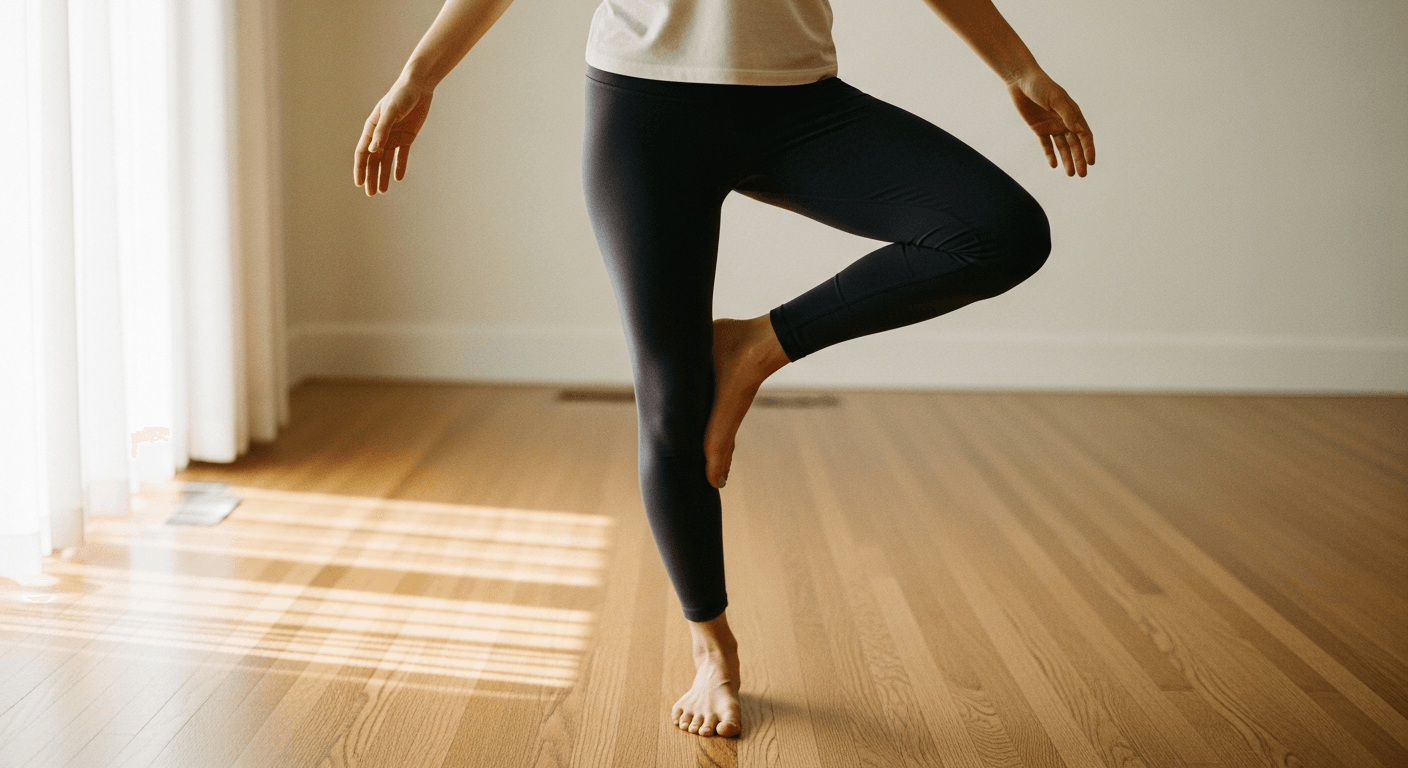
- Single-leg stand with eyes closed (30 seconds each side): Stand on one foot, arms out to the sides, eyes closed. This forces your nervous system to rely on proprioception alone. It's harder than it sounds.
- Bear crawl forward and back (60 seconds): On all fours with knees hovering an inch off the floor, move forward four steps and reverse. Slow and controlled beats fast here.
- Lateral shuffle into squat hold (45 seconds each direction): Three lateral steps, drop into a two-second squat hold, reverse. Reinforces hip stability and lateral agility simultaneously.
- Single-leg Romanian deadlift reach (10 reps each side): Stand on one leg, hinge at the hip, and reach the opposite hand toward the floor. You're training balance, hip hinge mechanics, and posterior chain activation at once.
- Rotational plank (45 seconds): Start in a forearm plank. Rotate to a side plank on the right, return to center, rotate left. Slow, controlled rotations challenge anti-rotation stability.
- Low hurdle steps (60 seconds): Imagine stepping over a low obstacle, alternating legs. Knees drive high, landing is soft. This trains dynamic balance under light impact.
- Supine glute bridge with single-leg hold (10 reps each side): Bridge up, extend one leg, hold two seconds at the top. This links glute activation to pelvic stability, which is foundational for balance in upright positions.
- Prone Y-T-W raises (10 reps each position): Lying face down, raise your arms into Y, T, and W shapes. Activates posterior shoulder, upper back, and scapular stabilizers, often the weakest link in overall postural balance.
How to Stack It Into Your Existing Training
The most practical way to use this routine is as either a warm-up before your main session or a cool-down afterward. Both approaches work, though there are slight differences in what you'll get from each.
As a warm-up, this routine primes your proprioceptive system before you load it. Your joints communicate better with your brain when they've been through balance challenges first. That can translate to better movement quality during your working sets, particularly on unilateral exercises like split squats or single-leg Romanian deadlifts.
As a cool-down, the lower intensity helps transition your nervous system out of high-output mode. You're still training something meaningful, but you're not adding fatigue that interferes with recovery. Research on low-cost recovery strategies consistently points to the value of active, low-intensity movement in the post-training window.
If you train five days a week, consider doing the floor protocol on your two rest days as well. The study participants who saw the strongest results were those doing daily sessions, not just on training days. Ten minutes is low enough in intensity that it won't interfere with recovery from heavier work.
Accessible for Every Level
One of the most useful aspects of this protocol is its scalability. Beginners can perform the single-leg exercises with a hand resting lightly on a wall for support, gradually reducing contact as stability improves. More advanced athletes can add instability by performing some movements on a folded yoga mat or a slightly uneven surface.
The zero-equipment requirement also removes a real barrier. You don't need a balance board, resistance bands, or a dedicated training space. This makes it viable for travel, home gyms, small apartments, and anyone who doesn't have access to a commercial gym. That accessibility matters when the research benefit depends on daily consistency rather than occasional high-effort sessions.
This principle connects to broader findings on workout variety and long-term outcomes. Research reviewed in our article on how mixing up your workouts may support longevity suggests that incorporating different movement patterns, not just increasing load, has measurable effects on health and durability over time.
The Case for Training What You Can't See in the Mirror
Balance and agility don't show up in progress photos. They don't add plates to the bar. But they underpin almost every physical quality you do care about, including strength expression, movement efficiency, and injury resilience.
If you're currently choosing between squat-focused and hinge-focused lower body work, understanding which movements demand the most from your stabilizers is worth the time. Our breakdown of squats versus deadlifts for glute activation covers this in detail, including how each pattern challenges your posterior chain differently.
The floor-based protocol described here doesn't replace strength training. It fills a gap that most training programs leave open. Ten minutes a day, done consistently, is enough to meaningfully shift your proprioceptive baseline within a month. That's not a long timeline for a real, measurable adaptation.
The harder part is treating it as non-negotiable rather than optional. Balance work tends to get skipped precisely because it's not uncomfortable in the way hard sets are. But that low discomfort is also why it's sustainable every day, and daily repetition is exactly what the research shows makes the difference.
Start tomorrow morning. Ten minutes on the floor before you do anything else. Four weeks from now, your body will move differently, and your training will feel more controlled as a result.