
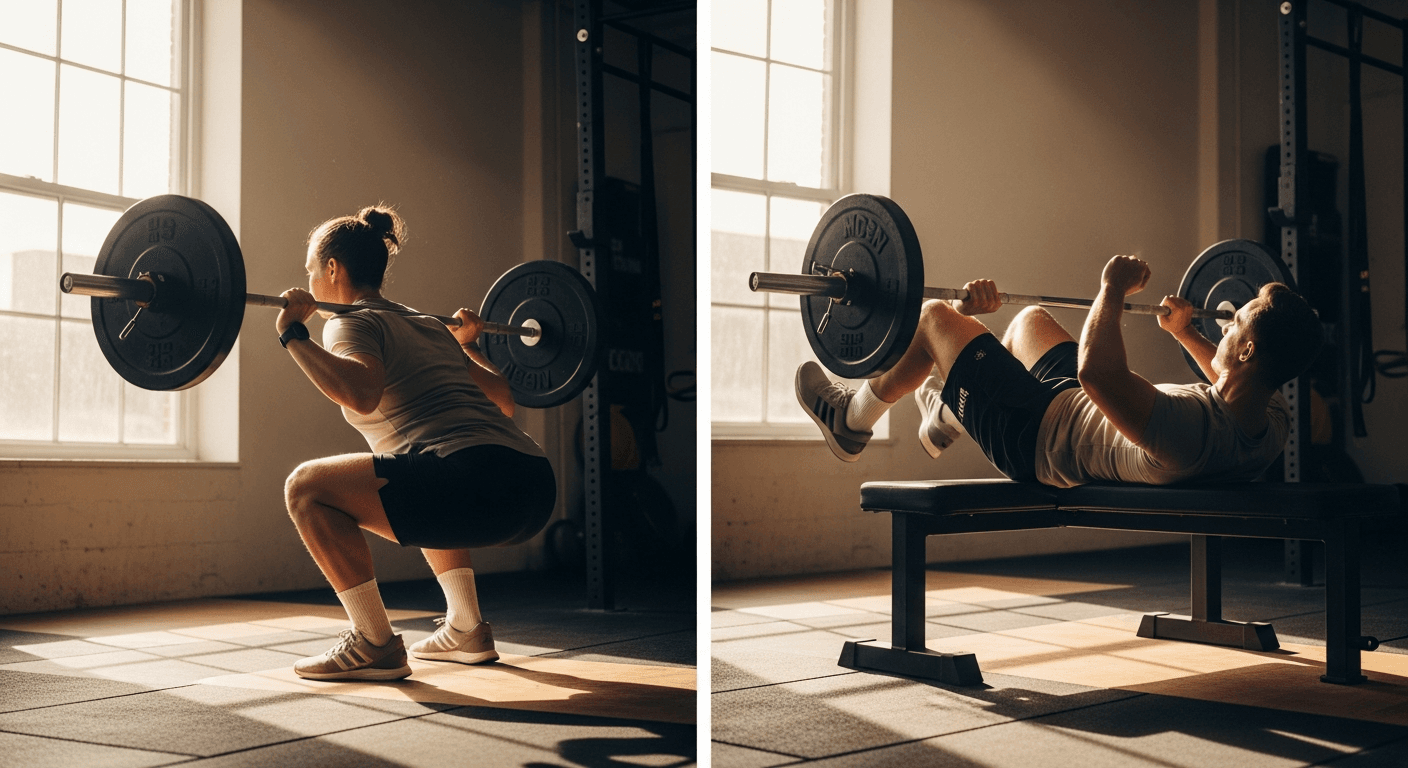
If you've spent years loading a barbell and wondering whether you're doing the right lift for your goals, you're not alone. The squat versus deadlift debate has occupied gym floors and fitness forums for decades. Now, a multi-study analysis published in April 2026, drawing on research from 2018 to 2021, offers the clearest picture yet of how these two movements actually compare for glute development. The answer is more nuanced than either camp wants to admit.
What the Research Actually Shows About Glute Activation
The analysis found that both conventional deadlifts and hex-bar deadlifts produce slightly greater gluteus maximus activation than the classic back squat. The difference isn't dramatic, but it's consistent across the studies reviewed. When you pull from the floor, your hips are involved through a longer range of motion and against higher absolute loads, which drives more total demand on the glutes.
The hex-bar deadlift, in particular, showed strong glute recruitment while also reducing spinal load compared to the conventional version. That makes it a compelling option if you want posterior chain training with lower injury risk. For most lifters, it's an underused variation sitting right in the middle of a squat and a deadlift mechanically.
That said, the squat is far from a poor glute exercise. The gluteus maximus is heavily involved in the ascent phase of any squat, especially once depth increases. The distinction here is one of degree, not category. Both lifts train the glutes. The deadlift simply edges ahead in raw activation metrics.
Strength Gains Are Roughly Equal Across Both Lifts
One finding from the analysis that surprises many lifters: squats and deadlifts produce comparable improvements in maximal lower-body strength over time. Neither lift is a clear loser for overall development. If your goal is to get stronger from the floor to the knee, both movements contribute meaningfully.
This matters because it pushes back against the idea that you need to prioritize one over the other for general strength. What separates them isn't effectiveness but emphasis. The squat loads the quads more heavily through the knee-dominant pattern. The deadlift shifts emphasis toward the hamstrings, glutes, and lower back. Both improve hip extension strength, which underpins athletic performance, daily movement, and longevity in the gym.
If you're already structuring your training around progressive overload and managing fatigue well, adding both to your program makes more sense than swapping one for the other. For guidance on structuring variety without derailing your progress, how to add workout variety without wrecking your progress breaks down the practical approach.
The Real Winner: Hip Thrusts Outperform Both
Here's where the data gets uncomfortable for lifters who've never loaded a barbell across their hips. The same analysis confirms that hip thrusts produce even greater gluteus maximus activation than either the squat or the deadlift. Not marginally. Consistently and substantially.
The mechanics explain it. In a hip thrust, the glutes are the primary driver through the entire range of motion, without the quad or hamstring involvement that dilutes glute demand in compound lifts. The movement places the glute under load at peak contraction, which is a key driver of hypertrophy. If your explicit goal is glute size, hip thrusts are arguably the most direct tool available.
Despite this, hip thrusts remain underused. Part of it is setup friction. Loading plates onto a barbell while sitting on the floor in a busy gym is less convenient than walking to a squat rack. Part of it is perception. The movement doesn't carry the same cultural weight as a heavy squat or deadlift. But if glute hypertrophy is on your list, skipping hip thrusts means leaving your most targeted option on the table.
It's worth noting that glute activation during exercise doesn't automatically translate to muscle growth unless load, volume, and recovery are managed properly. But the activation advantage of hip thrusts gives them a structural edge when all else is equal. The same logic that makes isolation work valuable for chest or biceps applies here.
Matching Exercise Choice to Your Actual Goal
The most practical takeaway from this analysis isn't that one lift wins. It's that each lift serves a different purpose, and your selection should follow your goal rather than habit or ego.
- For posterior chain strength: Deadlifts, both conventional and hex-bar, are your primary tool. They build hip hinge strength, load the hamstrings through a full range, and transfer directly to athletic power and functional capacity.
- For quad-dominant development: Squats remain the gold standard. Whether you're training for aesthetics, sport, or general strength, the back squat and its variations load the quads in a way no other compound movement replicates at scale.
- For isolated glute hypertrophy: Hip thrusts should anchor your glute-specific work. Pair them with Romanian deadlifts for hamstring depth and you've covered the posterior chain comprehensively.
This goal-matching approach also applies to training volume. Adding more exercises doesn't automatically add more results. The body has adaptation ceilings, and whether there's a ceiling to how much exercise actually helps is a question worth revisiting before you start stacking every glute variation into one session.
Why Lifters Tend to Undervalue Hip Thrusts
Social media has had an outsized influence on which exercises get taken seriously. Heavy squats and deadlifts dominate training content because they photograph well and signal raw strength. Hip thrusts don't carry the same visual prestige, even though the research consistently supports them for glute development.
This connects to a broader pattern in fitness culture where perceived intensity often overrides evidence. Lifters, especially those newer to training, gravitate toward movements that feel hard or look impressive rather than movements that align with their specific goals. That's a training inefficiency that compounds over months and years.
The fitness media ecosystem doesn't always help. The pressure to follow trending routines or aesthetic ideals can distort exercise selection in ways that have real consequences. TikTok's muscle ideal and its impact on young men explores how platform-driven aesthetics are reshaping training decisions, often in directions that conflict with long-term health.
How to Build a Smarter Lower-Body Program
If you're training three to four days per week and want to develop the full lower body, including meaningful glute growth, a sensible structure might look like this. Deadlifts anchor your hip hinge work on one or two days. Squats anchor your knee-dominant sessions. Hip thrusts appear as a primary or secondary movement on glute-focused days, loaded progressively just like any other compound lift.
Progressive overload applies equally to hip thrusts. You should be tracking load and reps just as you would for squats or deadlifts. The mistake most lifters make is treating hip thrusts as an accessory movement with casual load selection, then wondering why their glutes aren't responding.
Recovery also matters. The glutes are a large muscle group and they respond to volume over time. If you're pushing hard on three or four lower-body exercises per session, fatigue management becomes a real variable. Sleep quality and consistency play a direct role in how well you recover and adapt. sleep consistency as a lever for better rest is a factor that training-focused lifters frequently underestimate.
The Bottom Line on Squats, Deadlifts, and Hip Thrusts
The 2026 multi-study analysis doesn't declare a single winner so much as it clarifies the role each exercise plays. Deadlifts lead for raw glute activation among compound lifts. Squats remain essential for quad development and total lower-body strength. Hip thrusts outperform both when gluteus maximus hypertrophy is the specific target.
The question was never really which lift is better. It's which lift is better for what you're trying to build. Once you match your exercise selection to your actual goal rather than convention or social proof, training stops being a debate and starts being a system.
You don't have to choose between these movements. Most well-structured programs use all three. The real inefficiency isn't picking the wrong lift. It's spending years avoiding the one that would have made the biggest difference for your specific goal.