
Most people who train their back and chest are chasing aesthetics or strength. A broader back, a fuller chest, better posture under a loaded bar. But a new body of research is adding a more compelling reason to prioritize these muscle groups: direct cardiovascular protection.
A recent study published in a peer-reviewed cardiology journal found that individuals who regularly trained the back and chest musculature showed measurable improvements in cardiac health markers, beyond what could be explained by general physical activity alone. The finding shifts how coaches and clinicians might think about exercise prescription for heart health.
What the Study Actually Found
Researchers tracked participants across a structured resistance training program and monitored several cardiovascular markers, including resting heart rate, arterial stiffness, and left ventricular workload. Those who incorporated consistent back and chest training showed statistically significant improvements across all three measures compared to a control group performing only lower-body resistance work and moderate cardio.
The effect size was notable. Reductions in arterial stiffness, a key predictor of long-term cardiovascular risk, were comparable to those typically seen with dedicated aerobic training programs. That's a meaningful result, because resistance training has historically been considered secondary to cardio for heart health outcomes.
What makes this study stand out is its specificity. Prior research has established that resistance training broadly supports cardiovascular health. But this is among the first work to isolate upper-body pushing and pulling movements, particularly those targeting the thoracic musculature, as having a distinct and measurable cardioprotective effect.
The Mechanical Explanation
So why would training your back and chest specifically benefit your heart? The proposed mechanism comes down to thoracic pressure and posture.
The heart sits within the thoracic cavity, surrounded by structures whose positioning directly influences how hard the heart has to work. When the muscles of the upper back are weak or undertrained, the thoracic spine tends to round forward, a posture pattern known as kyphosis. This forward collapse compresses the chest cavity, increases intrathoracic pressure, and forces the heart to work against a higher mechanical load with every beat.
Strengthening the posterior chain of the upper back, including the rhomboids, mid-trapezius, and rear deltoids, pulls the shoulders back and opens the chest. This reduces chronic compression of the thoracic cavity. Over time, a more open posture means lower baseline intrathoracic pressure and less mechanical resistance for the heart.
The chest musculature plays a complementary role. The pectorals, when properly developed and balanced with back strength, support the anterior thoracic wall. Without that support, excessive anterior tension can contribute to a forward-drawn posture. Training both sides of the upper body creates a structural balance that benefits the heart's working environment.
It's a compelling mechanism because it's cumulative. Every hour you spend in a rounded, compressed posture adds to the lifetime mechanical load on your heart. Resistance training that corrects that posture works in the opposite direction.
How This Fits Into Existing Evidence
This finding doesn't replace what we already know about exercise and heart health. It adds a layer.
The evidence base for cardiovascular exercise and cardiac protection is decades deep. Aerobic training improves VO2 max, lowers resting heart rate, reduces blood pressure, and improves lipid profiles. None of that changes. What this new research does is extend the cardioprotective argument into the weight room, and specifically toward movements that most people already include in their training for entirely different reasons.
Resistance training more broadly has been associated with reduced cardiovascular mortality risk. A large meta-analysis published in the British Journal of Sports Medicine found that muscle-strengthening activities were associated with a 17% reduction in cardiovascular disease risk, independent of aerobic activity. The new data on back and chest training fits within this framework but adds anatomical specificity that prior research lacked.
For anyone who's already committed to a structured training program, this is validating. You're not choosing between heart health and a stronger physique. You're building both simultaneously. And if you've been neglecting resistance training in favor of cardio alone, the evidence now gives you a stronger reason to reconsider that balance. Research also consistently shows that 87% of people fall short on both sleep and exercise, suggesting that optimizing training habits across the board remains one of the highest-leverage health interventions available.
The Exercises That Apply Most Directly
Based on the study's parameters and the mechanical rationale behind the findings, four categories of exercise emerge as the most relevant applications.
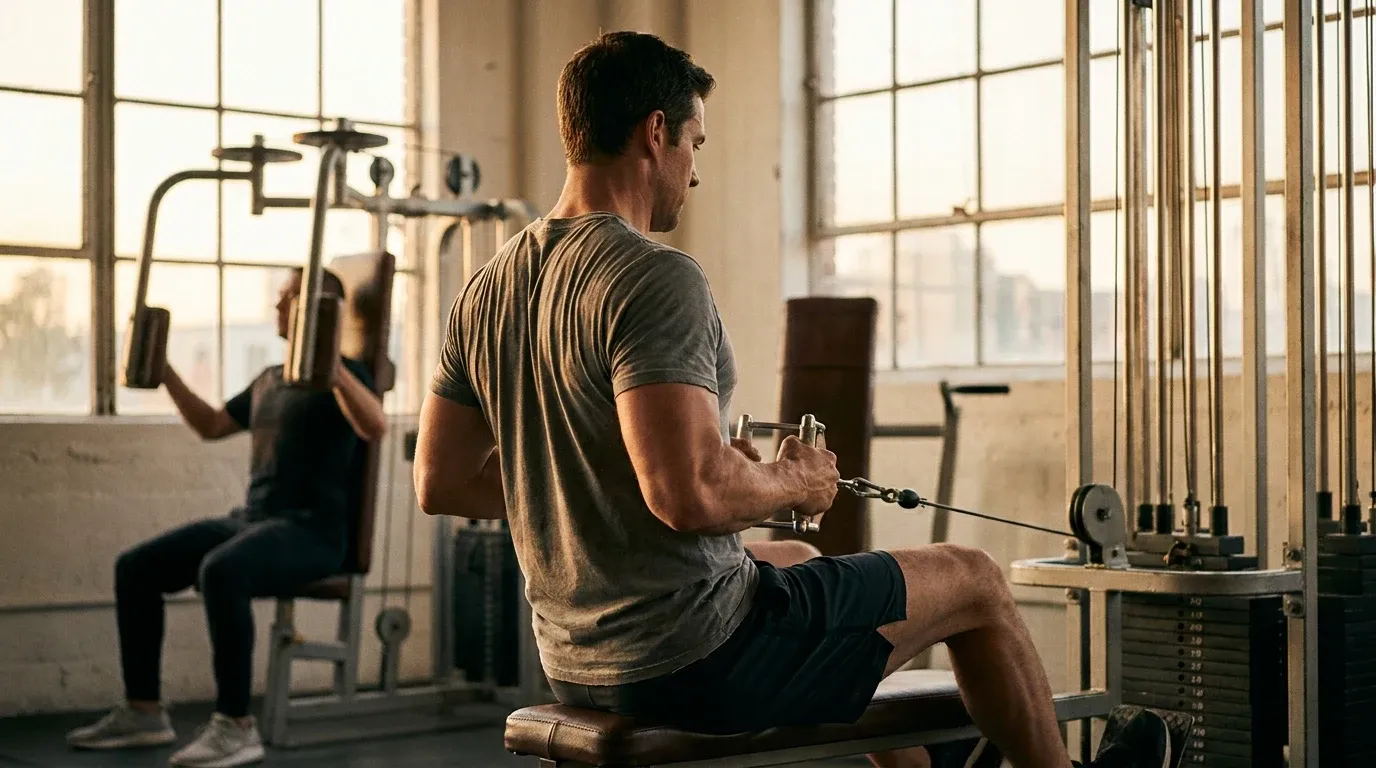
- Rows (barbell, dumbbell, cable, machine): Horizontal pulling movements directly target the mid-back, rhomboids, and rear delts. These are the muscles most responsible for scapular retraction and thoracic extension. Any row variation performed with full range of motion and a focus on squeezing the shoulder blades together will activate the key musculature involved.
- Pull-ups and lat pulldowns: Vertical pulling builds the lats and teres major while reinforcing scapular depression. A well-developed lat structure supports thoracic integrity and contributes to the postural improvements the study links to cardiac benefit. Pull-ups also require core and shoulder stability that reinforces overall upper-body alignment.
- Bench press (flat, incline, dumbbell variants): Horizontal pushing develops the pectorals, anterior deltoids, and triceps. The key for cardiac benefit is training these in balance with back work, not in isolation. A chest-dominant program without posterior counterbalancing reinforces the forward posture you're trying to avoid.
- Cable flyes and chest flies: These isolation movements develop the sternal and clavicular heads of the pectorals through a longer range of motion, which supports the anterior thoracic wall more completely than press-only training. They're useful as accessory work when paired with pulling movements in the same session.
The programming implication is straightforward: train back and chest together, prioritize pulling volume to match or exceed pushing volume, and focus on full range of motion to capture postural benefits. A common evidence-supported ratio is two pulling movements for every one pushing movement, particularly for anyone who works at a desk or spends extended time in a forward-flexed posture.
Nutrition Still Matters for the Full Picture
Building the muscle required to create these structural and cardiovascular benefits depends on adequate protein intake. That means not just hitting a protein target, but consuming quality protein that your body can actually use efficiently.
The quality of the protein you consume determines how much of it becomes available for muscle protein synthesis. Understanding how different protein sources compare is worth your attention, and the metrics have become more precise. Not all protein is equal, and the DIAAS score changes how you should count your grams, particularly if you rely on plant-based sources or supplements to meet your daily needs.
Distribution across the day also plays a role. Consuming protein in evenly spaced doses throughout the day, rather than concentrating it in one or two meals, supports a more sustained muscle protein synthesis response. Protein timing matters for active adults, especially when training volume is high enough to create the kind of muscular adaptation this research depends on.
For older adults specifically, the protein requirements to maintain and build muscle are higher than standard guidelines suggest. New science on protein and aging indicates that the anabolic sensitivity of muscle tissue declines with age, making adequate intake and distribution even more critical for those looking to build functional upper-body strength later in life.
Recovery Is Part of the Equation
The structural adaptations that improve posture and reduce intrathoracic pressure happen between sessions, not during them. Recovery quality directly determines how quickly and completely your body rebuilds trained tissue.
Sleep is the most powerful recovery tool available, and it's free. The hormonal environment during deep sleep stages is when the majority of muscle protein synthesis occurs. The recovery strategies that hold up to scientific scrutiny in 2026 consistently reinforce sleep as non-negotiable, ahead of any supplement, massage tool, or contrast therapy protocol.
Training your back and chest consistently, recovering properly, and fueling that training with quality protein creates a compounding effect. You're building the strength and structural support your heart benefits from, while also reinforcing the recovery habits that protect your health more broadly.
The Takeaway
The case for training your back and chest has always been strong. Now it includes your heart. The mechanism is anatomically logical, the early data is statistically meaningful, and the practical application requires no new exercises. You're likely already doing rows, pull-ups, and bench press. The research just gives you a better reason to keep doing them.
Structure your upper-body training with intention, balance your pushing and pulling, support it with quality nutrition, and let the cumulative postural improvements do their work. Your cardiovascular system will reflect that effort over time, even if you never see it on a performance metric or in a mirror.